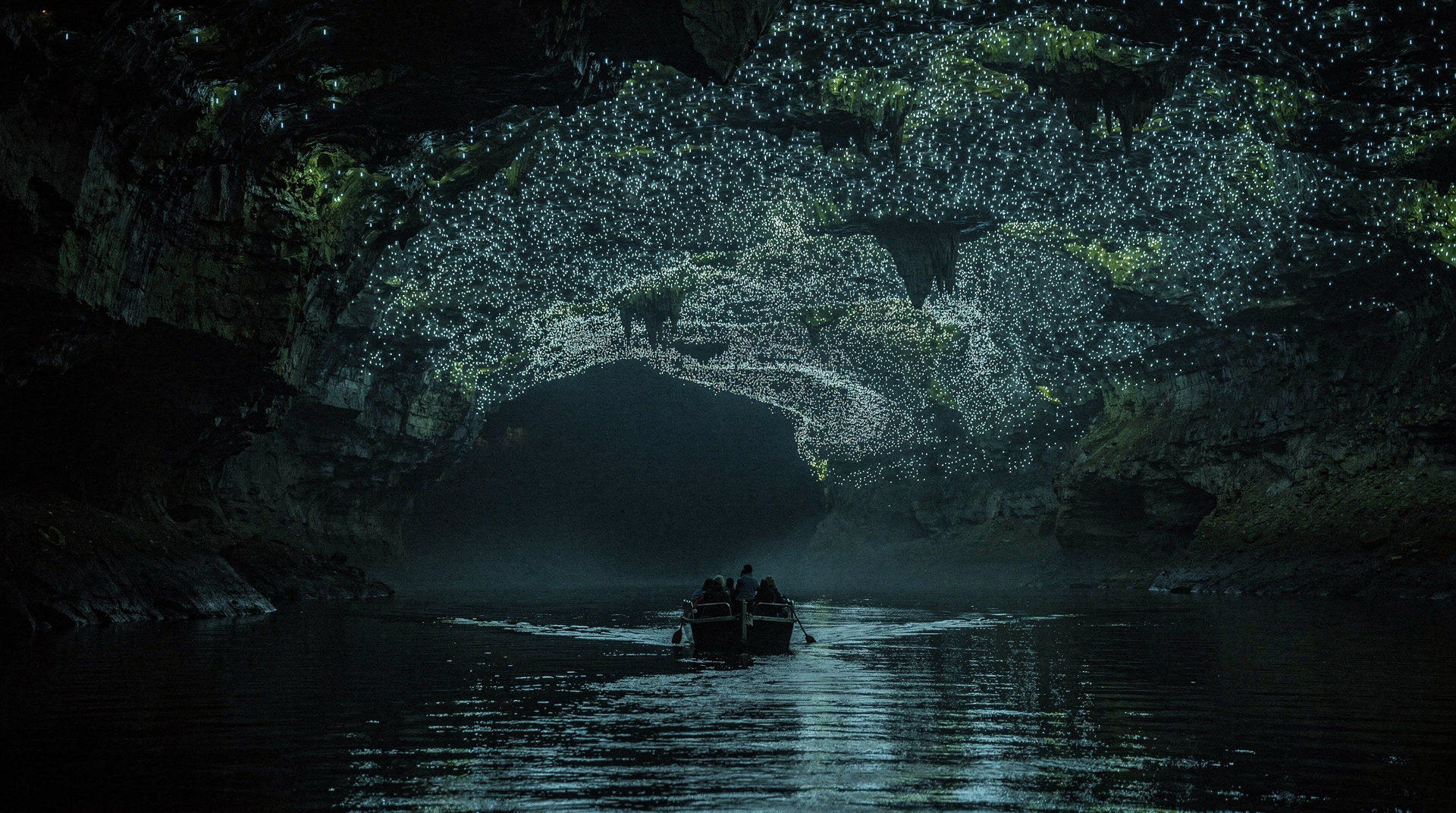
Waitomo
Honest Waitomo guide: glowworm cave boat tour, black water rafting, Lost World abseil, real prices NZD/USD/EUR, and how to combine with Hobbiton.
Quick facts
- Location
- Waitomo, Waikato — 2.5 hours south of Auckland
- Temperature inside caves
- Constant 13°C / 55°F — bring a layer
- Currency
- NZ$ — USD ~$0.60 / EUR ~€0.55
- Best for
- Glowworm cave experience, black water rafting, adventure caving
- Skip if
- Caves aren't your thing — there are no outdoor highlights at Waitomo itself
Waitomo in one paragraph
Popular experiences here
Waitomo is a limestone cave system in the Waikato hill country, and its glowworm caves are among the most genuinely magical experiences in New Zealand. The Arachnocampa luminosa glowworm is found only in New Zealand and Australia, and the ceiling of the Waitomo Glowworm Cave — covered in thousands of tiny blue-green lights reflected in still, black water — is something that photographs can’t fully convey. The experience lasts 45 minutes and is accessible to all ages. For those who want more, the same operators offer black water rafting (tubing through underground rivers), abseiling into cave systems, and multi-hour guided expeditions. Waitomo rewards even the reluctant cave visitor.
| Where | Waitomo village, Waikato — 2.5 hrs south of Auckland, 1 hr south of Hamilton |
| Time needed | Half-day for the standard tour; a full day if adding an adventure activity |
| Cost | From around NZD 55 for the glowworm boat tour; NZD 155+ for black water rafting |
| Getting there | Self-drive (SH37/SH3) or a combined day tour from Auckland or Hamilton |
| Best time | Year-round — caves hold a constant 13°C regardless of season |
The glowworm experience
The Arachnocampa luminosa is the larval stage of a fungus gnat. The glowworm produces bioluminescent light to attract prey (small insects) into the sticky silk threads it hangs from the cave ceiling. It is not a worm and not technically a worm’s life stage — but the name has stuck since the 1880s when the caves were first commercially opened.
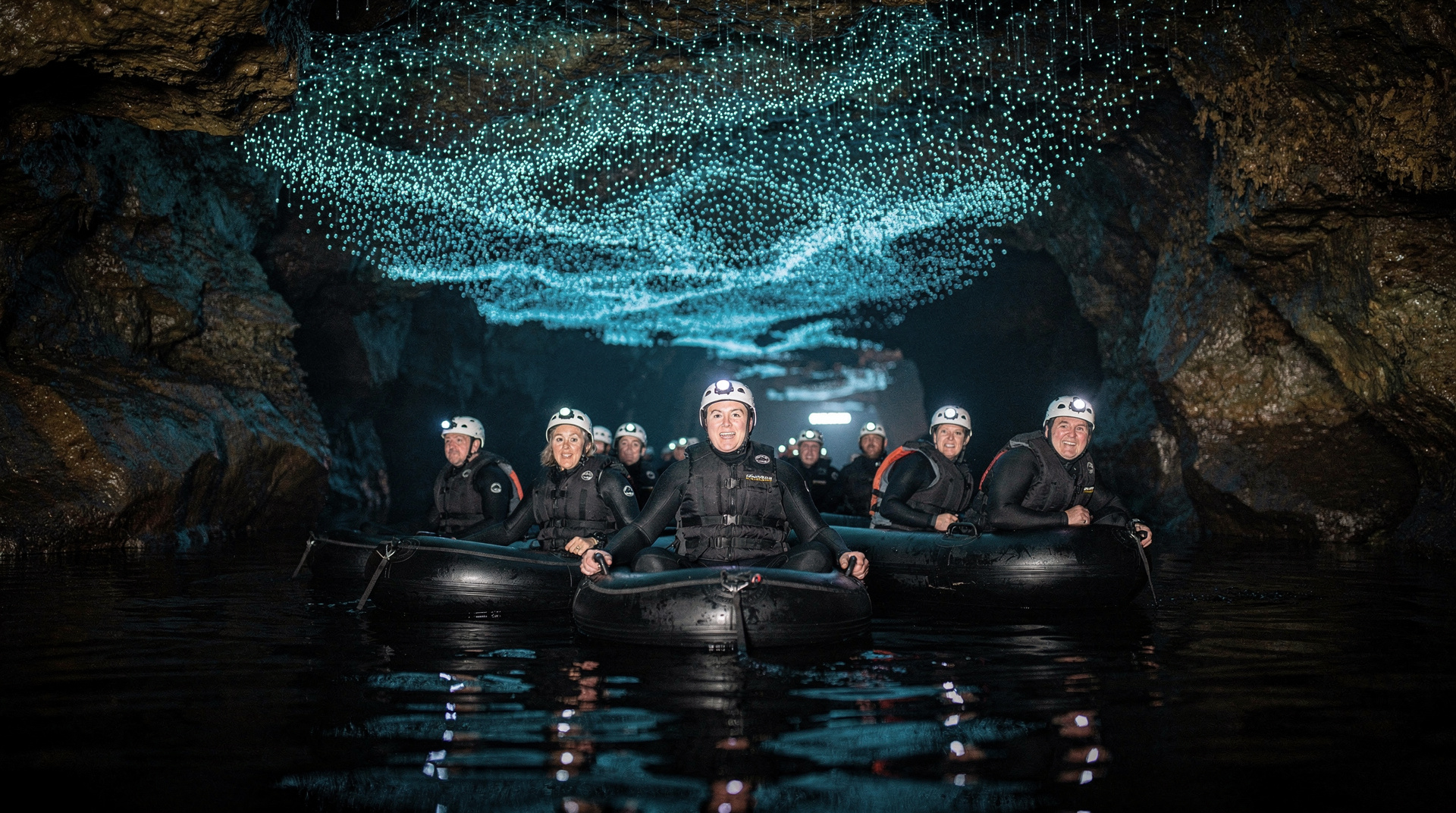
The standard glowworm cave tour runs 45 minutes and ends with a silent boat ride through the Cathedral Cavern, where the ceiling glows with thousands of blue-green lights. The silence is maintained by guides so the glowworms continue producing light (noise vibrations cause them to extinguish temporarily). The effect is deeply impressive. Children and adults consistently rate this as one of the most memorable experiences in New Zealand.
Waitomo: Glowworm Caves Guided Tour by Boat (45-min)
Waitomo glowworm caves 45-minute guided tour by boat — the classic experience from the main cave entrance.
From NZD 55–65 / USD 33–39 / EUR 30–36
Beyond the standard tour: adventure options
Waitomo’s second major offering is adventure caving — getting wet, dirty, and exhilarated underground. These experiences are managed by separate operators and are significantly more physical.
Black water rafting: Floating on inflated tyre tubes through underground rivers in wet suits, with headlamps and helmets.
Waitomo Caves: Labyrinth Black Water Rafting Experience
Waitomo Caves Labyrinth Black Water Rafting Experience — 3 hours, includes wetsuit, helmet, tube, and hot shower. The original, most-reviewed operator.
From NZD 155–175 / USD 93–105 / EUR 86–96
Minimum age typically 12, though check operator requirements.
Black Abyss: A longer, more demanding version combining abseiling, black water rafting, and flying fox (zip line) elements. The Waitomo Caves Black Abyss ultimate caving experience runs 5 hours and is physically demanding. NZD 210–250 / USD 126–150 / EUR 116–138.
Lost World abseil: The headline adventure experience — a 100-metre abseil into a massive underground cave system.
Waitomo: Lost World 4-Hour Guided Tour with 100m Abseil
Waitomo Lost World 4-hour guided tour with 100m abseil — for confident climbers and adventure seekers.
From NZD 360–395 / USD 216–237 / EUR 198–217
Ruakuri Cave guided walk: A longer, more geological cave experience than the standard glowworm tour. The Ruakuri glowworm cave guided walking tour covers different cave formations and a separate glowworm section. 1.5 hours, NZD 55–65 / USD 33–39 / EUR 30–36. Good for visitors who want more depth than the 45-minute standard tour.
TumuTumu Cave tubing: For families and casual adventurers who want something between the standard boat tour and full black water rafting. The Waitomo Caves tubing adventure with glowworm display is accessible from age 8 and doesn’t require the full commitment of black water rafting. NZD 95–110 / USD 57–66 / EUR 52–60.
Getting to Waitomo
Waitomo is 80 km south of Hamilton on SH37. From Auckland, allow 2.5 hours driving. There is no direct public transport to Waitomo from Auckland — the InterCity bus service runs to Hamilton, from where you’d need a shuttle or rental car.
For visitors from Auckland without a car, the combined day tours are the practical option:
- Waitomo alone from Auckland: approximately NZD 140–165 / USD 84–99 / EUR 77–91 for a guided day tour
- Waitomo plus Hobbiton from Auckland: the Hobbiton and Waitomo day trip from Auckland is the most popular combined option (NZD 195–220 / USD 117–132 / EUR 108–121, includes lunch)
From Hamilton: Waitomo is 80 km south; 1 hour driving. The Hamilton-Waitomo-Gardens private tour option combines Hamilton Gardens, Waitomo caves, and Ruakuri Cave in a day.
En route to Rotorua: Waitomo is 115 km west of Rotorua on SH30. A morning at Waitomo followed by an afternoon drive to Rotorua is a logical combination — plan to arrive in Rotorua by mid-afternoon so there’s still time for a geothermal park or the Skyline gondola before dinner. See the Waitomo day trip from Rotorua guide for the reverse direction if you’re basing yourself there instead.
Where to stay in Waitomo
Waitomo village is tiny but has adequate accommodation for visitors planning to base here overnight:
Waitomo Caves Hotel — the heritage property adjacent to the main cave entrance, NZD 140–210 / USD 84–126 / EUR 77–116 per night. Good value given the convenience.
Kimi Ora Eco Resort — a short drive from the village, self-contained chalets in a bush setting, NZD 160–240 / USD 96–144 / EUR 88–132. Good for couples wanting something quieter.
BBH and backpacker accommodation — Waitomo Top 10 Holiday Park offers cabin and camping options from NZD 35 (tent site) to NZD 130 (cabin). Good facilities.
Most visitors treat Waitomo as a half-day to full-day stop rather than a multi-night base, which is appropriate. The village itself has a couple of cafes, a small supermarket, and not much else.
What to eat
Waitomo has limited dining options. The Huhu Cafe near the cave entrance is the best option — quality food using local ingredients, open daily, prices NZD 18–32 / USD 11–19 / EUR 10–18 for mains. The Waitomo Caves Hotel dining room is a reliable backup. For more choice, drive to Te Awamutu (30 min) or Hamilton (1 hour).
Skip / worth it / splurge
- ✕ Skip : Multiple cave experiences in the same visit — the glowworm boat tour plus one additional cave tour is plenty; diminishing returns set in quickly
- ✕ Skip : Waitomo entirely if subterranean experiences genuinely don’t appeal to you (no judgement — but the surrounding countryside doesn’t compensate)
- ✓ Worth it : The standard 45-minute glowworm cave boat tour — this is one of the most genuinely unique natural experiences in New Zealand and the entry price is fair
- ✓ Worth it : Black water rafting if you have any appetite for adventure — it’s excellent, very well managed, and the operators have decades of experience
- ★ Splurge : The Lost World 100m abseil — an unforgettable experience for the right person, but confirm you’re comfortable with heights and commitment
Cost breakdown
Waitomo activity costs at a glance
| Item | NZD | USD | EUR | Verdict |
|---|---|---|---|---|
| Glowworm cave boat tour (45 min) The essential Waitomo experience | 55–65 | 33–39 | 30–36 | ✓ Worth it |
| Ruakuri Cave guided walk (1.5 hrs) More geological depth than the standard tour | 55–65 | 33–39 | 30–36 | ✓ Worth it |
| TumuTumu cave tubing Best family-friendly adventure option | 95–110 | 57–66 | 52–60 | ✓ Worth it |
| Black water rafting — Labyrinth (3 hrs) Original operator, best reviews | 155–175 | 93–105 | 86–96 | ✓ Worth it |
| Black Abyss — rafting + abseil + zip (5 hrs) Most demanding, most complete adventure | 210–250 | 126–150 | 116–138 | ★ Splurge |
| Lost World abseil (100m, 4 hrs) Bucket-list abseil — heights required | 360–395 | 216–237 | 198–217 | ★ Splurge |
| Hobbiton + Waitomo day trip from Auckland Best combined day trip option from Auckland | 195–220 | 117–132 | 108–121 | ✓ Worth it |
How Waitomo fits in your itinerary
On any North Island itinerary, Waitomo works as a half-day inclusion rather than a destination in its own right. The three most common approaches:
- Day trip from Auckland (long day, 12–14 hours): Combine with Hobbiton. Leave Auckland by 7:30am, visit Hobbiton 9:30–12pm, lunch in Matamata, drive to Waitomo (1 hour), glowworm cave tour 2:30pm, return to Auckland by 8:30pm.
- Stop en route Auckland to Rotorua: Leave Auckland morning, visit Waitomo mid-morning, drive to Rotorua for the evening (1.5 hours from Waitomo).
- Stop en route Rotorua to Auckland: Use Waitomo to break the northbound journey and arrive back in Auckland for a late dinner.
The science of the Waitomo glowworm
The Arachnocampa luminosa is endemic to New Zealand and Australia, with several closely related species. The Waitomo cave subspecies has been studied extensively since the 19th century. A few facts that make the experience more interesting:
Why they glow: The light is produced by bioluminescent chemical reactions in the larva’s abdomen — similar to the mechanism in fireflies, but chemically distinct. The blue-green light (approximately 480 nm wavelength) attracts small flying insects, which are caught on the sticky silk threads the larva suspends from the cave ceiling.
Life cycle: The glowworm spends most of its life as a larva — up to 11 months in the cave. It then pupates (a brief, dim-glowing stage), emerges as a short-lived fungus gnat with no mouth parts, mates, and dies within 2–3 days. The adult gnat cannot eat.
Sensitivity: The larvae extinguish their lights in response to vibration, sudden light changes, and atmospheric disturbance. This is why silence is maintained on the boat tour — it preserves the display for subsequent visitors and the long-term wellbeing of the colony.
Colony management: The Waitomo caves have had commercial tourism since 1889, making them one of the longest-running cave tourism operations in the world. The current operation balances visitor access with conservation — visitor numbers are managed and areas with active breeding are off-limits.
The geology of the Waitomo district
The caves exist because of the specific limestone geology of the Waitomo district. The rock is the Oparau Limestone, formed approximately 30 million years ago from compressed marine organism shells in a shallow tropical sea that then covered this part of New Zealand. As the seabed lifted, rainwater percolated through cracks in the limestone, slowly dissolving it over millions of years to create the cave network.
Stalactites (growing from ceiling) and stalagmites (from floor) throughout the Ruakuri and Aranui caves show typical karst cave formations — particularly dramatic in Ruakuri, which has chambers far larger than the main glowworm cave. The calcite formations include “cave coral,” helictites (formations that defy gravity by growing sideways), and organ pipe stalactites.
The Ruakuri Cave was considered tapu (sacred) by local Maori for centuries; human bones were found in the cave system in the 19th century. The entrance was redesigned in 2010 to avoid disturbing this sacred site — visitors enter via a spiral ramp that bypasses the original entrance.
Multi-activity planning: combining cave experiences in one day
Waitomo’s multiple operators and cave systems allow a full day of underground activity if that’s your inclination. A suggested sequence for a dedicated caving day:
Morning: Standard glowworm cave boat tour at 9am or 10am (45 min). This is the introductory experience; do it first for the right context.
Mid-morning: Ruakuri Cave guided walking tour (1.5 hours) — larger formations, different cave character, still includes glowworms. The two caves together give a comprehensive overview of what the Waitomo system contains.
Afternoon: Black water rafting (3 hours, departing around 1pm) — a complete change of register from passive watching to active participation. Wetsuit, tube, underground river. Ends around 4pm.
Total: A full day underground, with three distinct types of cave experience. Accommodation for the night in Waitomo village or a return to Hamilton or Rotorua in the evening.
For the adventure-only visitor who wants to skip the standard tour: black water rafting alone is a complete experience and doesn’t require the boat tour as a prerequisite.
Accessibility in the Waitomo caves
The standard Glowworm Cave tour is not fully wheelchair accessible. The lower section of the cave and the boat ride are accessible, but the upper cave walk involves steps and uneven terrain. The visitor centre staff can advise on current accessibility conditions.
Ruakuri Cave has better accessibility — the purpose-built walkways in the 2010 redesign included ramp access for most sections. Check with the operator for specific requirements before booking.
Black water rafting requires the ability to float in a tube, wade through waist-deep water, and climb out of a river — not suitable for guests with significant mobility limitations. The TumuTumu cave tubing experience has lower physical demands and may be more accessible; confirm with the operator.
Which cave experience suits you
Waitomo’s operators can feel like a wall of near-identical names when you’re booking. This comparison cuts through it by matching each experience to the traveller it actually suits, rather than by price alone.
| Experience | Best for | Physical demand | Duration |
|---|---|---|---|
| Standard glowworm boat tour | First-time visitors, families, anyone short on time | Low — a walk and a boat ride | 45 min |
| Ruakuri Cave guided walk | Visitors who want more cave, no getting wet | Low-moderate — steps, uneven ground | 1.5 hrs |
| TumuTumu cave tubing | Families with kids 8+, casual adventure seekers | Moderate — wading, floating | 2–2.5 hrs |
| Black water rafting (Labyrinth) | Adventure travellers wanting the signature Waitomo activity | High — cold water, climbing out of the river | 3 hrs |
| Black Abyss | Fit, confident adventurers wanting the full package | Very high — abseil, rafting, zip line combined | 5 hrs |
| Lost World abseil | Bucket-list seekers comfortable with heights | Very high — 100m abseil, sustained exertion | 4 hrs |
If you’re only doing one thing at Waitomo, the standard glowworm boat tour is the correct default — it’s the experience Waitomo is actually famous for. Everything else is an add-on for travellers who have the time and appetite for it.
Photographing the glowworm cave
Cameras and phones are not permitted on the standard glowworm boat tour — the flash and light from screens disturbs the glowworms and ruins the experience for other visitors, so operators enforce a strict no-photography rule on the cave section itself. This surprises some visitors who plan their visit around getting a photo. The honest advice: accept it, and be present for the 45 minutes instead.
Photography is permitted in the entrance areas, the visitor centre, and on the Ruakuri Cave walk’s non-glowworm sections, where low-light photography with a tripod can produce reasonable results of the limestone formations. For an actual image of the glowworm effect, official photographs are available for purchase at the visitor centre, taken with specialist long-exposure equipment that isn’t practical for casual visitors to replicate underground.
Frequently asked questions about Waitomo
Is the glowworm cave experience worth it for adults?
Yes — the Arachnocampa luminosa is found only in New Zealand and Australia, and the boat tour under a cave ceiling of thousands of bioluminescent lights is a genuinely singular experience. The 45-minute duration is appropriate; longer would be welcome, but the experience doesn’t feel rushed.
Do I need to book in advance?
In peak season (December to February) and on school holiday weekends, yes — book at least a week ahead. In shoulder season (March to May, September to November), same-day booking is often possible, particularly for the standard cave tour. Adventure activities like black water rafting have limited group sizes and fill up faster.
What temperature is it inside the caves?
A constant 13°C / 55°F regardless of outside temperature. This feels cold after 15–20 minutes, particularly in summer when you arrive warmly dressed. Bring a light layer even on hot days; the tour operators often remind you of this, but it’s easy to forget.
Is Waitomo suitable for very young children?
The standard glowworm boat tour is accessible from age 3. Children must be able to sit still and reasonably quiet on the boat. Adventure activities have minimum age requirements (typically 12 for black water rafting). The quiet, dark boat section is exciting rather than frightening for most children.
What should I wear for black water rafting?
Operators provide wetsuits, helmets, and boots — you’ll be fully kitted out. Bring a change of clothes and a towel for afterward; there are changing facilities and hot showers at the end. You will get wet from head to toe. Leave electronics and valuables at the vehicle. The wetsuit is effective; you’ll be cold in the water for the first few minutes but adjust quickly.
Can I see glowworms elsewhere in New Zealand?
Yes — Te Anau glowworm caves (Fiordland), the Whangarei glowworm caves (Northland), and some sea caves around the Coromandel coast all have glowworm populations. Te Anau is a genuine alternative, particularly for South Island visitors. The Waitomo caves are the most developed and most accessible experience, but they’re not the only one.
How does the Okohua glowworm cave tour differ from the main caves?
The Waitomo Experience Okohua glowworm cave tour is a newer, smaller-group cave experience in a separate cave system from the main Aranui and Ruakuri caves. It provides a more intimate encounter with glowworms in a cave setting that sees significantly fewer visitors. Priced competitively at NZD 85–110 / USD 51–66 / EUR 47–60. Good option for visitors who want smaller groups and a different cave character from the main tourist operation.
What is the Waitomo 3-hour eco-cave tour?
The Waitomo guided eco-cave tour (3 hours) is a more extended cave walk covering geological formations, glowworm ecology, and the history of cave exploration in the Waitomo district. Suitable for curious visitors who want more depth than the standard 45-minute boat tour. NZD 95–115 / USD 57–69 / EUR 52–63. Not an adventure activity — it’s a walking tour in standard clothing.
How far in advance should I book Waitomo activities?
For the standard glowworm cave tour, same-day booking is often possible in shoulder season (May–November) with some advance notice. Black water rafting has limited group sizes — book 1–2 weeks ahead in summer and at least 3–5 days ahead at other times. The Lost World abseil requires coordination with operators and advance booking of 1–2 weeks minimum. For school holidays and summer peak (December–February), all activities benefit from booking 2–4 weeks ahead.
Is Waitomo suitable for visitors with claustrophobia?
The standard glowworm cave boat tour involves a low-ceilinged passage that may feel enclosed for some visitors but is not a tight squeeze. Most people with mild claustrophobia manage comfortably. The more adventurous experiences (black water rafting, Lost World abseil) involve deeper, darker, more enclosed cave passages. If claustrophobia is a significant concern, discuss it with operators before booking — they have experience with this and can advise on the specific passages involved in each tour.
Is Waitomo worth doing if I’m also visiting Te Anau’s glowworm caves?
Yes, they’re different enough to justify both if your itinerary allows it. Waitomo’s Arachnocampa colony is larger and the tourism infrastructure more developed, with adventure add-ons Te Anau doesn’t offer. Te Anau’s glowworm caves are smaller and more intimate, reached by boat across Lake Te Anau, and convenient for South Island travellers who won’t otherwise pass through the Waikato. Neither makes the other redundant.
Should I do Waitomo before or after Hobbiton?
Either order works, but most day-trippers from Auckland do Hobbiton first (morning light suits the photos) and Waitomo second, since the cave interior looks the same regardless of time of day. If you’re staying overnight in the area, a Hobbiton-morning, Waitomo-afternoon sequence also avoids the midday crowds at both sites.
Top experiences: Waitomo Glowworm Caves
See all →Guides for Waitomo
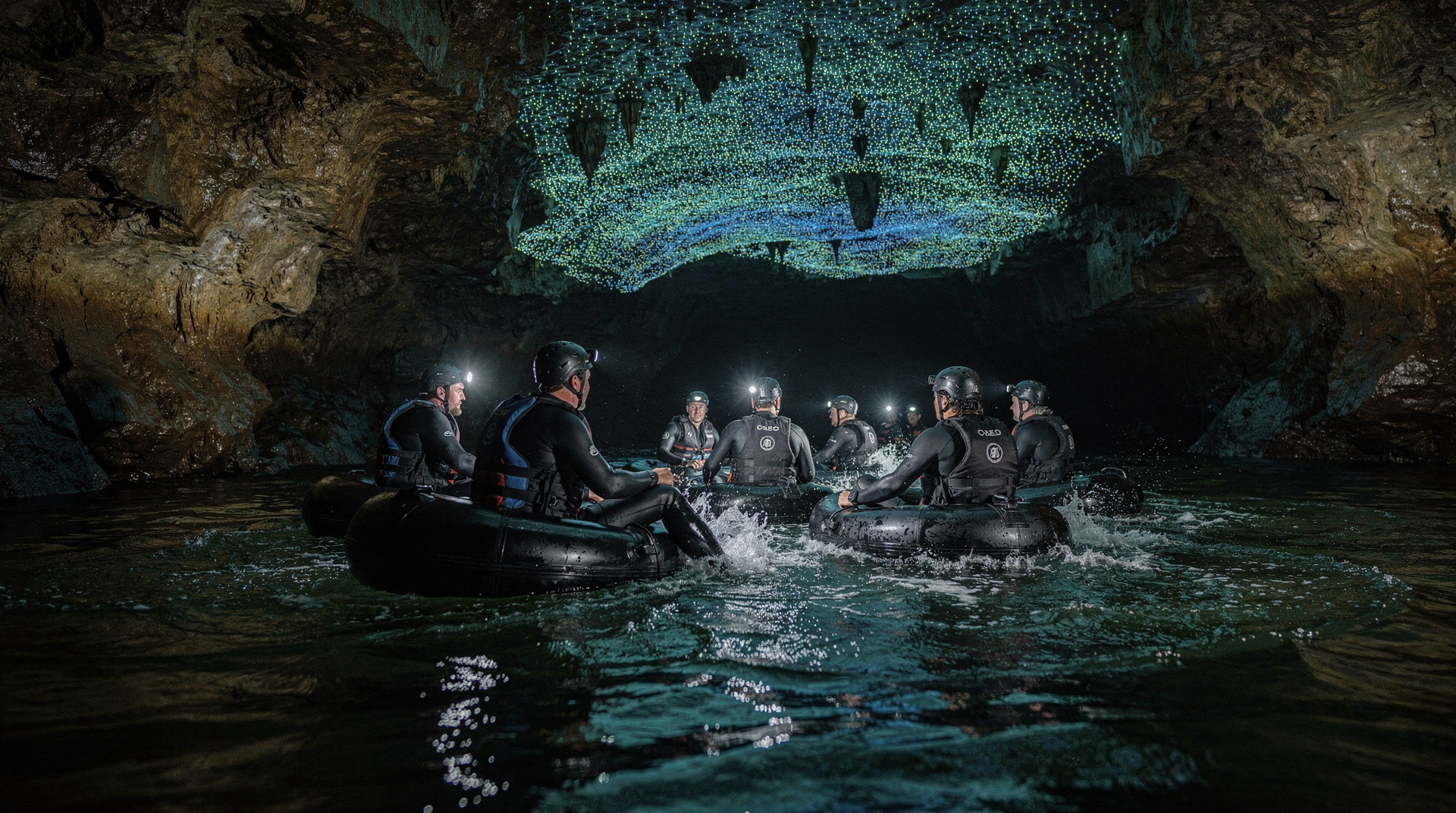
Black water rafting at Waitomo — full activity guide
Black water rafting Waitomo: float underground rivers past glowworm caves on rubber rings. Black Labyrinth 3h NZD 155, Black Abyss 5h NZD 245. Wetsuit included.
Waitomo Black Abyss review — abseil, zipline, and glow-worms underground
Waitomo Black Abyss 5h adventure review — NZD 295 well spent or overpriced? Honest verdict on who should book and who should skip.
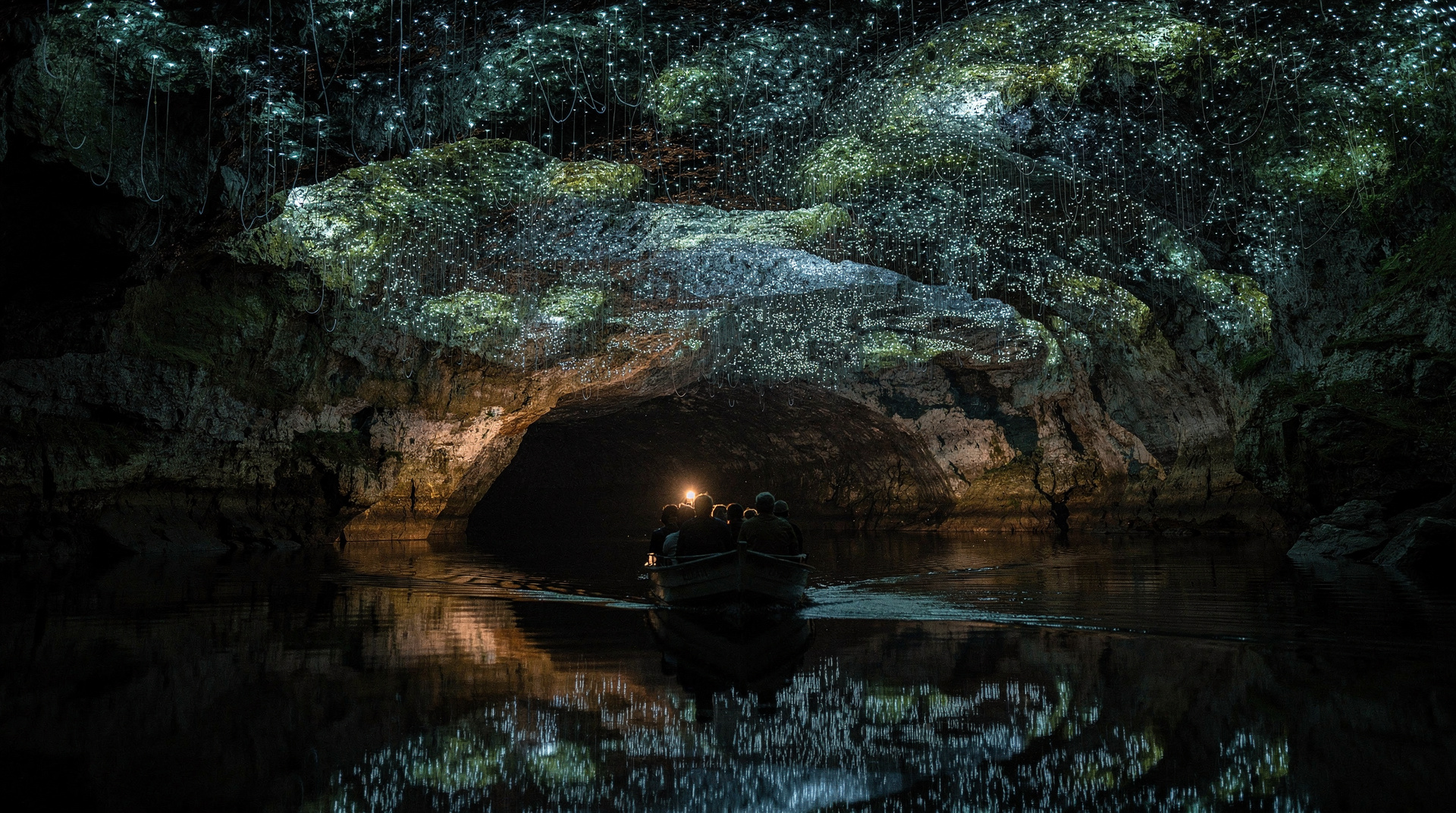
Waitomo Glowworm Caves — visitor guide
Waitomo Glowworm Caves: 45-min boat tour under a bioluminescent ceiling, NZD 75 adult. Three cave systems. Honest guide to what's worth doing.
Related guides
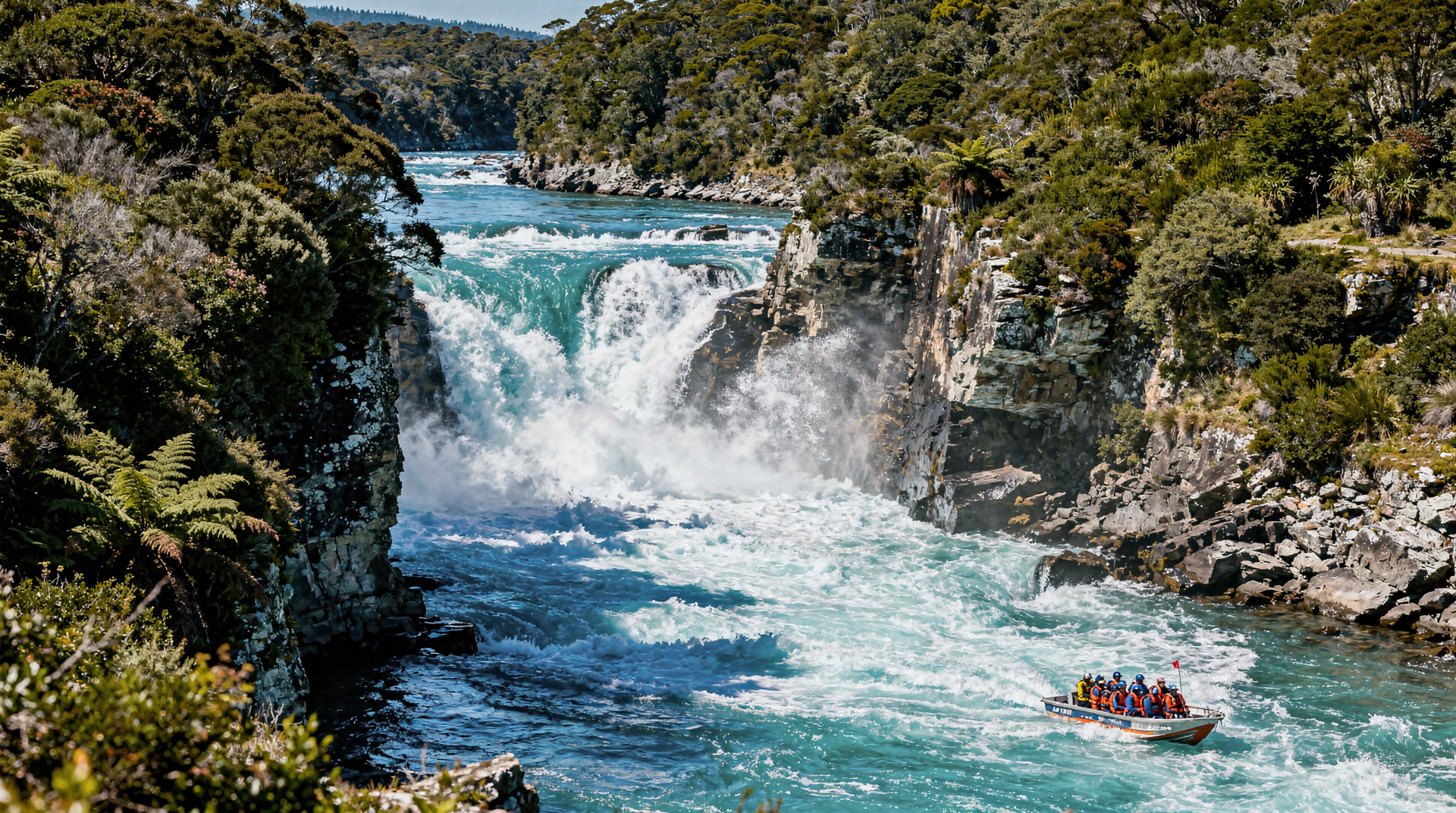
Waikato
Honest Waikato guide: Hobbiton Movie Set, Waitomo glowworm caves, Hamilton Gardens, Raglan surf. Real NZD/USD/EUR prices, what's worth your time.
Rotorua
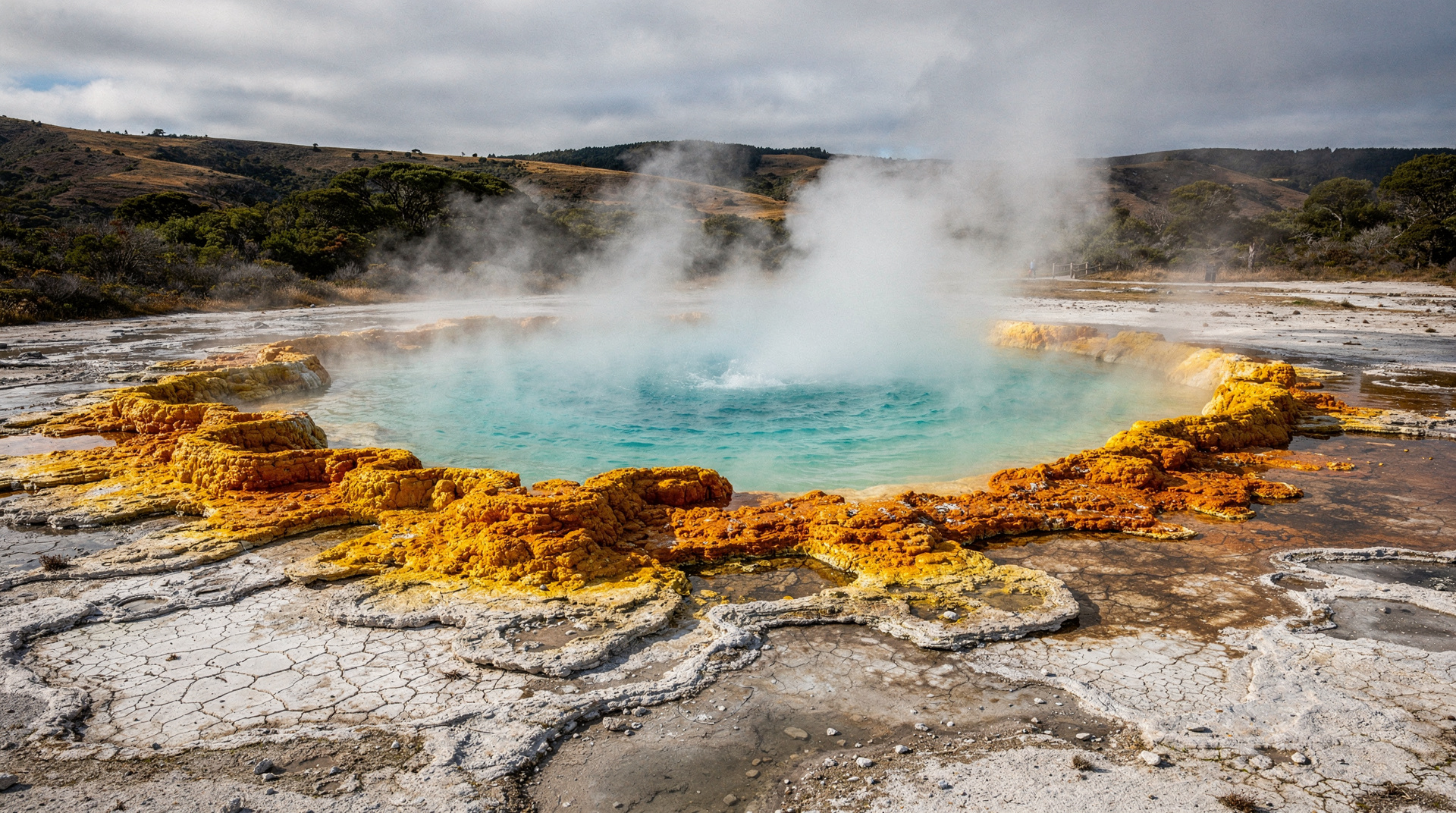
Honest Rotorua guide: Te Puia, Wai-O-Tapu, Polynesian Spa, Maori hangi, real prices NZD/USD/EUR, tourist traps to avoid, and best 2 days.
Hobbiton
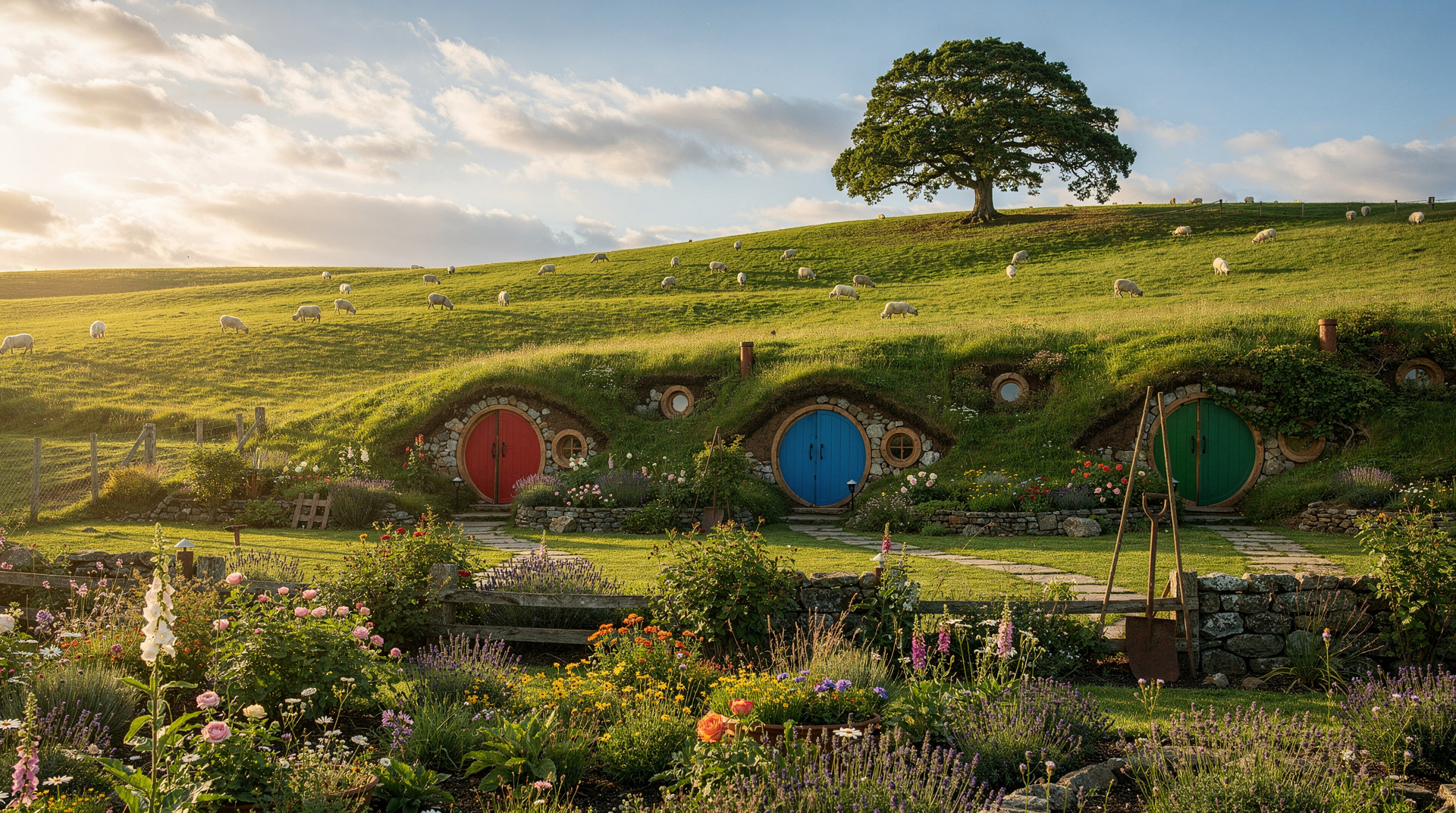
Honest Hobbiton guide: what to expect on the movie set tour, real ticket prices NZD/USD/EUR, best time to visit, and whether it's worth the cost.
Waitomo Glowworm Caves — visitor guide
Waitomo Glowworm Caves: 45-min boat tour under a bioluminescent ceiling, NZD 75 adult. Three cave systems. Honest guide to what's worth doing.
Black water rafting at Waitomo — full activity guide
Black water rafting Waitomo: float underground rivers past glowworm caves on rubber rings. Black Labyrinth 3h NZD 155, Black Abyss 5h NZD 245. Wetsuit included.
Waitomo Caves day trip from Auckland
Everything about a Waitomo Caves day trip from Auckland: drive time, tours, cost in NZD/USD/EUR, and why combining with Hobbiton makes sense.

10-day New Zealand itinerary — both islands by air
Auckland → Rotorua → Wellington → fly to Queenstown → Milford Sound. Compact 10-day NZ loop with real costs in NZD, USD, and EUR.
Hobbiton at 25 — how the Shire became a permanent fixture in New Zealand
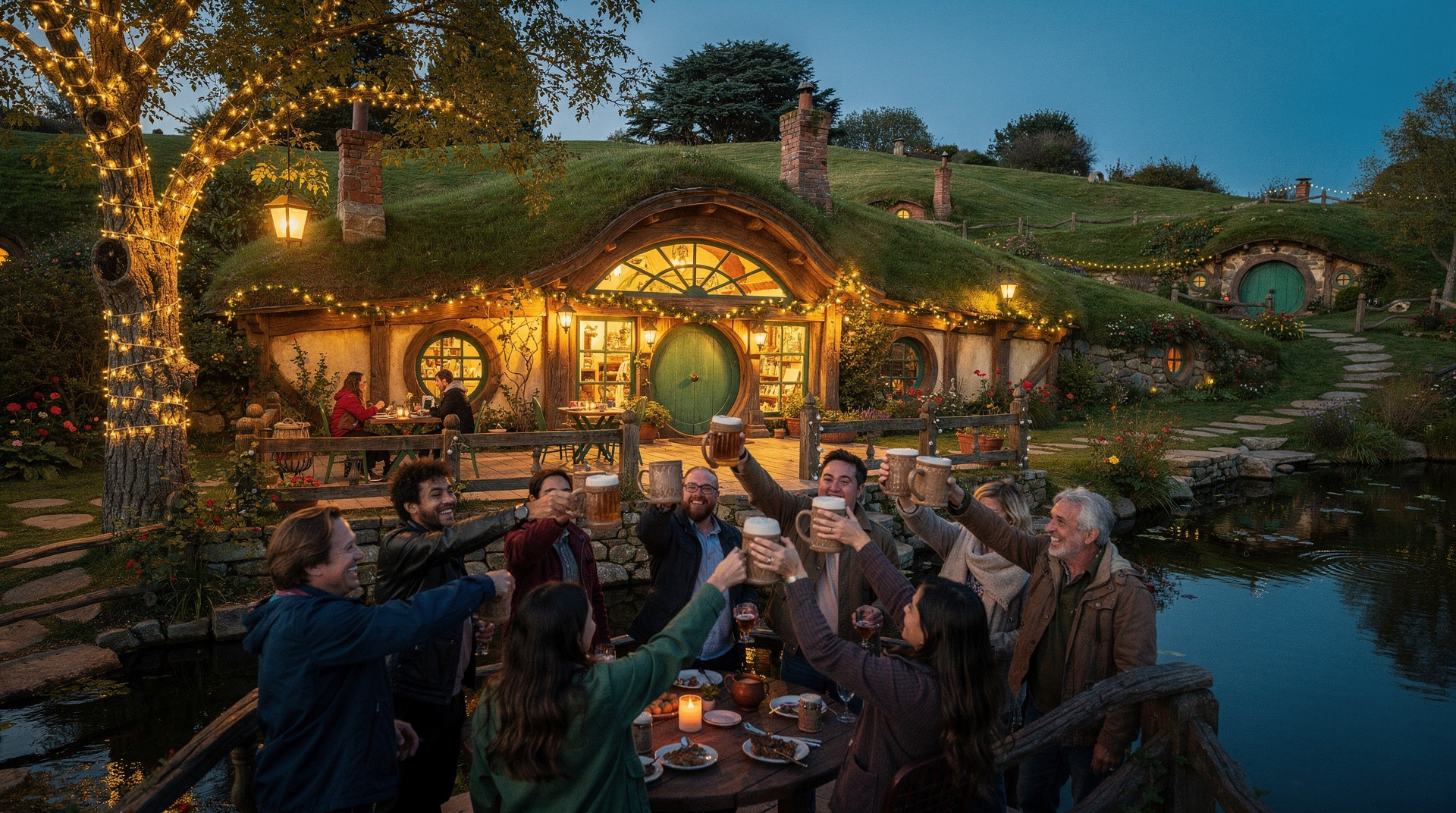
From a rushed film set built in 1999 to a permanent tourism destination visited by 600,000 people a year — the unlikely story of Hobbiton's evolution.
Last reviewed: