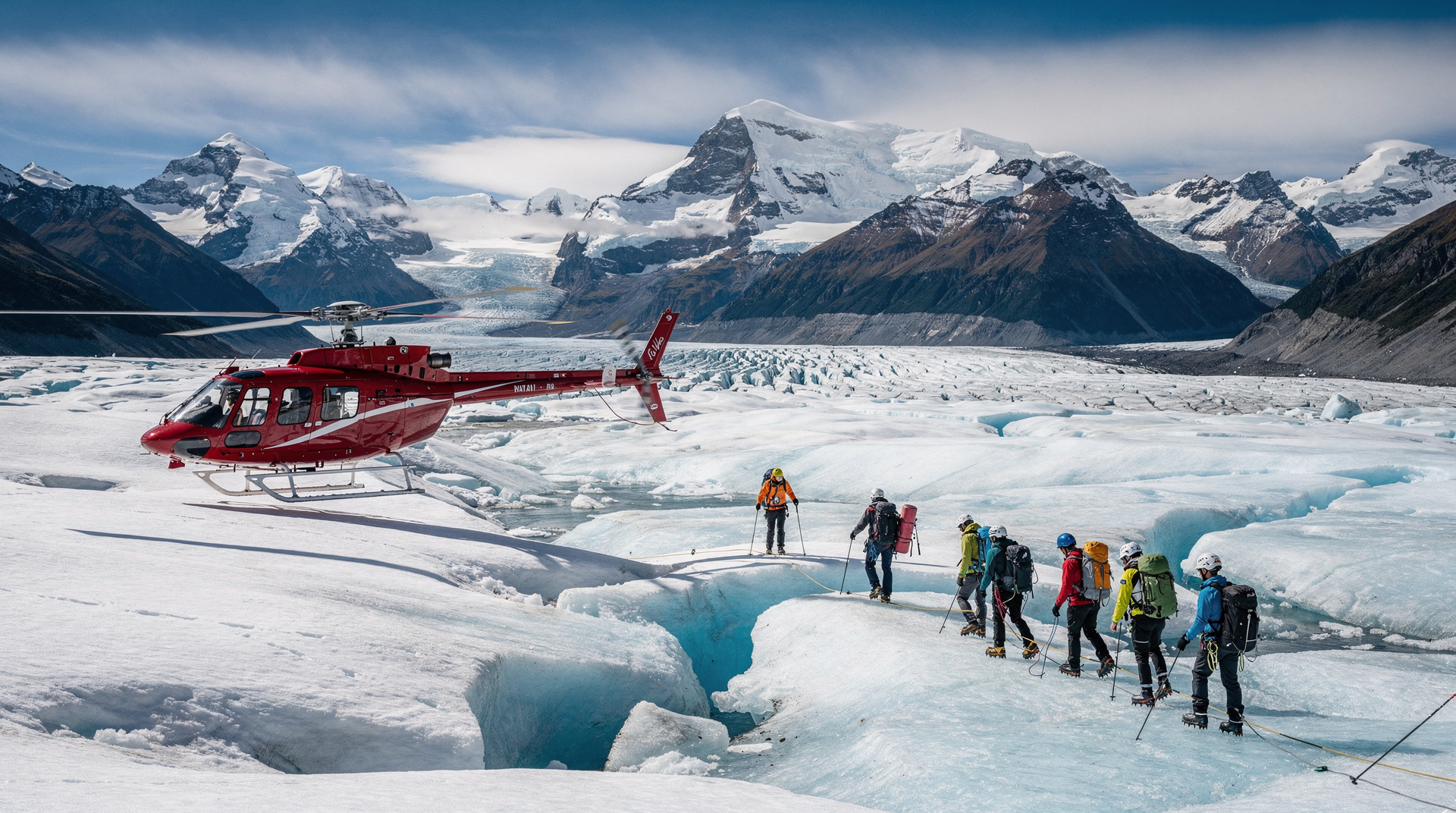
Franz Josef glacier heli-hike review — the honest 4-hour ice walk verdict
Is the Franz Josef glacier heli-hike worth NZD 499?
Yes, if you understand what you're buying: 4 hours on an active glacier with crampons, ice walls, crevasse edges, and a guide who knows the ice intimately. No, if you're expecting a gentle walk — the terrain is genuinely demanding and the cold is real.
Standing on a living glacier — ✓ Worth it
Franz Josef Glacier descends from the Southern Alps to within 300 metres of sea-level rainforest. The distance from the coast to the ice — under 20 km — is what makes Westland’s glaciers geographically extraordinary: nowhere else in the temperate world does an active glacier terminate this close to subtropical coastal forest. Nikau palms grow within 5 km of permanent ice.
| Where | Franz Josef township, SH6, South Island West Coast |
| Cost | around NZD 399–699 for the heli-hike; NZD 245 for flight-only |
| Time needed | Half day (3–4 hours on ice, plus helicopter transfers) |
| Getting there | Self-drive SH6; no practical public transport option |
| Best time | Stay 2+ nights; book the earliest morning slot for best odds |
The glacier itself has been retreating significantly since the 1990s, but substantial ice remains accessible. Walking on it requires a helicopter because the lower glacier — formerly accessible on foot — has calved away. The heli-hike puts you on the upper ice, where crevasses, seracs, ice caves, and meltwater channels form and reform continuously. For the broader retreat context across both West Coast glaciers, see the New Zealand glaciers overview.
Franz Josef: Half-Day Glacier Helicopter and Hiking Tour
Franz Josef half-day glacier helicopter and hiking tour — crampons, ice tools, glacier guide included.
From NZD 499 / USD 299 / EUR 274
This is not a passive sightseeing experience. You will walk on ice for 3–4 hours with steel crampons strapped to your boots, following a guide across terrain that changes from week to week. The West Coast operators have been running glacier heli-hikes for over 30 years. The safety record is strong; the physical demands are real.
If you are still weighing which glacier product suits you, the Franz Josef helicopter tours guide lays out the flight-only options, and the heli-hikes comparison puts the New Zealand ice walks side by side. For the village itself, the Franz Josef Glacier guide and the Franz Josef Glacier destination page cover where to eat, sleep and base yourself.
What you actually get
The helicopter approach
Tours depart from Franz Josef township, approximately 5 km from the glacier terminal. The helicopter flight to the landing zone takes 5–8 minutes — the glacier fills the windscreen as you approach from the valley, the surface transitioning from grey moraine rubble on the lower ice to blue-white seracs on the upper zone. The pilot lands on a prepared platform cleared by the guide team that morning (guides go up ahead of each client group to assess and prepare the day’s route).
The helicopter returns to base while you’re on the glacier. You hike. It comes back for you at the end.
Gear-up and crampon fitting
On the glacier, the guide fits your crampons (steel 10-point, strapped over your boots) and issues ice tools (short axes, primarily for balance in steeper sections rather than technical climbing). The guide demonstrates crampon technique: flat-footed on moderate terrain, front-pointing on steeper ice. The learning curve is 15 minutes; the technique becomes intuitive on flat sections and requires concentration on the angled ones.
Gear is provided: crampons, ice tools, helmet, jacket (rental — bring your own layers underneath). Gloves are your responsibility and essential; bring waterproof gloves, not just fleece.
The ice walk itself
Franz Josef’s upper glacier surface is an active environment. The route changes weekly as the ice moves and new features form. What the guide finds on any given day depends on recent snowfall, melt rates, and ice movement.
Typical features encountered:
Ice caves: Blue-walled caverns formed by meltwater channels. The colour of glacial ice — compressed over decades until the air bubbles are removed — is a deep, translucent blue unlike anything at surface level. Some caves are walkable; others require a brief crouch. The guide will assess each for safety before entry.
Crevasses: The glacier fractures as it flows over uneven bedrock. Crevasses range from narrow (step across) to multi-metre gaps with unfathomable depth. The guide routes around or along these carefully; you will be within metres of open crevasses throughout. This is managed, not reckless — but people who are uncomfortable with exposure to drops should consider whether this tour is appropriate.
Ice walls and seracs: Towers of ice formed by differential glacier movement. Some reach 5–10 metres. They are unstable by nature (the ice is always moving) and guides route groups at safe distances from active faces. Occasional ice-fall sounds — cracking, shifting — are normal and not dangerous from the designated paths.
Meltwater channels: Streams running on the glacier surface in summer. Beautiful to photograph; the water is achingly clear and flowing from ice that formed perhaps 300 years ago.
Duration and physical demands
Total time on the glacier: 3–4 hours depending on the half-day or full-day option. The half-day heli-hike (the most common booking) gives approximately 3 hours on ice. The full-day bespoke option extends this.
Physical demands are moderate to high. You will be walking on slippery irregular terrain for the entire ice time. The crampons provide grip but require conscious, deliberate foot placement. The cold at altitude is real even in summer — the glacier surface hovers near 0°C regardless of the season. Stamina matters more than strength. People in their 50s and 60s with reasonable fitness complete this regularly; people in poor cardiovascular shape should consider the helicopter-only sightseeing option instead.
What it costs and what’s not included
Cost breakdown
Prices approximate 2026. Exchange: 1 NZD ≈ 0.60 USD ≈ 0.55 EUR.
| Item | NZD | USD | EUR | Verdict |
|---|---|---|---|---|
| Half-day glacier heli-hike (most common) 3 hours on ice, crampons and gear included | NZD 499 | USD 299 | EUR 274 | ✓ Worth it |
| 2.5-hour glacier hike with helicopter transfer Shorter version — less time on ice | NZD 399 | USD 239 | EUR 219 | ✓ Worth it |
| Bespoke small group heli-hike with lunch Full-day; smaller groups (4–6); includes packed lunch | NZD 699 | USD 419 | EUR 384 | ★ Splurge |
| Helicopter-only 35-min two-glaciers flight (no hike) If weather closes, this is a solid consolation | NZD 245 | USD 147 | EUR 135 | ✓ Worth it |
| Boot hire (if needed) | NZD 20 | USD 12 | EUR 11 | |
| Accommodation in Franz Josef village Budget to mid-range; book ahead in peak season | NZD 120–280 | USD 72–168 | EUR 66–154 |
What’s not included: Warm underlayers (bring your own — the operator’s rental jacket goes over your clothing; thermals and fleece mid-layer are essential). Waterproof gloves. Sunscreen and sunglasses (glacier glare is severe). Meals and transport to Franz Josef township.
Who should book ✓ Worth it
- You have more than one day on the West Coast — weather cancellations are common, and flexibility to rebook the following day significantly increases your chances of flying
- You’re reasonably fit and comfortable on uneven terrain for 3+ hours
- You want genuine glacier access rather than a scenic flyover — this is walking on ice, not looking at it from a helicopter window
- This is your only New Zealand visit and you want the glaciers properly
- You’re combining with Fox Glacier to compare the two systems — the two glaciers offer different terrain and character; Franz Josef is steeper and more dramatic, Fox tends toward wider open expanses
Who should skip ✕ Skip
- You have a single day on the West Coast with a fixed schedule — weather cancellations will not be resolved in your favour if you can’t rebook
- Significant fear of heights or exposed drops is a genuine issue for you — crevasse edges are real and unavoidable on the route
- Poor ankle stability or knee problems — crampon walking on uneven ice puts real stress on both
- You’re expecting a warm experience — the glacier is near-zero degrees regardless of the air temperature below. Visitors who underpack layers are miserable
When to splurge ★ Splurge
The bespoke small-group heli-hike with lunch is the answer if you want the maximum time on ice with the minimum group size. Groups of 4–6 (vs the standard 8–10) mean the guide can take more ambitious routes and spend more time in complex terrain. The packed lunch on the glacier — brief though it is — is the kind of detail that becomes a story.
Franz Josef: Bespoke Small Group Heli-Hike with Lunch
Franz Josef bespoke small-group heli-hike with packed glacier lunch — maximum 6 people.
From NZD 699 / USD 419 / EUR 384
If you want the helicopter experience without the hike, the 35-minute flight over both Franz Josef and Fox glaciers is excellent and substantially cheaper:
Franz Josef: 35min Helicopter Trip over Two Glaciers
35-minute helicopter over Franz Josef and Fox glaciers — no landing, pure aerial sightseeing.
From NZD 245 / USD 147 / EUR 135
How to actually get there
Franz Josef township (population ~300 in winter, several thousand in summer) sits on SH-6, the West Coast road. It is not near anything major:
- Greymouth: 175 km north, approximately 2.5 hours (the road is coastal and genuinely beautiful)
- Queenstown: 380 km southeast via Haast Pass, approximately 4.5–5 hours (the Haast Pass route is one of NZ’s great drives — Haast itself, the Blue Pools, Thunder Creek Falls)
- Christchurch: 480 km via Lewis Pass or Arthur’s Pass, approximately 5–6 hours
There is no practical public transport to Franz Josef from either Queenstown or Christchurch. InterCity buses run the West Coast route but on infrequent schedules unsuitable for activity-based timing. A rental car is essentially required. If you’re driving from Christchurch via Arthur’s Pass, build in a stop there — it breaks up the drive and is worthwhile on its own.
Fuel note: Franz Josef has one petrol station. It is expensive (West Coast prices are uniformly higher than South Island cities). Fill up in Hokitika or Queenstown before driving to Franz Josef; the next reliable station north is Hokitika, south is Haast or Wanaka.
Combining with the wider trip: Franz Josef sits naturally between Queenstown/Wanaka and the northern West Coast. Travellers doing a full South Island loop often pair it with Fox Glacier as a two-village stay, or route north toward Hokitika and Greymouth afterward. If your trip also includes Fiordland, note that Franz Josef and Milford Sound are on opposite sides of the island and not easily combined in a single loop day.
Because the drive itself is a big part of the trip, it helps to read up on driving in New Zealand before you set off, especially if you are used to driving on the right. Travellers building the glacier stop into a longer route may find the 7-day South Island itinerary a useful skeleton, and the West Coast region page shows what else sits along the road. If you are arriving from the south, Queenstown is the usual starting point.
Honest red flags
The glacier is retreating. Franz Josef has lost significant mass since the 1990s, and while upper glacier access remains good, the lower glacier that was once walkable directly from the valley floor is gone. This is not a secret. The operators are transparent about it. The heli-hike exists specifically because ground-level access degraded. The experience remains genuine and the ice remains extraordinary — but it is also measurably less extensive than it was 20 years ago, and this trend will continue.
Weather cancellations are extremely common. The West Coast receives the highest annual rainfall in New Zealand — some locations exceed 5,000 mm per year. Franz Josef’s location at the base of the main divide means cloud descends frequently and without much warning. Tours are cancelled when visibility at altitude drops below the helicopter’s safe operating threshold. This happens on roughly 30-40% of booked days. If you’re on a fixed itinerary with one day at Franz Josef, there is a realistic chance you won’t fly. Stay two nights; bring a book.
The brief notice cancellation is frustrating. Operators typically make the call 1–2 hours before the scheduled departure, after checking the morning forecast and sending guides to assess the ice. You may have woken at 6am, eaten breakfast, geared up, and arrived at the helipad before being told the tour is cancelled. This is not incompetence — it is the reality of the environment. The operators refund fully or reschedule; they cannot control the weather.
Groups of 8–10 are larger than they sound on a glacier. The guide manages this by dividing into sub-groups at times, but the most complex terrain is navigated sequentially rather than simultaneously. If you want a more intimate experience, the small-group bespoke tour is genuinely better.
Plan for the retreat to keep changing the picture. What you see on your day may differ from photos taken even a few years ago. The blog piece on what to see now as the West Coast glaciers retreat is a good companion read before you commit your budget and your days.
Alternatives if you don’t book
Glacier lookout walks (free): The Franz Josef Glacier Valley Walk is a 1.5-hour return walk on the valley floor to the glacier viewpoint. You see the glacier terminus from approximately 500 metres — close enough to understand the scale, not close enough to touch it. The retreat markers along the path (showing where the glacier reached in 1900, 1950, 1975, 2000) are sobering. This is the free alternative and it’s worth doing regardless of whether you hike.
Fox Glacier heli-hike: 24 km south of Franz Josef, Fox Glacier offers the same product from a different glacier. Fox tends to have wider, flatter terrain at the top; Franz Josef is steeper with more dramatic crevasse scenery. If Franz Josef is fully booked or the weather is better at Fox (sometimes true; they’re different drainages), the Fox option covers the same base experience. Book via Fox Glacier 3-hour helicopter hike .
Helicopter scenic flights (no hike): If weather closes out the heli-hike, the helicopter-only 35-minute flight over both glaciers gives the aerial view without ice walking. Franz Josef 35-minute helicopter trip over two glaciers is the correct fallback.
Frequently asked questions about Franz Josef glacier heli-hike review — the honest 4-hour ice walk verdict
Is the Franz Josef glacier heli-hike still available after the glacier retreat?
Yes. The upper glacier — where the heli-hike operates — remains substantial and accessible. The lower glacier (formerly accessible on foot from the valley) has retreated beyond practical walking access, which is why the helicopter is now the only means of reaching the ice. The heli-hike format was developed in the 2000s and continues to operate on significant ice volume.
What fitness level is required?
Moderate. You need to be able to walk on uneven terrain for 3–4 hours with steel crampons attached to your boots. There is no technical climbing; the guide handles route-finding. People with good walking fitness who can manage 3–4 hours in hilly terrain will be fine. People with ankle or knee problems, or significant cardiovascular conditions, should consult their doctor and discuss with the operator before booking.
What do I wear?
Thermal base layer, fleece mid-layer, and the operator’s rental jacket on top. Waterproof trousers over warm leggings or hiking trousers. Wool or synthetic socks (not cotton — cotton holds moisture). Waterproof gloves (essential — not optional). Sunglasses or goggles. The operator will tell you this at booking but many people underdress and are cold for 3 hours.
Can children do the heli-hike?
Minimum age varies by operator — typically 8 years old for the standard heli-hike and 10+ recommended for the more demanding routes. Children must also meet minimum weight requirements for crampon fitting. Family groups should contact the operator directly before booking.
Is Franz Josef better than Fox Glacier?
Different experiences rather than one being objectively better. Franz Josef is steeper and more dramatically crevassed at the upper elevations. Fox tends to have more open plateau terrain. Franz Josef town has more accommodation and services; Fox is quieter. If you can only do one, Franz Josef is the more visited for good reason — the scenery is more dramatic. If you have a second day and want to compare: Fox is an easy 24-km drive south.
What happens if the tour is cancelled due to weather?
Full refund or free reschedule, typically offered for the next available departure that suits your itinerary. Operators are well-practiced at this — they know the frustration and handle it professionally. The challenge is logistical for visitors on fixed schedules. Some operators offer standby bookings (you come to the helipad and wait for a weather window) but these are informal and not guaranteed.
Is the glacier heli-hike ethical given climate change?
This is a reasonable question. The two main operators at Franz Josef (Glacier Guides / Skydive Franz Josef Group) support glacier research partnerships and are outspoken about retreat rates. The carbon cost of the helicopter flights is real and not trivial. The operators offer carbon offset options at booking; some visitors use third-party offsetting. The experience of standing on a glacier that will be significantly smaller in 30 years has its own educational dimension — the retreat markers make the change viscerally clear. Whether that justifies the carbon cost is a judgment call each visitor must make for themselves.
What should I do if I only have one day and the weather looks uncertain?
Book the earliest possible slot and have a backup plan for the rest of the day rather than assuming you’ll fly. If cancelled, the free Glacier Valley Walk gives a genuine view of the terminus, and the 35-minute two-glacier scenic flight (weather permitting) is a lower-commitment alternative. If your itinerary genuinely allows only one day on the West Coast, weigh whether the Tasman Glacier near Mt Cook, with its far more reliable eastern-side weather, might serve your trip better.
Do I need travel insurance specifically for the heli-hike?
Standard travel insurance with adventure-activity cover is worth checking before you book — most policies cover heli-hiking as a listed activity, but confirm cancellation and medical cover for glacier terrain specifically. This won’t help with weather cancellations (operators reschedule those directly) but matters if you need cover for injury on the ice.
Related guides
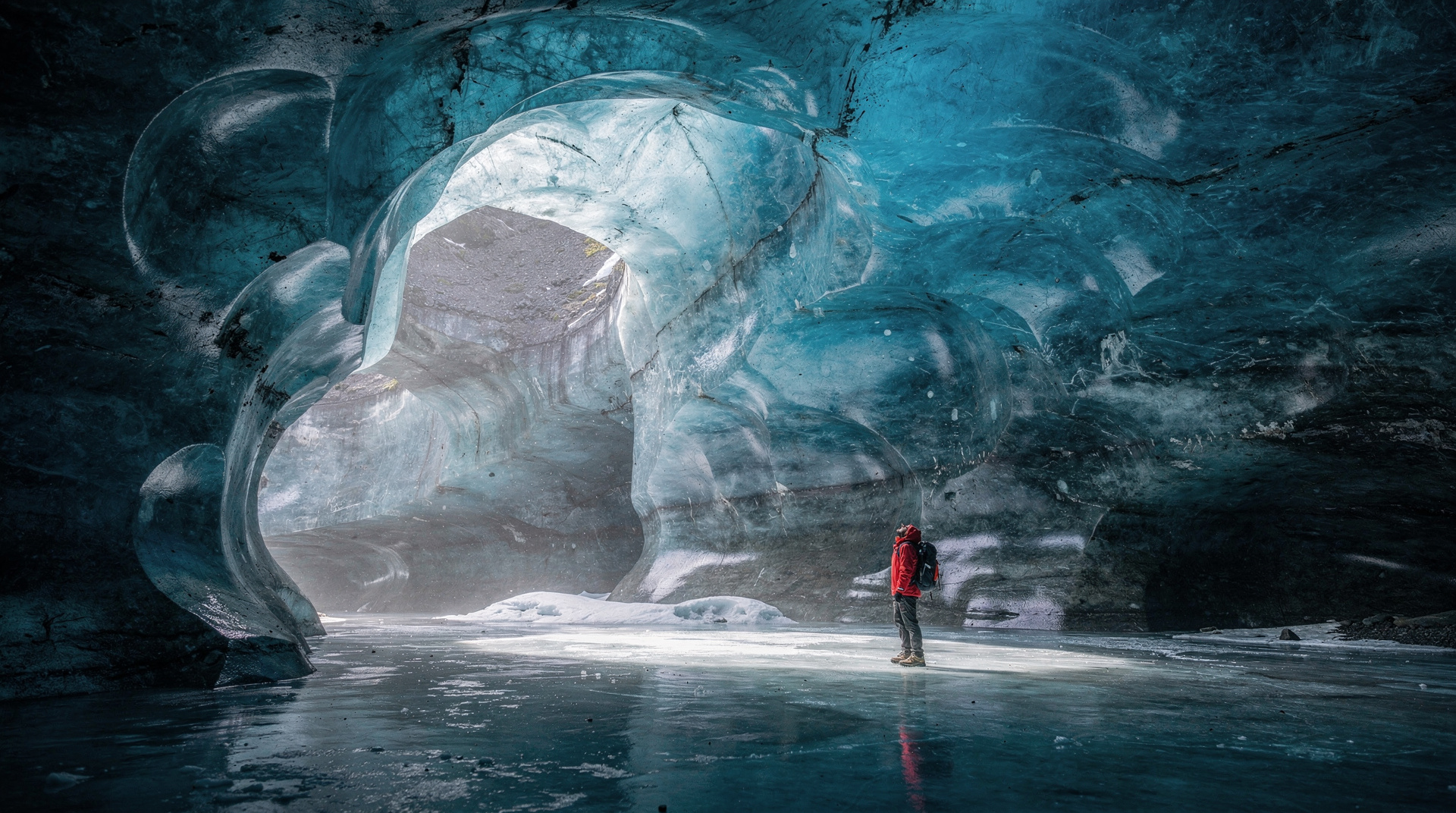
Franz Josef Glacier
Honest Franz Josef guide: heli-hike vs ice walk, glacier retreat reality, real NZD/USD/EUR costs and what's possible after significant ice loss.
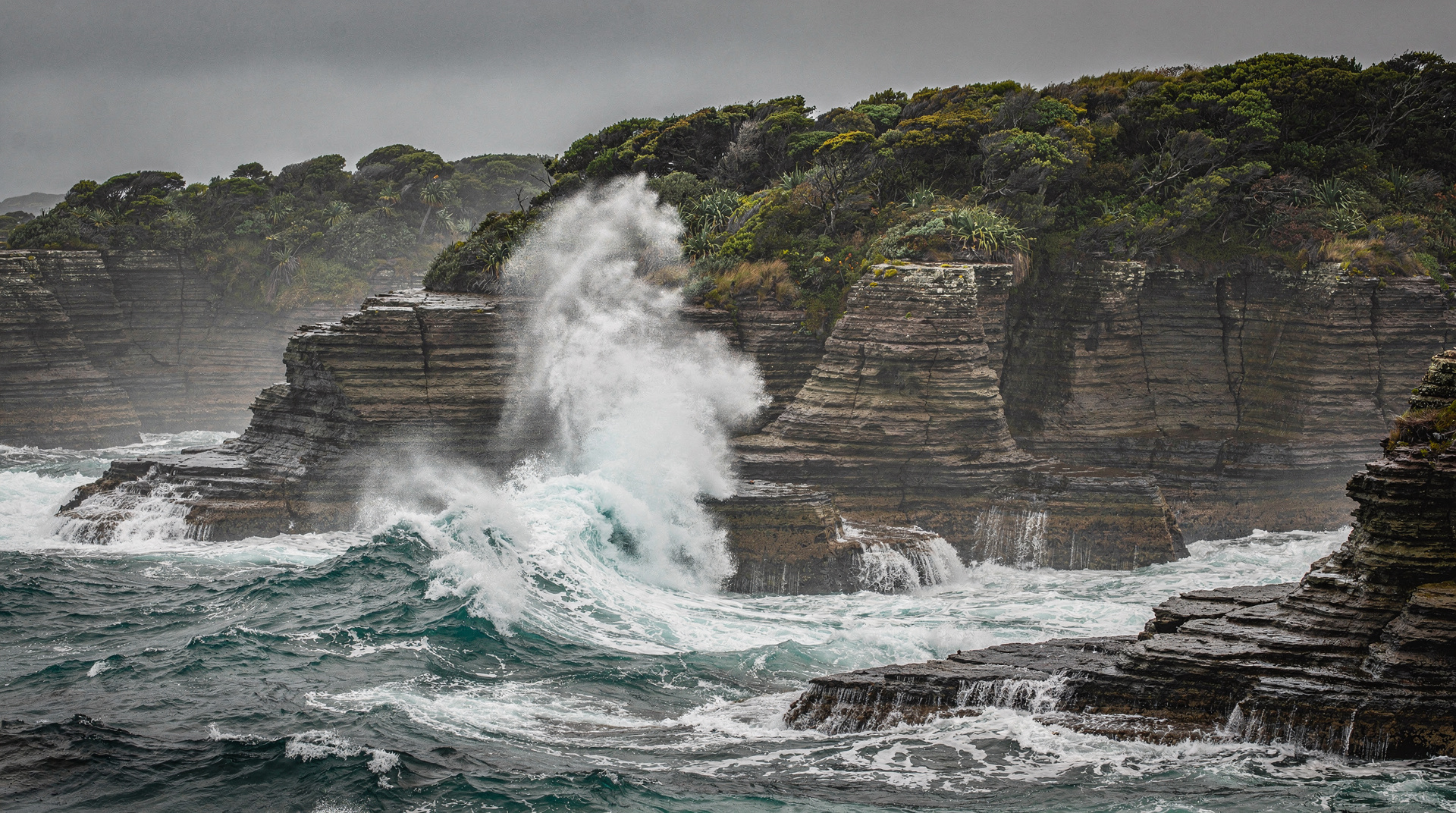
West Coast
Honest West Coast guide: Franz Josef and Fox Glacier heli-hikes, Punakaiki Pancake Rocks, Hokitika, Greymouth. NZD/USD/EUR prices, what's worth it.
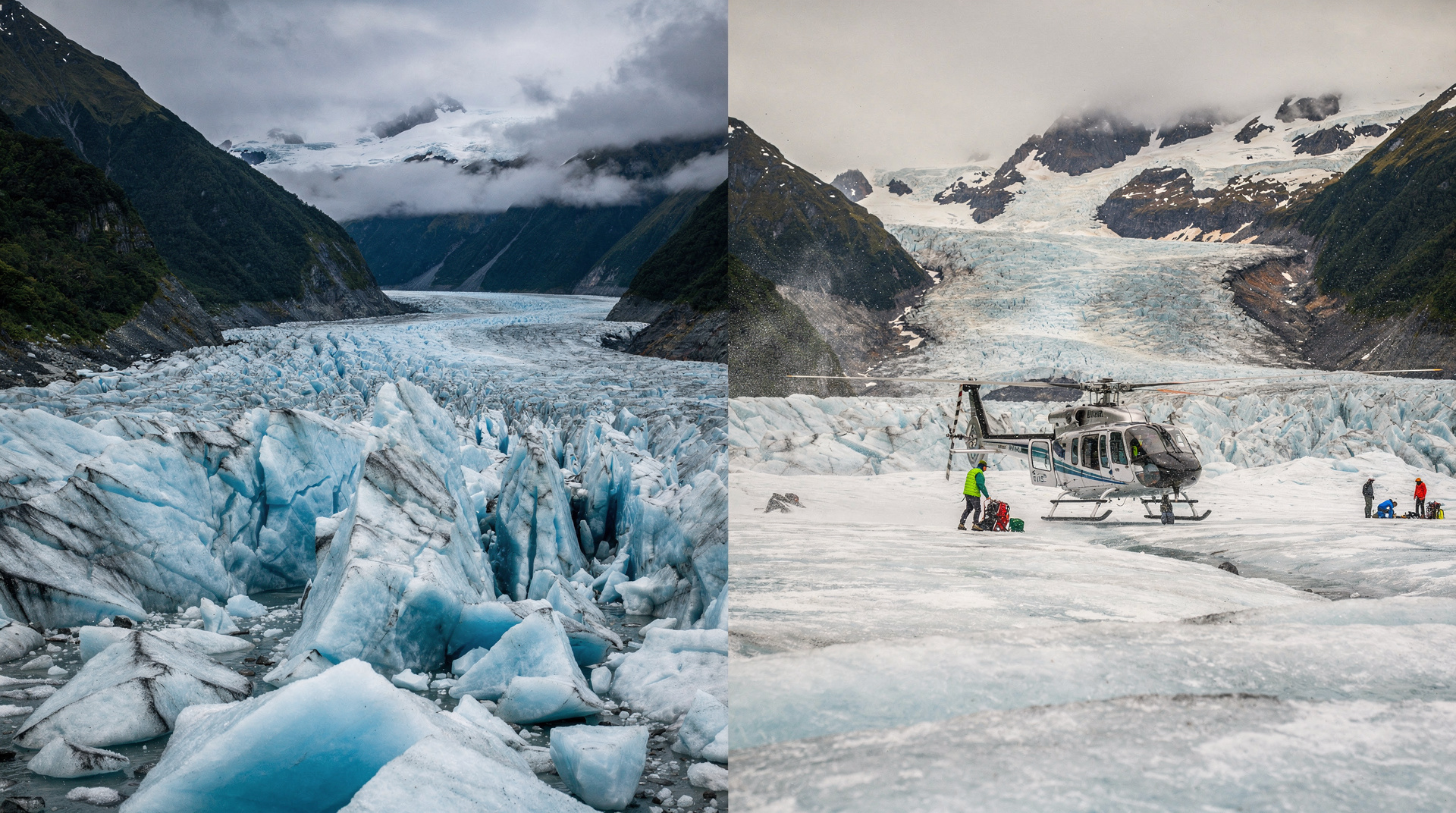
Franz Josef vs Fox Glacier
Honest Franz Josef vs Fox Glacier comparison: heli-hike options, town facilities, Lake Matheson, and which glacier to choose. Prices in NZD/USD/EUR.
West Coast
Honest West Coast guide: Franz Josef and Fox Glacier heli-hikes, Punakaiki Pancake Rocks, Hokitika, Greymouth. NZD/USD/EUR prices, what's worth it.
Arthur's Pass day trip from Christchurch
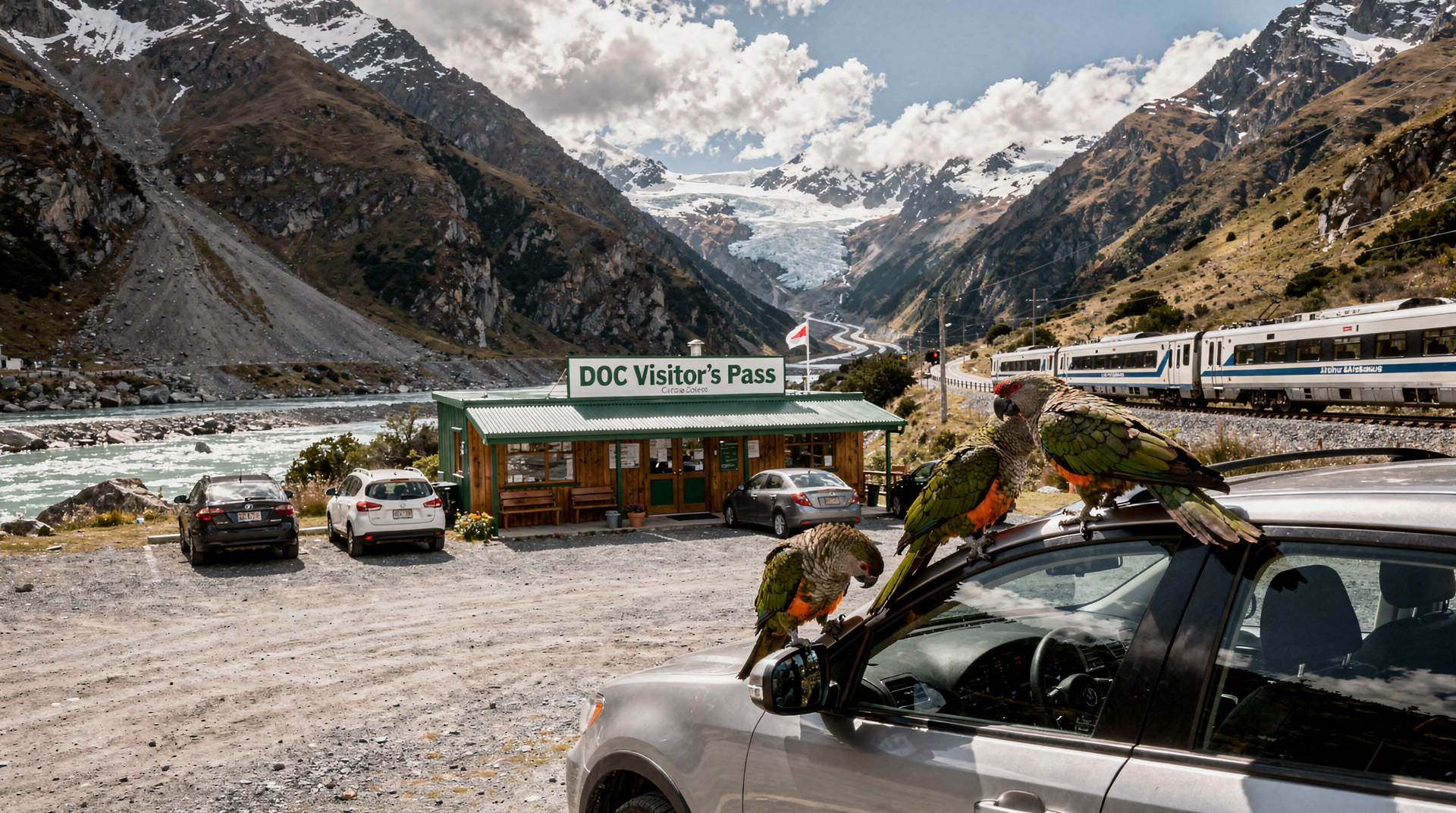
Arthur's Pass day trip from Christchurch: 1.5-hour drive, Castle Hill limestone boulders, kea parrots, alpine hikes, TranzAlpine option.