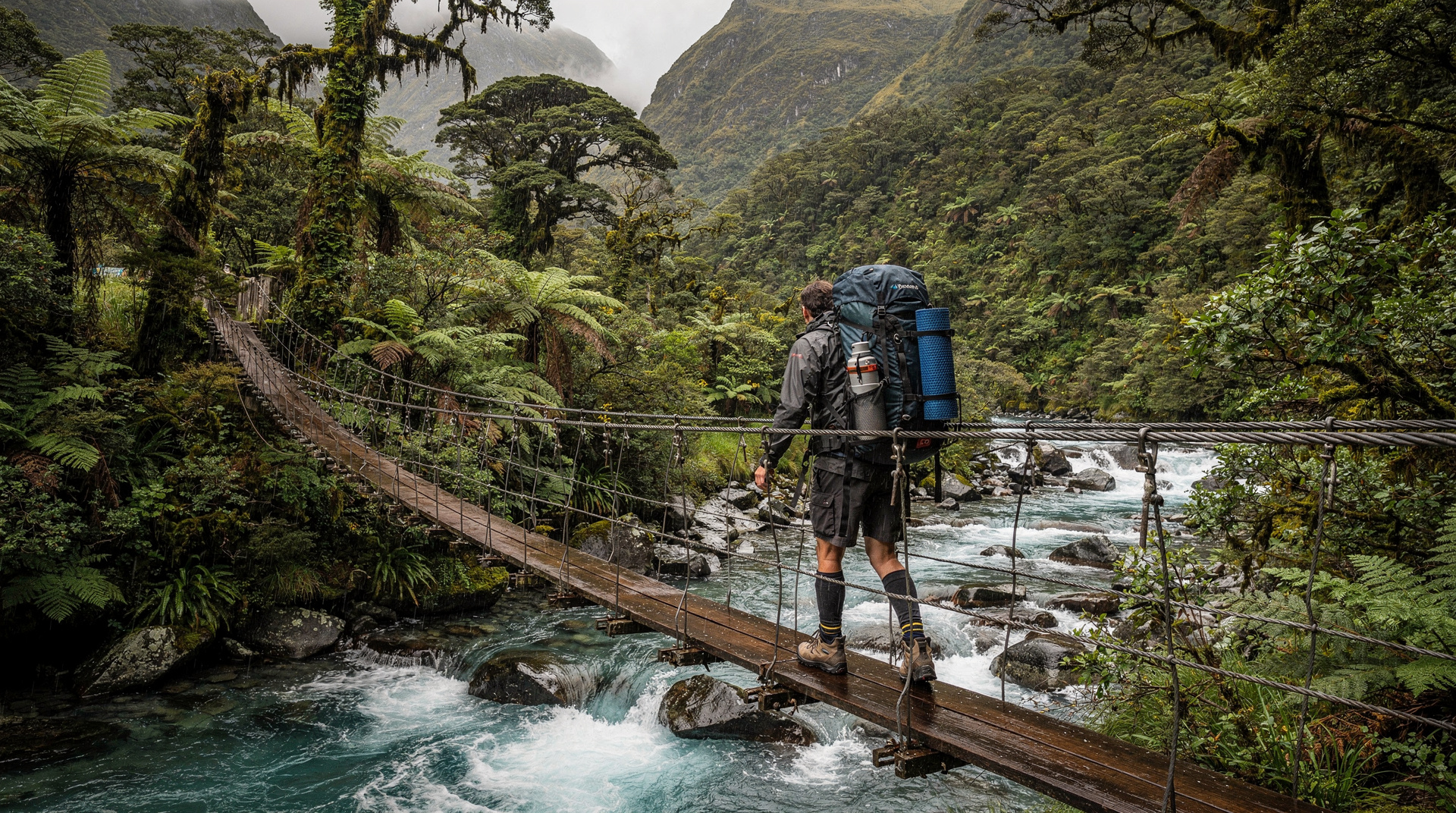
New Zealand Great Walks circuit — 21 days, 5 iconic tracks
New Zealand’s Great Walks — 11 official tracks, 5 covered here
New Zealand has 11 official Great Walks — a DOC-designated category of multi-day tramping routes with serviced or basic huts, maintained trails, and some of the world’s most extraordinary scenery. Doing all 11 in one trip would take 50+ days and hit every corner of both islands. This 21-day circuit covers the five most iconic and accessible Great Walks, building from the coastal warmth of Abel Tasman in the north to the Fiordland wilderness in the south.
The five walks selected:
- Abel Tasman Coast Track (Nelson-Tasman, 3–5 days, any season)
- Tongariro Northern Circuit (Tongariro NP, 3–4 days, October–April)
- Routeburn Track (Otago/Fiordland, 2–4 days, October–April)
- Kepler Track (Fiordland, 3–4 days, October–April)
- Rakiura Track (Stewart Island, 3 days, any season)
Plus the Tongariro Alpine Crossing (technically not a Great Walk but the country’s most famous day walk, covering the same volcanic terrain as the Northern Circuit’s highlights).
| Route | Nelson → Abel Tasman → Tongariro → Queenstown → Routeburn → Kepler → Stewart Island or Milford |
| Total walking distance | Approximately 180 km across 5 Great Walks |
| Total cost (mid-range) | Around NZD 7,040 / USD 4,224 / EUR 3,872 per person |
| Best for | Fit trampers, Great Walks completists, hikers wanting a car-supported hut trip |
| Book ahead | DOC Great Walks huts (April/May for the following season), domestic flights, Stewart Island ferry |
If a full 21-day hiking trip isn’t realistic, the 7-day South Island itinerary and 10-day New Zealand itinerary both include the Tongariro Alpine Crossing as a single-day taste of this terrain.
DOC booking — the critical system
All Great Walks require advance booking through the DOC Great Walks booking system (doc.govt.nz/great-walks-booking). Key facts:
- Booking opens: Generally 6 months ahead for the current season (October–April walks open for booking in April)
- Milford Track: Books out almost immediately when the system opens. The Milford Track hut bookings for December–January are gone within hours of opening. Book the moment the system goes live.
- Abel Tasman: More flexible — season is year-round, and capacity is larger. Huts book more quickly than campsites.
- Kepler and Routeburn: Open October–April. Book 2–4 months ahead for December–January. More capacity than Milford.
- Rakiura Track: Year-round. Less demand than mainland Great Walks. 2–4 weeks ahead usually sufficient except Christmas–New Year.
Hut fees (2026 estimates): NZD 55–80 per person per night at Great Walks huts. The huts include toilets, cooking facilities, and bunks — bring your own food and sleeping bag. Staff a warden in the peak season.
Fitness requirements
This circuit involves approximately 180 km of walking over the 5 tracks. The daily distances range from 12 km to 19.4 km. Some sections are steep (Routeburn Falls, Tongariro Red Crater descent, Kepler’s exposed ridge). You should be comfortable with:
- 5–7 hours of walking per day with a 10–14 kg pack
- Steep uphill and downhill sections on uneven terrain
- Multi-day outdoor conditions including rain and cool temperatures
- Cooking your own food from a lightweight pack
This is not technical mountaineering. No special skills are required. A basic level of fitness and experience with day walks is sufficient. The challenge is endurance over multiple days, not individual difficulty.
Gear: buy, hire, or bring from home
Most trampers on this circuit fly in without full tramping gear and either hire or buy in Nelson or Queenstown, both of which have excellent outdoor retailers.
| Bring from home | Hire in NZ | Buy in NZ | |
|---|---|---|---|
| Sleeping bag | Best if you own a good 3-season bag already | Widely available, NZD 10–15/day | Only worth it if continuing to hike after the trip |
| Backpack (50–65L) | Only if it already fits you well | Common hire item, NZD 8–12/day | Reasonable if gear is otherwise light in your luggage |
| Rain jacket | Bring if you already own a genuinely waterproof one | Less commonly hired | Worth buying — you’ll use it on every track |
| Trekking poles | Optional, bulky to fly with | Cheap to hire, NZD 5/day | Not necessary to own |
| Boots | Bring your own, broken in — this is not a category to improvise | Not recommended to hire boots | Buy early if new, to break them in before Day 3 |
Nelson (MacPac, Kiwi Outdoors) and Queenstown (MacPac, Kathmandu) are the two resupply points built into this route — plan gear gaps around those stops rather than carrying everything from your home country.
Day-by-day breakdown
Days 1–2: Nelson and preparation
- Fly into Nelson (from Auckland 1 hour, or Wellington via Air New Zealand or Sounds Air). Nelson is the gateway to Abel Tasman National Park.
- Day 1: Nelson city — the Saturday market (one of New Zealand’s best artisan markets), the Centre of New Zealand hill walk (30 min, panoramic views), Nelson pubs and craft beer scene.
- Day 2: Gear check and Marahau preparation. Drive (or take the local shuttle) to Marahau (1 hour from Nelson). The park entry is at Marahau. Book water taxi for the end of the track from the operators in the village.
- Gear hire in Nelson: Mountain Equipment, Kiwi Outdoors, or MacPac for anything you’re missing. Lightweight gear (sleeping bag liner, trekking poles, lightweight rain jacket) is critical on the Abel Tasman.
- Accommodation: Nelson mid-range hotel NZD 180–260 / USD 108–156 / EUR 99–143.
- Cost (2 days): NZD 300–450 / USD 180–270 / EUR 165–248.
Days 3–6: Abel Tasman Coast Track (4 days)
New Zealand’s most popular Great Walk runs 60 km along the coast of Abel Tasman National Park — golden sand beaches, turquoise water, forested headlands, and fur seal colonies. The track can be walked in either direction; north-to-south (Wainui to Marahau) is more logical for this itinerary if you end at Marahau to collect your car.
Day 3: Wainui to Awaroa Hut (12.4 km, 4 hours). The first section passes Mutton Cove (fur seals in residence year-round) and the magnificent Separation Point — the dividing line between Tasman Bay and Golden Bay. Stay: Awaroa Hut (Great Walks hut, NZD 55–80 per person, bunk beds, cooking facilities).
Day 4: Awaroa to Bark Bay Hut (17 km, 6 hours). The longest day on the track. The estuary crossing at Awaroa requires tide timing — consult the posted table. Tonga Island (fur seal colony visible from the water) is offshore during this section. Stay: Bark Bay Hut.
Day 5: Bark Bay to Anchorage Hut (12.5 km, 4 hours). Shorter day with more swimming time. The beach at Torrent Bay (tidal estuary, sand spit) is one of the park’s finest swimming spots in summer. Stay: Anchorage Hut or Anchorage campsite (DOC tent site NZD 20–28 per person).
Day 6: Anchorage to Marahau (13.5 km, 5 hours). The final section passes Adele Island (fur seal colony) and the beautiful Apple Tree Bay beach. Return water taxi from Marahau to the car park if finishing early.
Total Abel Tasman: NZD 220–320 for hut fees (4 nights at NZD 55–80/person) plus food and gear.
Days 7–8: Travel to Tongariro
- From Marahau: Drive or shuttle to Nelson Airport (1 hour). Fly Nelson to Auckland (1 hour, NZD 100–180) then Auckland to Rotorua (45 min domestic, NZD 80–140). Or drive to Picton (2.5 hours) and take the Interislander ferry + drive to Tongariro — much slower.
- Day 7: Arrive Rotorua. Rest, resupply, and recover. Rotorua’s Polynesian Spa (NZD 49–75) is the ideal post-Abel-Tasman recovery activity — geothermal pools ease four days of hiking muscles.
- Day 8: Drive south to Tongariro National Park (1.5 hours from Rotorua via Taupo). Stop at Huka Falls (free, 15 min). Check in to National Park Village.
- Tongariro Northern Circuit booking note: The Circuit begins at Whakapapa Village. Check your DOC bookings and hut availability. If the Circuit is not booked (it requires specific hut nights in sequence), the Tongariro Alpine Crossing is an excellent substitute for Days 9–10.
- Cost (2 days): NZD 300–500 / USD 180–300 / EUR 165–275 (flights + accommodation + Polynesian Spa).
Days 9–11: Tongariro Northern Circuit (3 days)
The Tongariro Northern Circuit is a 43 km loop around the active volcanoes of Tongariro National Park. The track crosses the same terrain as the famous Alpine Crossing but adds the spectacular Ketetahi section (thermal springs, views north to Lake Taupo) and the Waihohonu Valley section past the oldest DOC hut in New Zealand.
Day 9: Whakapapa Village to Mangatepopo Hut (9 km, 3 hours). Relatively easy opening day — broad valley, volcanic ash fields, views of Mt Ruapehu and Mt Ngauruhoe. Stay: Mangatepopo Hut (Great Walks, NZD 55–80/person).
Day 10: Mangatepopo Hut to Waihohonu Hut via the Crossing highlights (21 km, 7–8 hours). This is the hard day — the Red Crater ascent (steepest on the crossing at 30 degrees), descent to the Emerald Lakes (vivid green from mineral deposits), Blue Lake (sacred to local Maori iwi — tapu, no swimming), and down to the Waihohonu Valley. Stay: Waihohonu Hut (NZD 55–80/person). The oldest surviving DOC hut in New Zealand is a 10-minute walk away.
Day 11: Waihohonu Hut to Whakapapa Village (14 km, 4 hours). Return through the Tama Lakes (detour adds 1 hour) and down the volcanic plateau. Finish at Whakapapa — return to National Park Village.
Seasonal note: The Tongariro Northern Circuit is open October to April in full hut service. Outside those dates, the huts are still accessible but unstaffed — conditions can be severe, particularly on the exposed crossing section. Do not attempt in snow or ice without alpine experience.
Total Circuit: NZD 165–240 for hut fees (3 nights). Plus food and gear.
Days 12–13: Queenstown and preparation
- Drive from National Park to Queenstown (5 hours via Wellington or directly via Palmerston North — note: does not need ferry for this leg if going direct over the Crown Range). Or fly National Park to Wellington to Queenstown if time is short.
- Day 12: Queenstown arrival. Adventure activity options: Shotover Jet (NZD 169 / USD 101 / EUR 93) or Queenstown Skyline gondola. Resupply for Routeburn and Kepler tracks — excellent outdoor gear stores in Queenstown (MacPac, Macpac, Kathmandu).
- Day 13: Drive to Glenorchy (45 min north of Queenstown) where the Routeburn Track starts. Check the Div Valley Road conditions for the last 20 km of unsealed road to the trailhead.
- Glenorchy and Paradise LOTR day trip from Queenstown (NZD 115–149 / USD 69–89 / EUR 63–82) is an excellent orientation to the Dart Valley that serves as a preview of tomorrow’s Routeburn terrain.
- Stay: Glenorchy or Te Anau (if doing Routeburn from the Te Anau end).
- Cost (2 days): NZD 300–500 / USD 180–300 / EUR 165–275.
Days 14–16: Routeburn Track (3 days)
The Routeburn Track (32 km) runs through Fiordland and Mt Aspiring national parks — two of the world’s most dramatic alpine landscapes. The track can be walked from either end: Routeburn Shelter (near Glenorchy, Queenstown) or The Divide (near Te Anau via the Milford Road). Walking shelter-to-divide (or reverse) requires a shuttle or private pickup at the far end.
Day 14: Routeburn Shelter to Routeburn Falls Hut (18 km, 6 hours). Beech forest, the Routeburn Gorge, and a dramatic waterfall. Falls Hut is perched above the treeline with views south to Fiordland. Stay: Routeburn Falls Hut (Great Walks, NZD 55–80/person).
Day 15: Routeburn Falls Hut to Lake Mackenzie Hut (11 km, 4–5 hours). The alpine section of the track — Harris Saddle at 1,255m, the highest point on the track with views to both the Tasman Sea and Queenstown ranges on a clear day. Lake Mackenzie is extraordinary (turquoise glacial water, beech forest, waterfall). Stay: Lake Mackenzie Hut (NZD 55–80/person).
Day 16: Lake Mackenzie Hut to The Divide (10 km, 3 hours). Shorter day through subalpine shrub and beech forest. The Divide is on the Milford Road — book a shuttle from The Divide to Te Anau in advance (NZD 35–50 / USD 21–30 / EUR 19–27 per person).
Total Routeburn: NZD 165–240 for hut fees (3 nights) plus shuttle. Seasonal note: October to April for full service.
Days 17–19: Kepler Track (3 days)
The Kepler Track (60 km loop) begins and ends at the Te Anau Control Gates, walkable from Te Anau town centre. It is the easiest Great Walk logistically — no shuttles or water taxis, self-contained loop, excellent huts.
Day 17: Te Anau Control Gates to Luxmore Hut (14.5 km, 6 hours). The track climbs steeply from the lake edge through beech forest to the limestone bluffs and subalpine open tops above the treeline. Luxmore Hut sits at 1,085m with panoramic views over Lake Te Anau and the Kepler Mountains. Stay: Luxmore Hut (Great Walks, NZD 55–80/person). The Kepler water taxi shortcut from Te Anau to the Rainbow Reach junction (NZD 20–30, saves 2 hours of lake-edge walking) is available.
Day 18: Luxmore Hut to Iris Burn Hut (18.7 km, 8 hours). The hardest day — the exposed alpine ridge from Luxmore to the Forest Burn Shelter is spectacular but exposed to wind and weather. Check the forecast from Luxmore Hut before departing. The Hanging Valley shelter (4 km from Luxmore) is the last shelter before the ridge — turn back here if conditions are deteriorating. Stay: Iris Burn Hut (NZD 55–80/person).
Day 19: Iris Burn Hut to Te Anau via Moturau Hut (22.8 km, 7 hours). Long final day along the Waiau River flats and lakeside through beech forest. The Moturau Hut is available for an optional extra night, converting the Kepler into a 4-day walk.
Total Kepler: NZD 165–240 for hut fees (3 nights). Seasonal note: October to April for full service.
Days 20–21: Stewart Island/Rakiura (bonus) or Milford Sound
- Option A (for Great Walk completists): Drive from Te Anau to Invercargill (2 hours) and take the Bluebridge passenger ferry from Bluff to Oban, Stewart Island (1 hour, NZD 100–130 return). The Rakiura Track is a 29 km, 3-day loop — but with only 2 days remaining, you can complete one section of the track or focus on the Stewart Island wild kiwi encounter instead.
- Stewart Island wild kiwi encounter (NZD 120–160 / USD 72–96 / EUR 66–88) — guided nocturnal kiwi encounter, arguably the most reliable wild kiwi sighting in New Zealand. Highly recommended.
- Option B (for Milford Sound completists): Drive from Te Anau to Milford (1.5 hours) for a final Milford Sound experience. The Milford Sound 2-hour small boat nature cruise (NZD 85–115 / USD 51–69 / EUR 47–63) on a smaller vessel gets closer to the waterfalls. Or the Milford Sound overnight cruise is the finest Milford experience — from NZD 450/person.
- Fly home from Queenstown or Invercargill to Christchurch or Auckland.
- Cost (2 days): NZD 250–500 / USD 150–300 / EUR 138–275.
Total cost breakdown (21 days, per person)
Exchange rates 2026: 1 NZD = USD 0.60 = EUR 0.55.
| Category | Budget | Mid-range |
|---|---|---|
| Hut fees (15 nights in Great Walks huts) | NZD 900 | NZD 1,200 |
| Other accommodation (6 nights in towns) | NZD 600 | NZD 1,500 |
| Food (town + self-catering on tracks) | NZD 900 | NZD 1,400 |
| Activities (non-walking) | NZD 400 | NZD 900 |
| Rental car (town days + inter-walk driving) | NZD 700 | NZD 1,000 |
| Fuel (approx 3,000 km total) | NZD 240 | NZD 240 |
| Domestic flights (Nelson in, Invercargill or QN out) | NZD 300 | NZD 500 |
| Track shuttles, water taxis | NZD 200 | NZD 300 |
| TOTAL per person | NZD 4,240 | NZD 7,040 |
| USD | USD 2,544 | USD 4,224 |
| EUR | EUR 2,332 | EUR 3,872 |
Great Walks booking strategy
Book as early as possible. Great Walks booking for the October–April season opens in April or May via the DOC website. Set a calendar reminder.
Milford Track is hardest: The Milford Track hut bookings for December–January are typically sold out within days of the system opening. If you want to do the Milford Track (not included in this itinerary as a full 4-day walk), treat it as a separate dedicated trip, not an add-on.
Weather policy: DOC Great Walks huts allow rebooking if tracks are closed due to weather. Routeburn and Kepler are particularly weather-sensitive — the exposed alpine sections are closed or dangerous in severe conditions.
Cancellation: Bookings are cancellable with a full refund up to 7 days before the first hut night. After 7 days, the hut fee is forfeited if not transferred to another walker.
Maori cultural context for the Great Walks
The Great Walks traverse some of New Zealand’s most significant whenua (land). Tongariro National Park is a World Heritage Site for both cultural and natural reasons — the mountains are tapu (sacred) to the Ngati Tuwharetoa iwi. The Tongariro Crossing crosses terrain that includes the Blue Lake/Te Wai Whakaata o te Rangihiroa, a site of deep spiritual significance. The DOC signs at the lake request that visitors do not swim or eat nearby — this is a request based on Maori cultural values, not legal restriction, and should be respected.
Abel Tasman National Park sits in the rohe (territory) of the Ngati Rarua, Ngati Tama, Te Atiawa, and Rangitane iwi. The park’s name is European (Abel Tasman, first European to sight New Zealand in 1642), but the land itself carries much older stories.
On any Great Walk, taking time to read the DOC’s wayside panels about the cultural significance of the landscape adds depth to what might otherwise be experienced as purely a physical challenge.
Frequently asked questions
Do we need previous multi-day tramping experience for this circuit?
Not technical mountaineering experience, but genuine day-hike fitness and comfort carrying a loaded pack for several consecutive days. If you’ve never done an overnight tramp, consider doing the Abel Tasman section first (it’s the easiest and most forgiving of the five) before committing to the harder Kepler and Tongariro sections later in the trip.
What happens if a Great Walk hut booking falls through due to weather?
DOC allows rebooking for weather-related track closures, and Routeburn and Kepler in particular close their alpine sections in severe conditions. Build a buffer day or two into your itinerary if possible — this 21-day circuit is fairly tightly scheduled, so a cancelled day on one track can cascade into missed connections for the next. The Tongariro Crossing in shoulder season blog post has useful detail on how weather affects bookings outside peak months.
Is this circuit better done independently or with a guided tramping company?
Independently is cheaper and how this itinerary is built, but guided options exist for the Milford and Routeburn tracks specifically, staying in private lodges rather than DOC huts, if comfort matters more than budget. For the other three tracks (Abel Tasman, Tongariro, Kepler), independent DOC-hut tramping is the standard approach and what most trampers choose.
Could we shorten this to 14 days by dropping one track?
Yes — Abel Tasman is the easiest to shorten (a 2-night, 2-day version covering the northern half is a reasonable compromise) or drop entirely if coastal walking interests you less than alpine terrain. Dropping Kepler or Routeburn instead is a bigger loss, since both offer scenery genuinely different from anything else on the circuit. Cutting Stewart Island at the end is the least costly trim if time runs short, since the 21-day New Zealand itinerary covers it as a shorter add-on for travellers who aren’t primarily there to hike.
Related guides
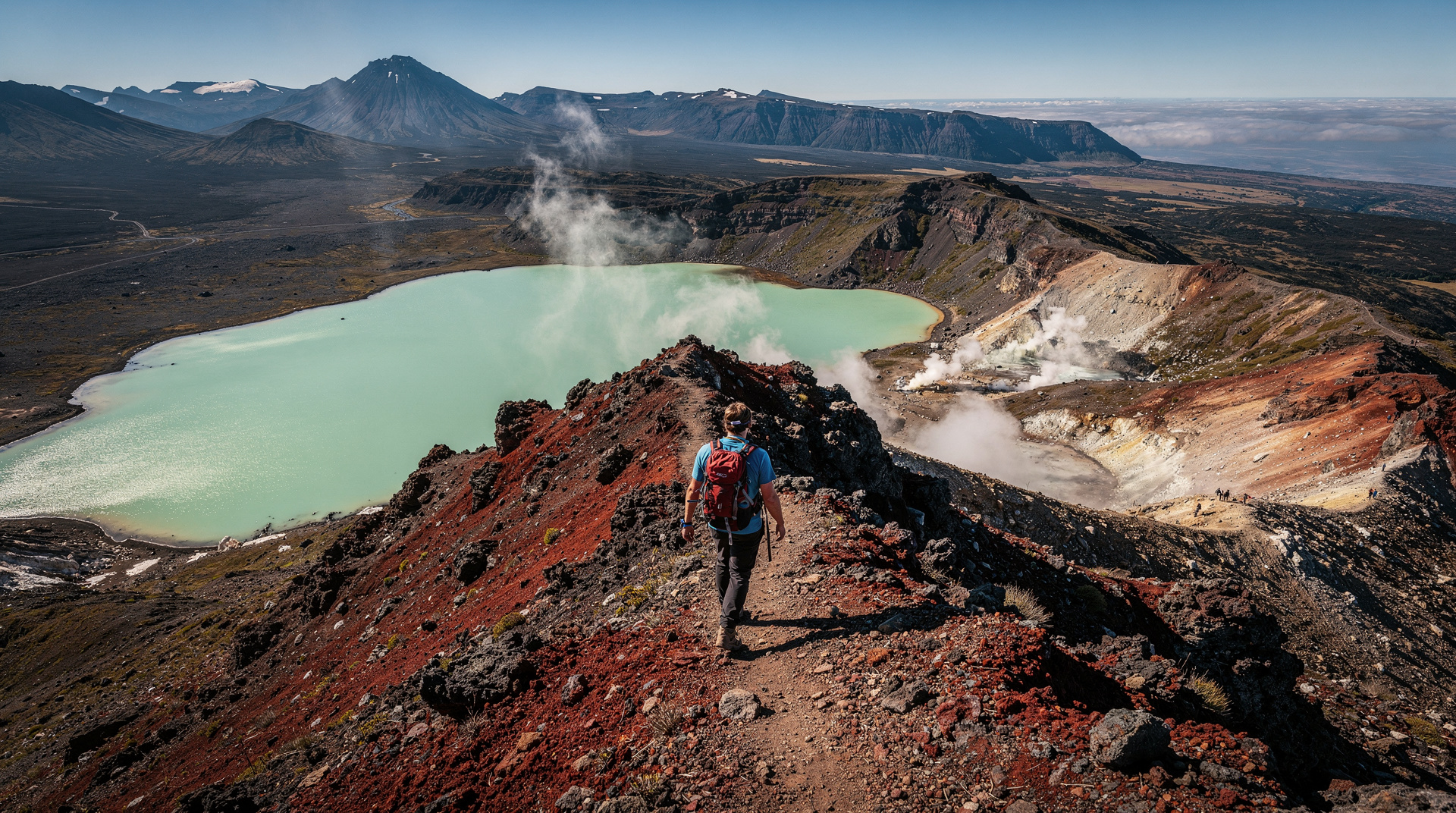
Tongariro Alpine Crossing
Honest Tongariro Crossing guide: 19.4km, 7-9 hours, shuttle logistics, gear, and why winter without a guide has killed people.
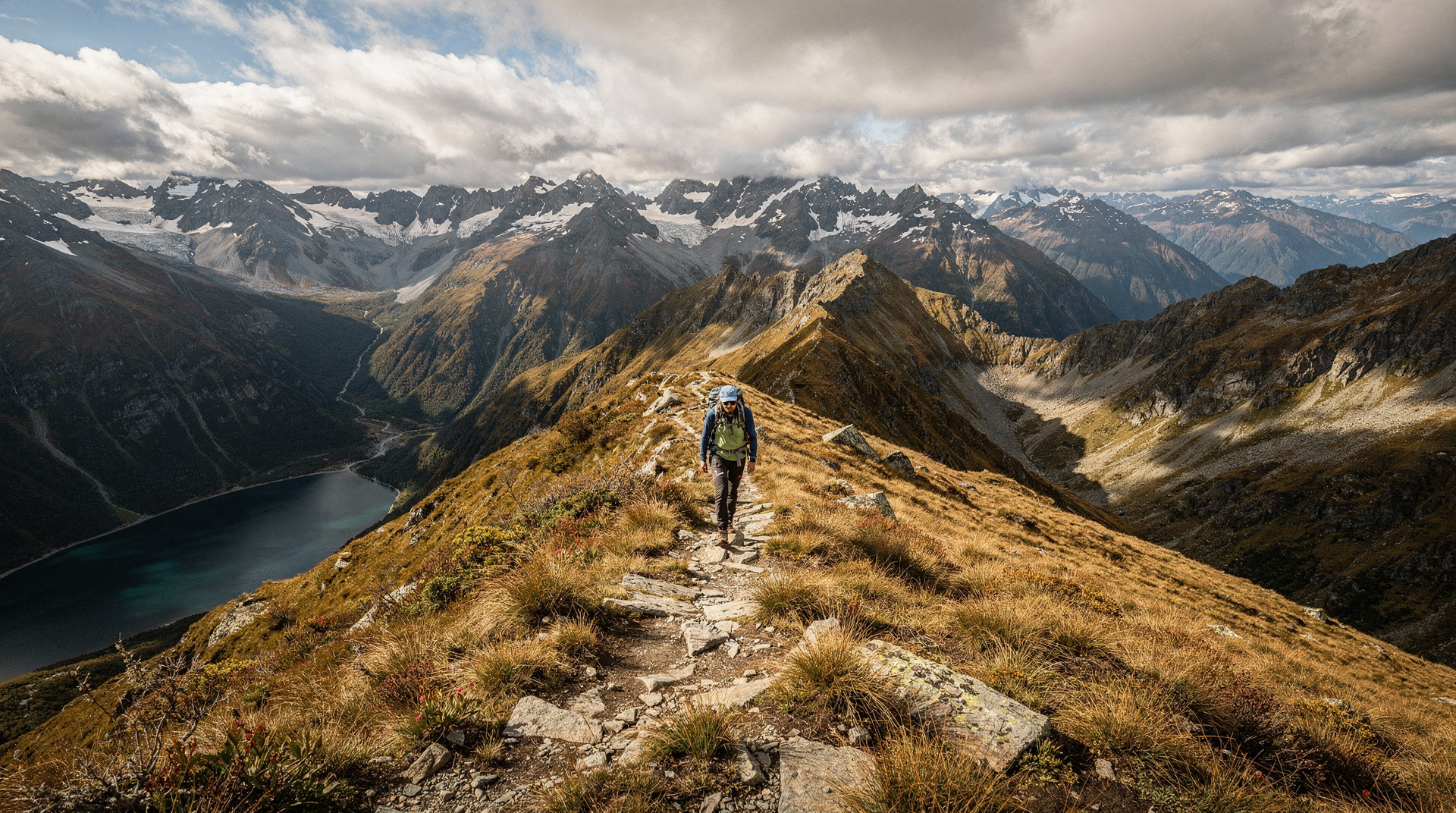
Routeburn Track — Great Walk on the Fiordland-Otago divide
Routeburn Track: 32km, 2-3 days, stunning alpine terrain. Book DOC huts from June. One-way transport required. Full logistics guide with costs.
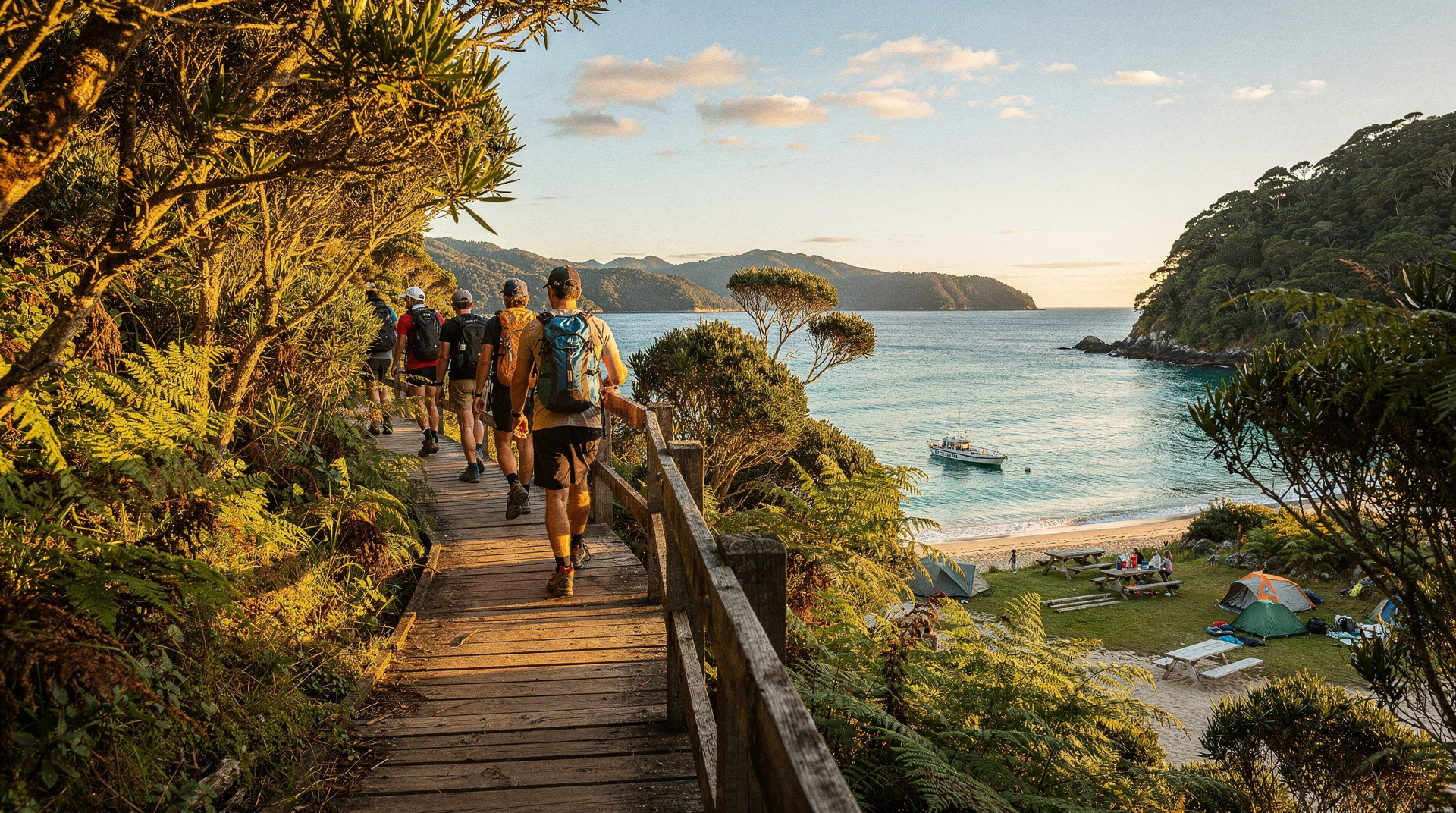
Abel Tasman Coast Track — Great Walk guide
Abel Tasman Coast Track: 60km, 3-5 days, NZD 102/night huts. NZ's most popular Great Walk — golden beaches, clear water, seals. Book months ahead.
Milford Track — the world's finest walk
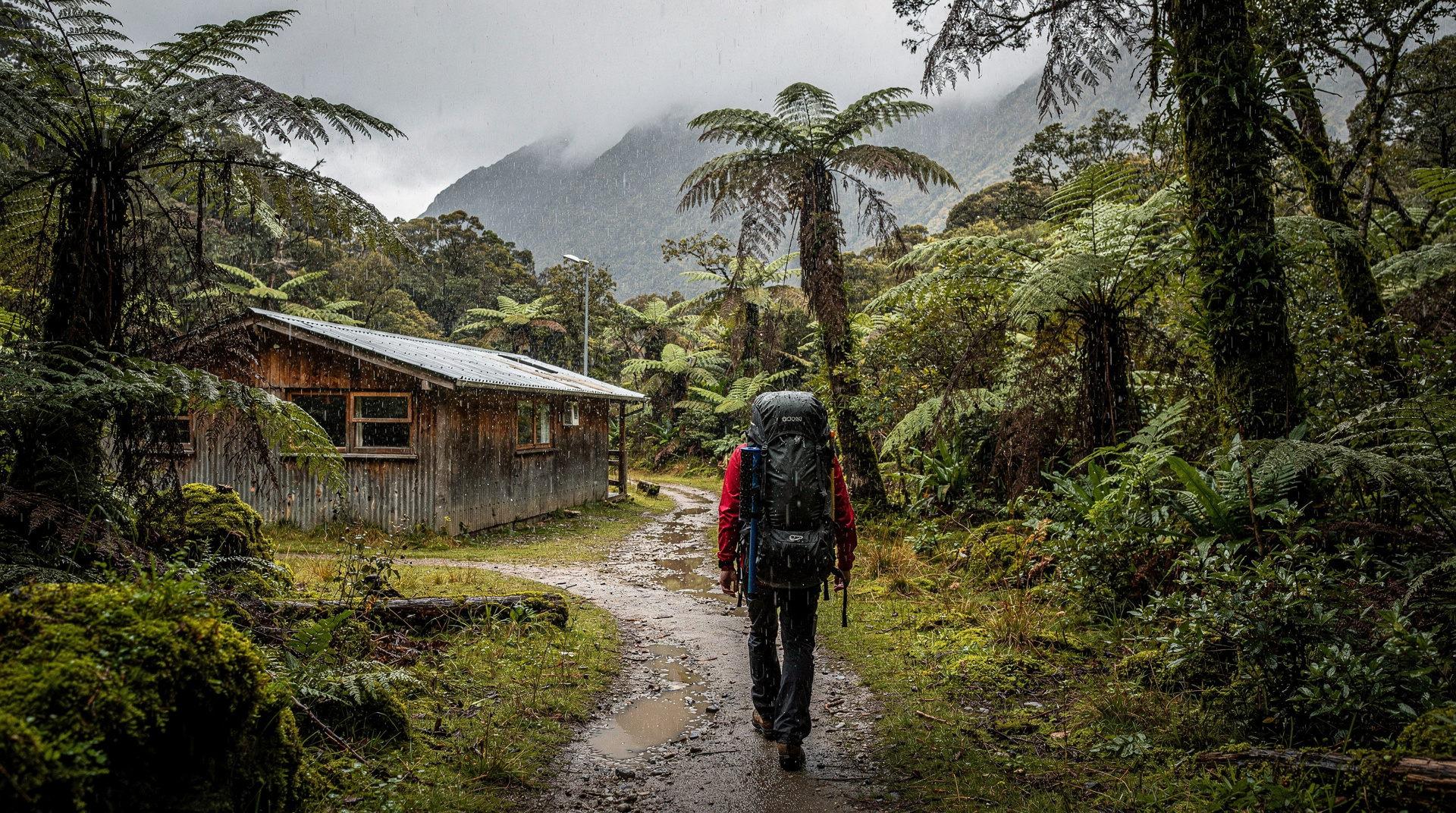
Milford Track: 53.5km, 4 days, one direction only, NZD 102/night huts. Book 6 months ahead. The most famous Great Walk in NZ — worth every step.
Best time to visit New Zealand
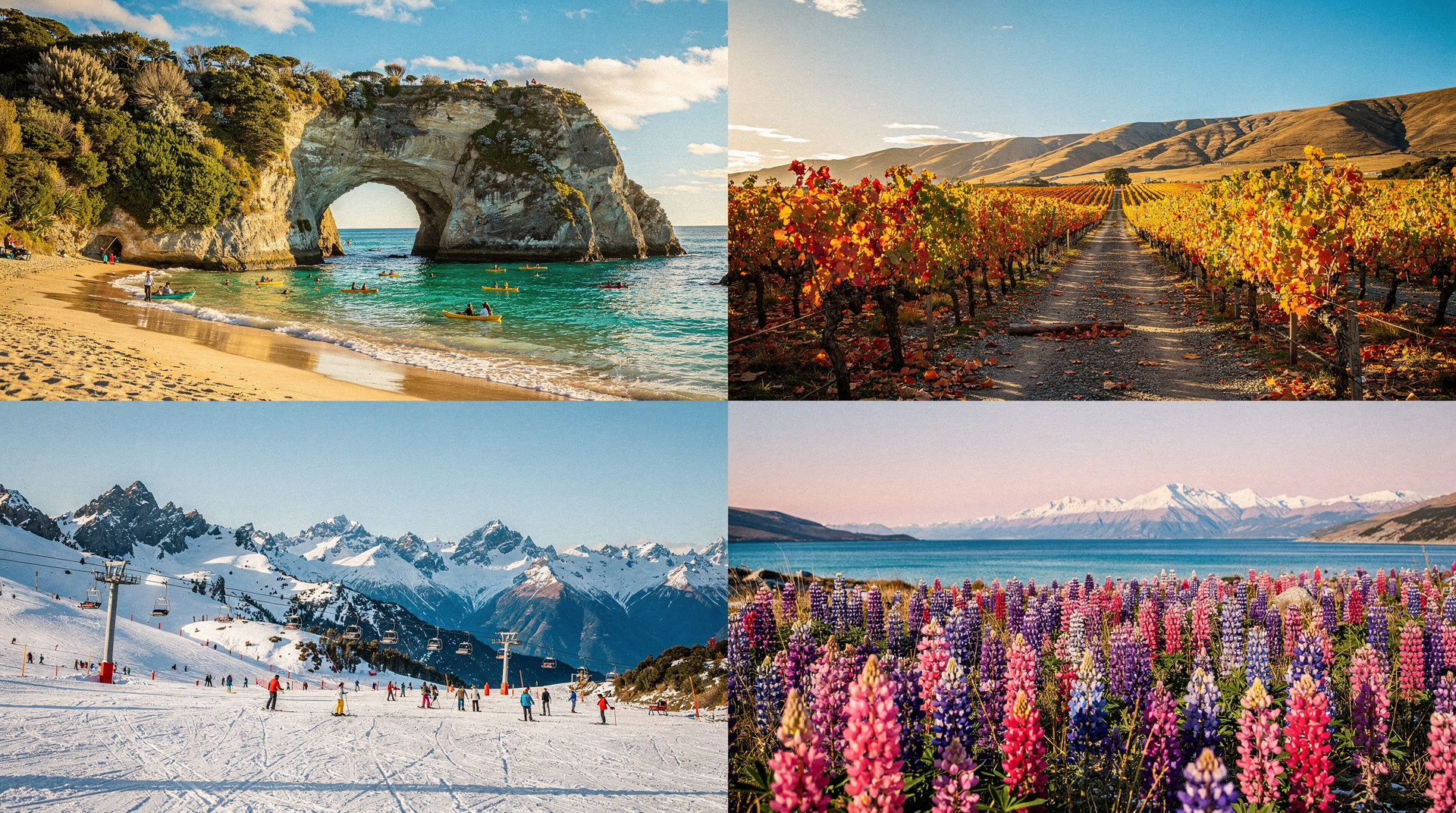
When to visit New Zealand: honest breakdown by season, region, and activity type. Summer is not always best. Spring and autumn often outperform the peak season.
Last reviewed: