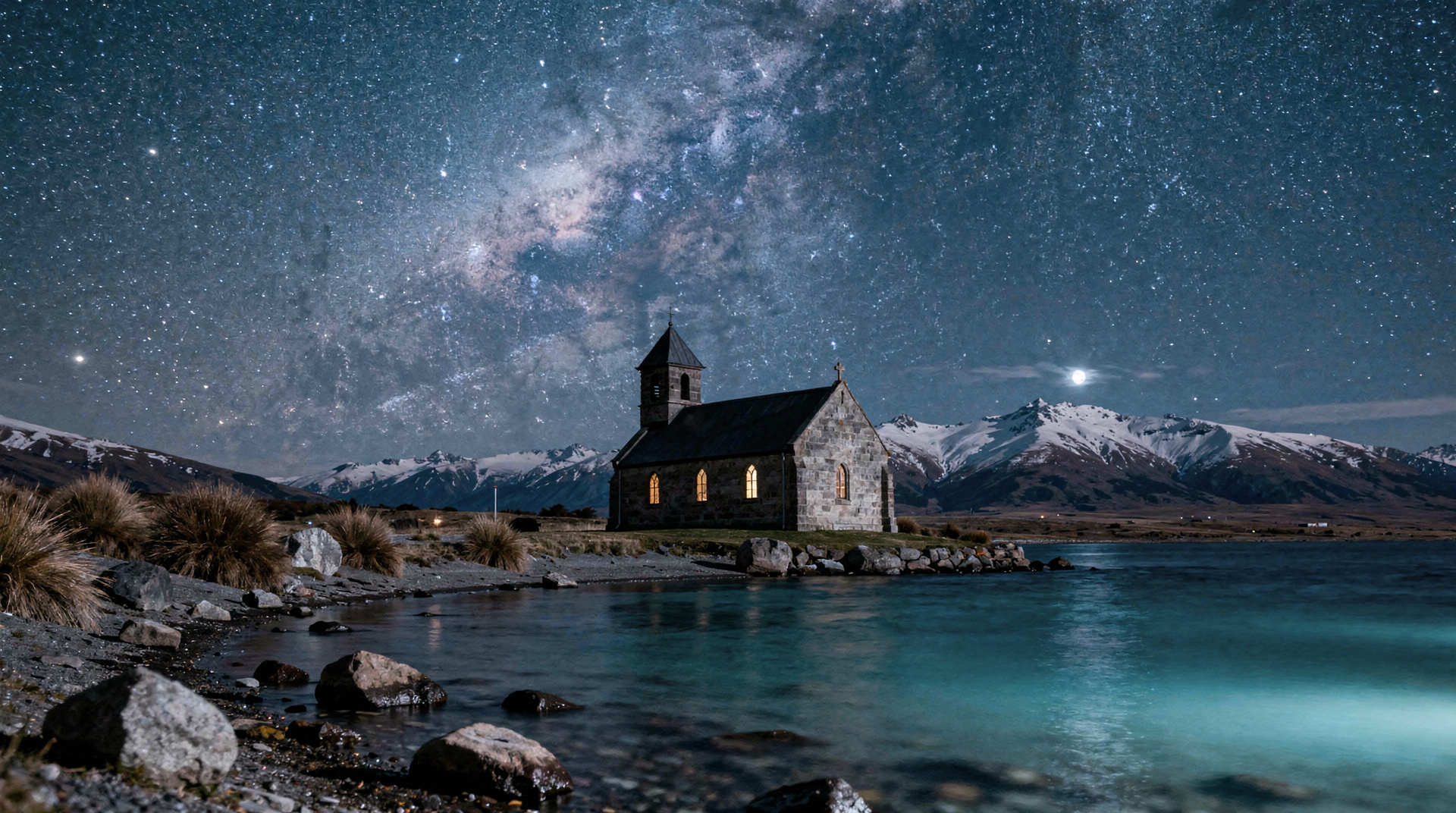
Lake Tekapo
Honest Lake Tekapo guide: stargazing, Church of the Good Shepherd, hot pools — real NZD/USD/EUR costs and how long you actually need here.
Quick facts
- Elevation
- 710m above sea level — part of the Mackenzie Basin
- Drive from Christchurch
- 2.5 hours (225 km, SH1 to SH8)
- Drive from Aoraki / Mt Cook
- 1.5 hours (105 km, SH8 north)
- Currency
- NZD — 1 NZD ≈ USD 0.60 / EUR 0.55
- Dark sky
- Aoraki Mackenzie International Dark Sky Reserve — one of 4 Gold-tier reserves globally
Lake Tekapo — is it worth stopping or just a pretty drive-through?
| Where | Mackenzie Basin, Canterbury, 2.5 hrs from Christchurch |
| Time needed | 1 night minimum for stargazing; 2 nights for the full experience |
| Getting there | Self-drive SH8, or a Queenstown to Tekapo shuttle |
| Cost | Observatory stargazing around NZD 165–195pp; church and Mt John hike free |
| Best time | May–September for peak stargazing; October–April for the turquoise lake |
Popular experiences here
It’s worth stopping. One night gives you the evening stargazing experience (the main reason to come) and a morning walk to the Church of the Good Shepherd. Two nights lets you add hiking on Mt John, the hot springs, and a day trip to Aoraki/Mt Cook without rushing.
The lake itself — that impossibly saturated turquoise-blue colour — is caused by fine rock flour suspended in glacial meltwater. It’s genuinely that colour in real life, not a colour-corrected photo. Standing at the lake edge in the morning light with the Two Thumb Range behind it is one of the straightforward visual rewards of the South Island.
Lake Tekapo sits 2.5 hours from Christchurch and 1.5 hours from Aoraki/Mt Cook on the classic inland tourist route. It’s easy to treat it as a drive-through. Don’t. The difference between passing through at midday and sleeping there (for the night sky) is enormous.
Stargazing — the Mackenzie Basin’s key advantage
The Mackenzie Basin, of which Lake Tekapo is the main hub, is protected as the Aoraki Mackenzie International Dark Sky Reserve. The reserve covers 4,300 km2 with strict outdoor lighting regulations that have been in place since 2012. The result is some of the darkest skies accessible by road in the Southern Hemisphere.
The best way to experience this properly is an observatory tour.
Lake Tekapo: Mountaintop Stargazing at Mount John Summit
Mount John Observatory stargazing tour — small groups (max 12), 2-hour guided session with professional telescopes above Tekapo's minimal light pollution.
From NZD 165–195 / USD 99–117 / EUR 91–107
The Cowan’s Observatory stargazing experience is a slightly more intimate option, using a purpose-built observatory on the edge of town. NZD 85–115 / USD 51–69 / EUR 47–63. Good for those who want a stargazing experience without the transport to the mountain summit.
Lake Tekapo: Indoor Maori Cultural Astronomy Experience
Maori cultural astronomy tour — guided explanation of Maori navigation and seasonal knowledge (Matariki, Southern Cross) alongside Western astronomy.
From NZD 165–195 / USD 99–117 / EUR 91–107
Can you stargaze independently without a tour? Yes — walk 2 km south of the village along the lake edge to escape the minimal town lights, and bring a star map app. On a clear moonless night the Milky Way is visible to the naked eye. The tours add significant value with telescopes and expert commentary, but free stargazing from the lakeshore is a legitimate option.
Best months for stargazing: May to September (longer nights, cleaner air, less moonlight in the mid-winter months). Summer nights (December–February) are shorter and twilight persists until 10pm, reducing the dark-sky window. Winter (June–August) has the longest nights but temperatures drop to -5°C or below. Dress accordingly.
Church of the Good Shepherd
The Church of the Good Shepherd (1935) sits on the lake’s edge with a stone altar window that frames Lake Tekapo and Mt John directly behind it. It is one of the most photographed buildings in New Zealand and genuinely earns its reputation. The building is small (seats about 30 people), Anglican, and is still used for services and private weddings.
Visiting tips: the photogenic angle from outside is from the northwest corner, looking southeast across the lake. Early morning (6–8am) avoids the tour buses and gives the best light. The interior has the altar window view; photography inside is by request but generally discouraged during services.
There is no entry charge. The grounds are open during daylight hours.
Mt John and hiking
Mt John Summit Loop — the main local hike, 10 km return from the village, climbing to the Mt John Observatory summit at 1,029m with 360-degree views over Lake Tekapo, Lake Alexandrina, and the surrounding Mackenzie Basin. Grade 3, 3–4 hours. The trail is well-marked. At the summit: the Earth and Sky observatory buildings, a café (opening hours variable), and the best views of the entire basin. Sunset here is extraordinary.
The 50-minute scenic flight from Lake Tekapo to Aoraki/Mt Cook covers the full Mackenzie Basin, the Tasman Glacier, and the Southern Alps from above. NZD 395–465 / USD 237–279 / EUR 217–256. This is the best aerial introduction to the region if you’re not planning a dedicated scenic flight from Mt Cook Village itself.
Lake Alexandrina — 5 km south of Tekapo village, a smaller, calmer lake that’s excellent for trout fishing and summer swimming. No facilities; bring your own supplies.
Hot springs
Tekapo Springs (on the edge of the town) has three outdoor hot pools heated to 38–42°C with views of Mt John and the surrounding peaks. The pools are excellent after a hiking day and particularly memorable in winter when steam rises and the mountain backdrop is snow-capped. Entry: NZD 32–40 / USD 19–24 / EUR 18–22 for 2-hour sessions. Also has a cold plunge pool, sauna, and in winter, a snow tube park (NZD 25 / USD 15 / EUR 14 for 30 minutes).
Book in advance for evening sessions, which often sell out in peak season.
November lupins — beautiful and controversial
Lake Tekapo’s lupin fields are an aesthetic phenomenon in November, when the Russell lupin (Lupinus polyphyllus) flowers in purple, pink, yellow, and red along the lakeshore and roadsides. The photographs are spectacular and the lake colour with the lupin foreground is one of NZ’s most iconic images.
The conservation context: Russell lupins are an invasive species introduced to New Zealand from North America and are actively managed (culled) by the Mackenzie District Council and DOC. They fix nitrogen and degrade the native golden tussock grassland ecosystem. The lupins are beautiful and ecologically problematic simultaneously. Travel photographers should be aware of this context.
Day trips from Lake Tekapo
Aoraki/Mt Cook — 1.5 hours south on SH8. A full day from Tekapo (early start, Hooker Valley Track, return) is manageable, but a night at Mt Cook is strongly recommended. See the Aoraki/Mt Cook guide.
Christchurch to Tekapo tour — the Lake Tekapo and Mt Cook day trip from Christchurch combines both stops in a single day tour. NZD 185–240 / USD 111–144 / EUR 102–132. Good for those on a tight schedule who can’t overnight in the Mackenzie Basin.
Twizel — 45 minutes south, a service town that’s also the nearest full supermarket to Mt Cook. Not a destination, but useful for supplies.
Where to stay in Lake Tekapo
Budget: YHA Lake Tekapo (NZD 42–65 / USD 25–39 / EUR 23–36 per dorm; excellent lakefront location); Peppertree Lodge (NZD 40–60 / USD 24–36 / EUR 22–33 per dorm; quiet, good kitchen); Lake Tekapo Motels and Holiday Park (NZD 45–75 / USD 27–45 / EUR 25–41 campervan/tent site).
Mid-range: Peppers Bluewater Resort (NZD 295–480 / USD 177–288 / EUR 162–264; full facilities, lake views, well-maintained); Lake Tekapo Scenic Resort (NZD 195–310 / USD 117–186 / EUR 108–171); Tekapo Motels (NZD 165–235 / USD 99–141 / EUR 91–129).
Splurge: Lake Tekapo Lodge (boutique, 5 rooms, excellent breakfast, NZD 395–595 / USD 237–357 / EUR 217–327); The Godley Hotel (heritage lakefront property, NZD 295–425 / USD 177–255 / EUR 162–234).
What to eat
Kohan Japanese Restaurant — the best meal in Tekapo, excellent sashimi and hot dishes, mains NZD 28–48 / USD 17–29 / EUR 15–26. Seems incongruous in a remote high-country town; it’s been operating for 35 years and is legitimately very good.
The Run Bar and Café — casual café with good breakfasts and coffee, NZD 18–28 / USD 11–17 / EUR 10–15.
Peaks Café — lakefront café with reliable lunch menu, NZD 18–32 / USD 11–19 / EUR 10–18. Good for a coffee and the Church of the Good Shepherd views simultaneously.
Cook on the Lake — attached to the Cook at Lake Tekapo accommodation, good evening menu with lake views, mains NZD 32–48 / USD 19–29 / EUR 18–26.
Skip / Worth it / Splurge
⚠ Tourist trap : Paying NZD 60+ for a guided church walk — the Church of the Good Shepherd is free to visit and straightforward to photograph. The guided tours add minimal value for what is essentially a single historical building visit.
✓ Worth it : An observatory stargazing tour (the primary reason to sleep in Tekapo, not just pass through). The Tekapo Springs evening hot pool after a hike. The Mt John loop for the panoramic basin views.
★ Splurge : The 50-minute scenic flight to Aoraki/Mt Cook if you’re not planning a dedicated Mt Cook scenic flight. The aerial view of the Mackenzie Basin and Tasman Glacier is one of the most dramatic things you can do from Tekapo.
Getting to Lake Tekapo from Queenstown
For travelers finishing their South Island loop in Queenstown and heading north toward Christchurch, the Queenstown to Tekapo small group tour (one way) is the most practical option without a rental car — a small-group transfer that covers the Central Otago interior (Cromwell, Lindis Pass) and arrives at Tekapo in time for an afternoon walk and evening stargazing. The group format keeps costs reasonable compared to a private transfer (typically NZD 85–115 / USD 51–69 / EUR 47–63 per person) while still covering the key visual moments of the route.
Cost breakdown
Lake Tekapo costs at a glance
| Item | NZD | USD | EUR | Verdict |
|---|---|---|---|---|
| Church of the Good Shepherd visit Free — go at 6am to avoid tour buses | 0 | 0 | 0 | ✓ Worth it |
| Mt John Summit Loop hike Free, best views of the basin | 0 | 0 | 0 | ✓ Worth it |
| Tekapo Springs hot pools (2 hrs) Book evening sessions in advance | 32–40 | 19–24 | 18–22 | ✓ Worth it |
| Cowan's Observatory stargazing Intimate, no transport to summit needed | 85–115 | 51–69 | 47–63 | ✓ Worth it |
| Mount John Observatory tour (2 hrs) The primary reason to stay overnight | 165–195 | 99–117 | 91–107 | ✓ Worth it |
| Maori cultural astronomy tour Best for cultural context alongside astronomy | 165–195 | 99–117 | 91–107 | ✓ Worth it |
| Queenstown to Tekapo small group transfer Covers Cromwell and Lindis Pass highlights | 85–115 | 51–69 | 47–63 | ✓ Worth it |
| 50-min scenic flight to Aoraki/Mt Cook Best aerial option if skipping Mt Cook flight | 395–465 | 237–279 | 217–256 | ★ Splurge |
How Lake Tekapo fits into your itinerary
Lake Tekapo is almost always a waypoint on the Christchurch–Queenstown inland route, appearing on virtually every 7-day South Island itinerary. The standard sequence: Christchurch → Tekapo (1 night, stargazing) → Mt Cook (1–2 nights) → Queenstown (3+ nights).
For the 14-day New Zealand itinerary, 2 nights at Tekapo works well: one evening for stargazing, one for the hot springs, one day for Mt John, and a morning drive to Mt Cook.
Driving from Christchurch: take SH1 south from the city to Rakaia, then SH77 through Methven (or SH72), joining SH8 at Burke Pass. The total drive is 225 km and takes 2.5 hours. The last 50 km on SH8 along the Tekapo Canal and into the Mackenzie Basin is among the most memorable drives in the South Island.
Lake Tekapo vs. basing at Mt Cook Village or Twizel
Travellers planning the Mackenzie Basin leg often ask whether to base themselves in Tekapo, at Mt Cook Village itself, or in Twizel. Our Mt Cook Village vs Lake Tekapo vs Twizel comparison breaks it down in full, but the short version: Tekapo wins for stargazing infrastructure and the Church of the Good Shepherd; Mt Cook Village wins if the Hooker Valley Track and glacier views are your priority and you don’t want to drive twice; Twizel wins on price and as a supply stop. Many itineraries do both — a Tekapo night for the sky, a Mt Cook night for the mountains.
Frequently asked questions about Lake Tekapo
How many days should you spend at Lake Tekapo?
One night is the minimum that makes sense — you need to be there after dark for the stargazing. Two nights lets you do the Mt John hike (half day), hot springs (evening), stargazing (evening), and a morning visit to the church at sunrise. Day-tripping from Christchurch (225 km) for a few hours misses the main experience entirely.
When is the best time to visit Lake Tekapo for stargazing?
May to September for the longest dark nights. The absolute best conditions are a clear, moonless night in June or July. Summer (December–February) has shorter nights and persistent evening twilight, reducing dark-sky time. Check the moon calendar before booking — a full moon significantly reduces star visibility regardless of cloud cover.
Is the Church of the Good Shepherd always open?
The grounds are generally open during daylight hours. The church interior is open most days except during services (Sunday mornings and occasional weddings). Check the noticeboard at the gate. There is no entry charge.
Why is Lake Tekapo that colour?
Rock flour — ultra-fine particles of rock ground by glaciers and suspended in the glacial meltwater that feeds the lake. The particles scatter blue and green wavelengths of light, creating the intense turquoise colour. The depth and intensity varies with temperature and season (the colour intensifies in summer when glacier melt is highest). It is not artificially enhanced.
Can you swim in Lake Tekapo?
The lake is cold year-round — typically 12–16°C in summer. Swimming is possible but not widely practiced by locals. The Tekapo Springs hot pools are the better option for a water experience. Some visitors swim at the main beach on hot summer days.
The Mackenzie Basin — agricultural and landscape context
Lake Tekapo sits within the Mackenzie Basin, a high-altitude tussock plateau ringed by the Southern Alps. The basin is named after James Mackenzie, a 19th-century shepherd who allegedly hid stolen sheep in the remote inland location for months before being discovered. The Mackenzie Country, as it’s also known, has been farmed since the 1860s and remains one of the most distinctive agricultural landscapes in New Zealand — vast merino sheep and cattle stations, irrigation canals cutting across the tussock, and the persistent nor’west wind that characterises the basin.
The irrigated Mackenzie is increasingly under cultivation (grain and vegetable crops) due to irrigation schemes from the Tekapo and Ohau rivers. This agricultural intensification has been controversial — the tussock grassland ecosystem is significant habitat for native species and the visual character of the basin is tied to the golden tussock. Understanding this context adds depth to the dark sky reserve story: the lighting regulations were introduced partly to protect the agricultural character of the basin (reduced light spill is valued by farmers too) as well as the observatory astronomy.
The Alpine Stargazing experience at Tekapo is an additional option for visitors who want a dedicated multi-hour observing session beyond the standard observatory tours. NZD 195–250 / USD 117–150 / EUR 107–138. Includes access to premium telescopes and extended observing time.
Practical logistics for Lake Tekapo
Petrol: available in Tekapo township. Next petrol heading south is Twizel (45 km). Fill up before driving toward Mt Cook, as Twizel is the last fuel before the Mt Cook access road (additional 66 km).
ATM and banking: one ATM in Tekapo; use it before heading to Mt Cook, which has no banking facilities.
Mobile coverage: patchy in Tekapo, non-existent on the Mt Cook road and in the village itself. Download offline maps before leaving Tekapo. The DOC visitors centre at Mt Cook has a phone for emergencies.
Camping: the Lake Tekapo campground (DOC-managed, lakefront, NZD 18–25 / USD 11–15 / EUR 10–14 per person) is a beautiful site in summer. Freedom camping near the town is not permitted — the council enforces this. The official campsite is worth the fee for the lakefront position.
Lake Tekapo in Maori tradition
The Tekapo area has a significant Ngai Tahu history as a mahinga kai (food gathering) site. The lake and its tributaries held native fish (particularly upland bully and shortjaw kokopu, small native fish endemic to the high country), and the surrounding tussock supported seasonal hunting by tangata whenua traveling through the Mackenzie Basin.
The place name Te Kap-o comes from the Maori phrase “tehe-apo” sometimes interpreted as “the night of glowing water” — a possible reference to the lake’s luminescent appearance under moonlight or starlight, or to the bioluminescent microscopic organisms that occasionally glow in still water at night. The connection between the Maori name and the contemporary dark sky designation is coincidental but resonant.
Ngai Tahu’s Treaty of Waitangi settlement (1998) gave the iwi customary rights over several high-country lakes including Lake Tekapo, along with the right to authorise water take and commercial activity. The iwi works with the Mackenzie District Council on resource consent processes that affect the lake’s catchment. Understanding this regulatory context helps explain why the dark sky reserve’s lighting regulations have the backing of both the local council and Ngai Tahu — both have an interest in preserving the basin’s natural character.
The science at Mt John Observatory
The Mt John University Observatory (MJUO) has been operating since 1965, making it one of the longer-running astronomical research stations in the Southern Hemisphere. It is operated by the University of Canterbury and its location — at 1,029m, above the temperature inversion layer that traps moisture near the valley floor, with minimal light pollution and excellent seeing conditions — makes it scientifically productive.
The observatory has contributed to the PLANET collaboration (a network of telescopes using gravitational microlensing to detect exoplanets), has discovered several new asteroids, and monitors variable stars. The commercial stargazing tours that use the site at night operate around the research programs — on nights when the research telescopes are in use, commercial observers use different instruments. This dual-use arrangement is worth noting: you’re visiting a functioning research observatory, not a purpose-built tourist attraction.
Should I do Tekapo or Queenstown for stargazing on a South Island trip?
Tekapo, without much debate. Queenstown has more light pollution from the town itself and no Gold-tier dark sky designation; Tekapo’s Mackenzie Basin protection makes it the country’s dedicated stargazing destination. If you’re deciding between the two towns generally rather than for astronomy specifically, Queenstown vs Wanaka covers that broader comparison.
Top experiences: Lake Tekapo
See all →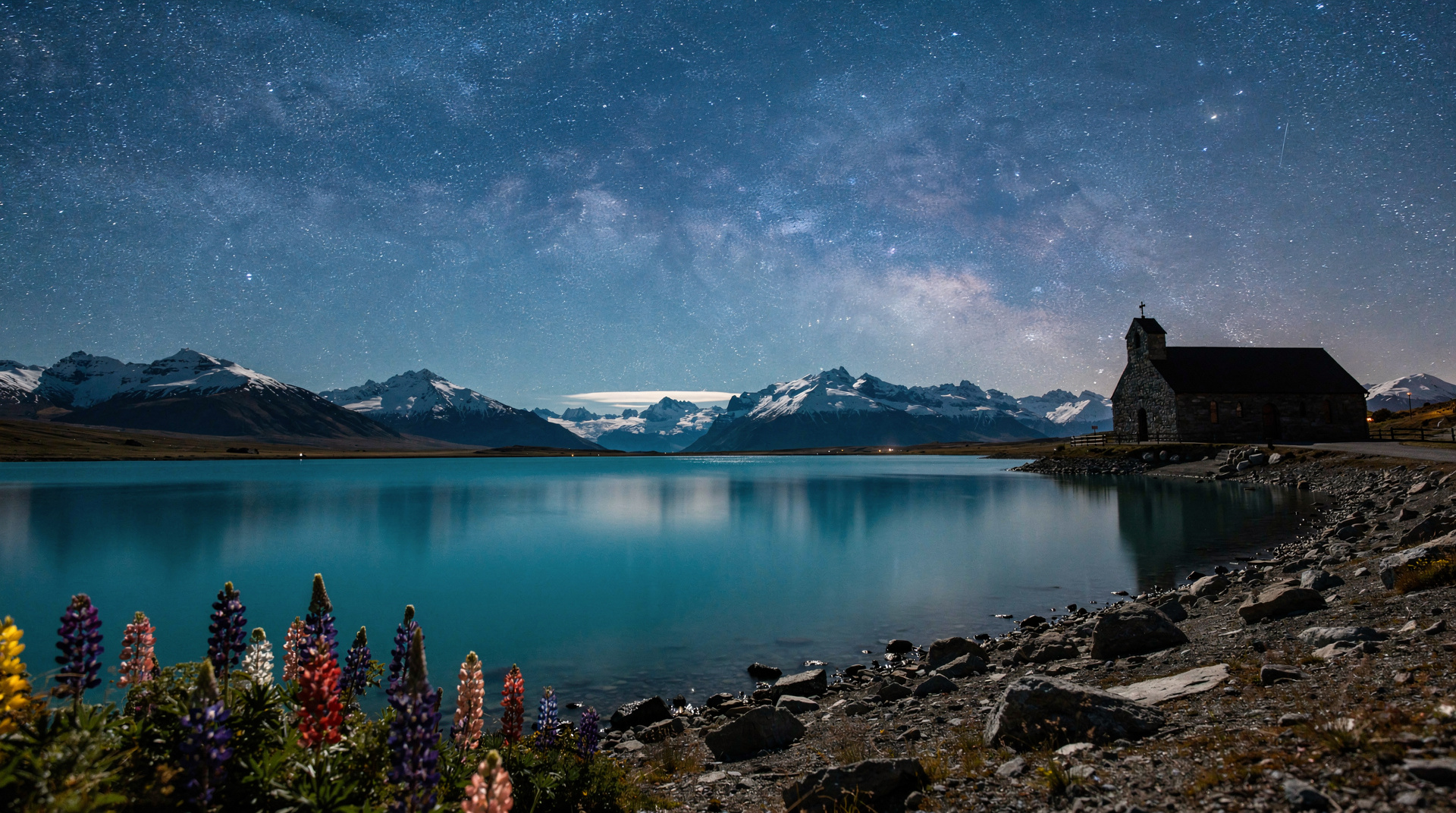
Related guides
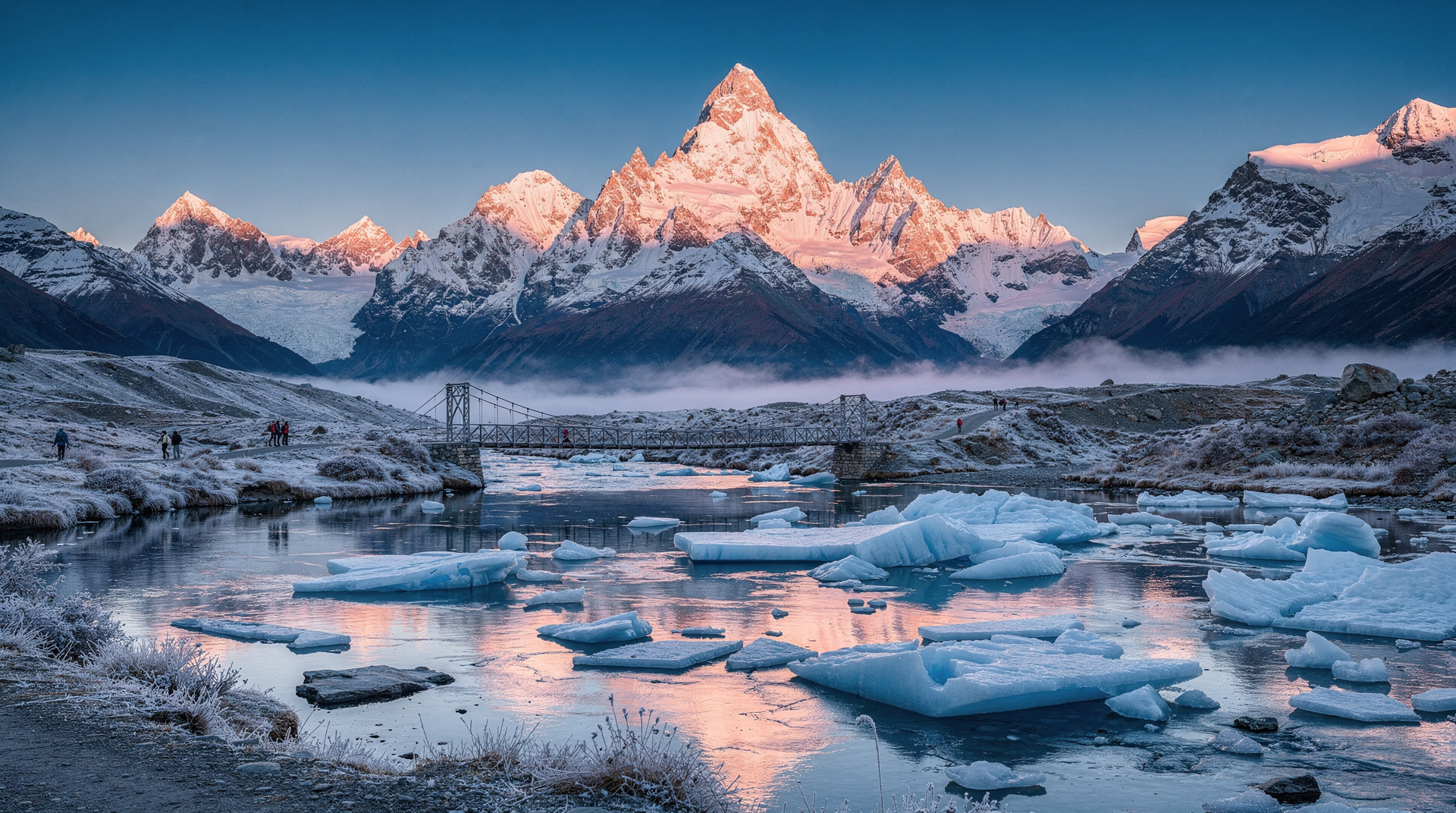
Aoraki / Mount Cook
Honest Aoraki / Mount Cook guide: Hooker Valley Track, Tasman Glacier, scenic flights — real NZD/USD/EUR prices and what to expect in all seasons.
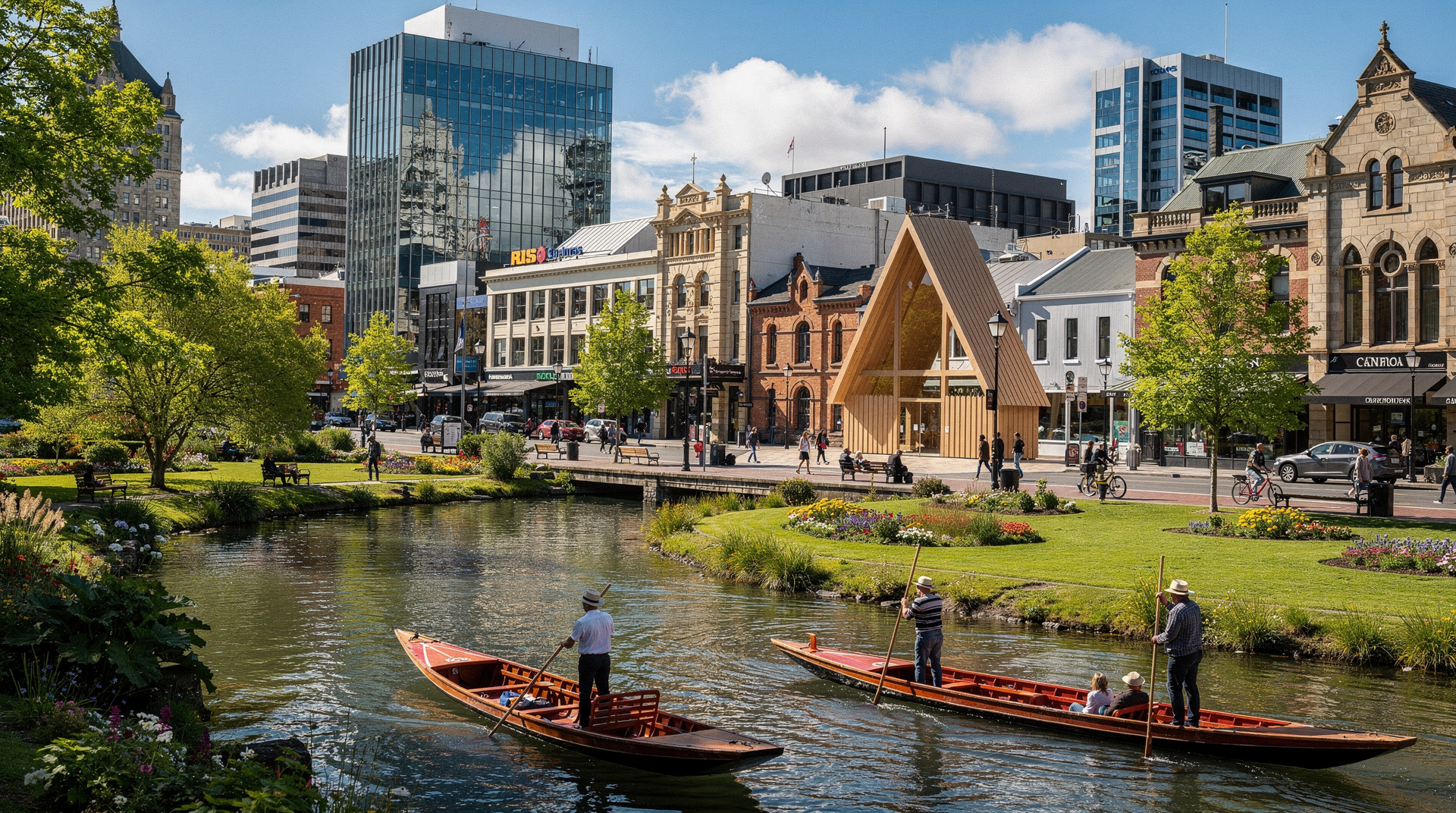
Christchurch
Honest Christchurch guide: the post-earthquake rebuild, best activities, Akaroa day trip — real NZD/USD/EUR prices and what's worth your time.
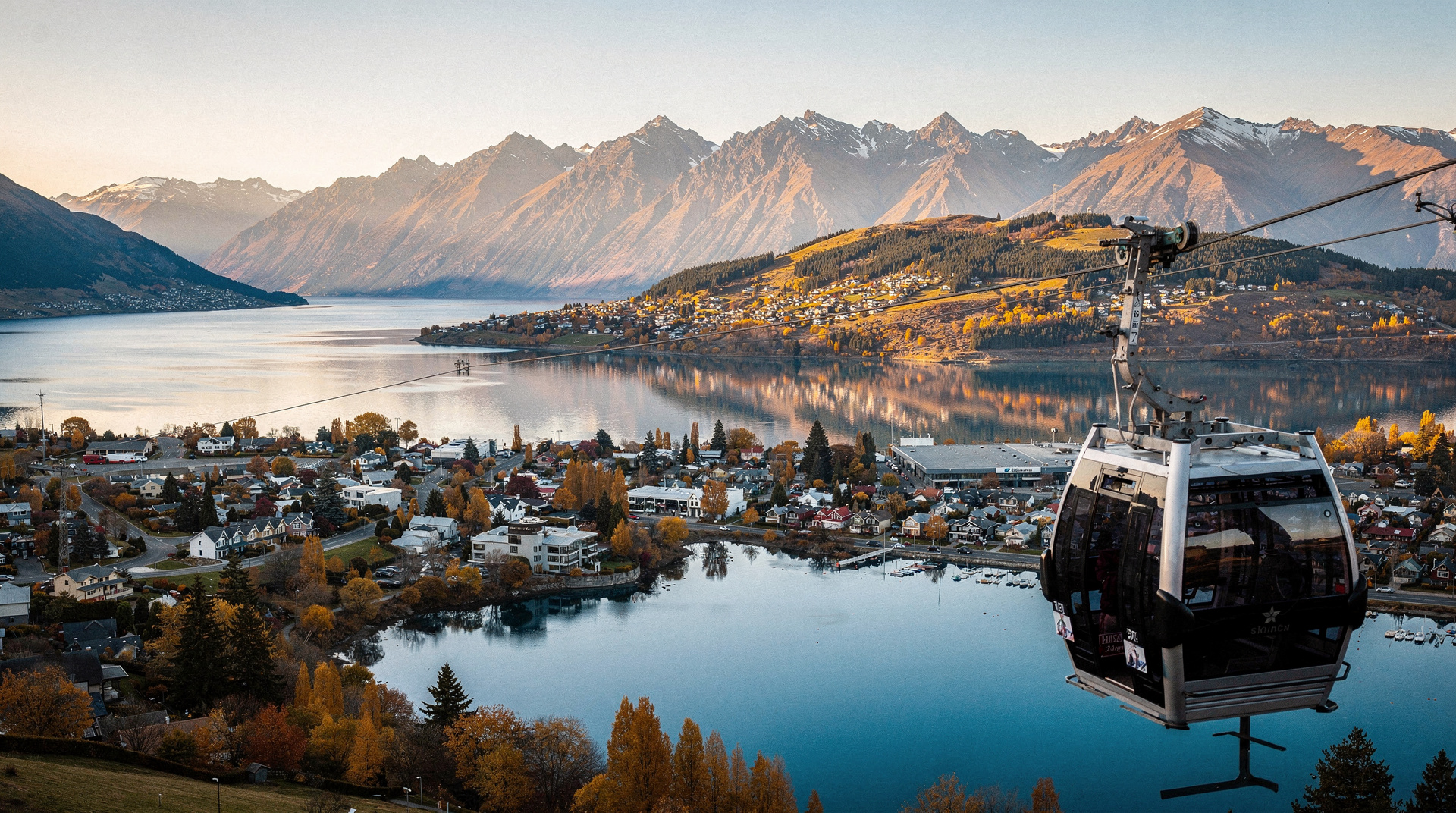
Queenstown
The honest Queenstown planner: bungy, jet boat, ski, scenic flights — real prices in NZD/USD/EUR, what to skip and what's worth your money.
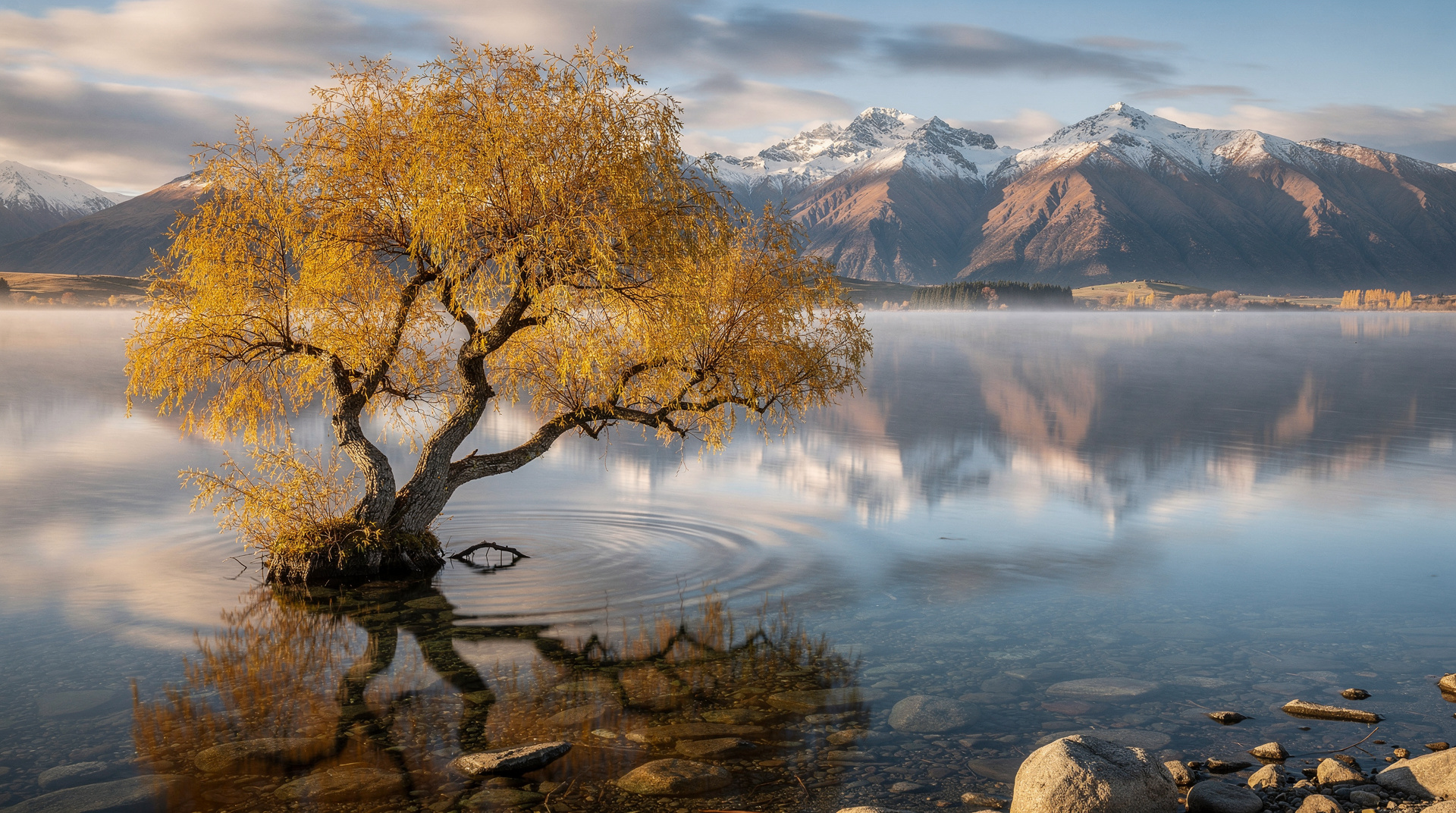
Wanaka
Honest Wanaka guide: Roy's Peak, Cardrona ski, lake kayaking — real NZD/USD/EUR costs and the honest Queenstown vs Wanaka verdict.
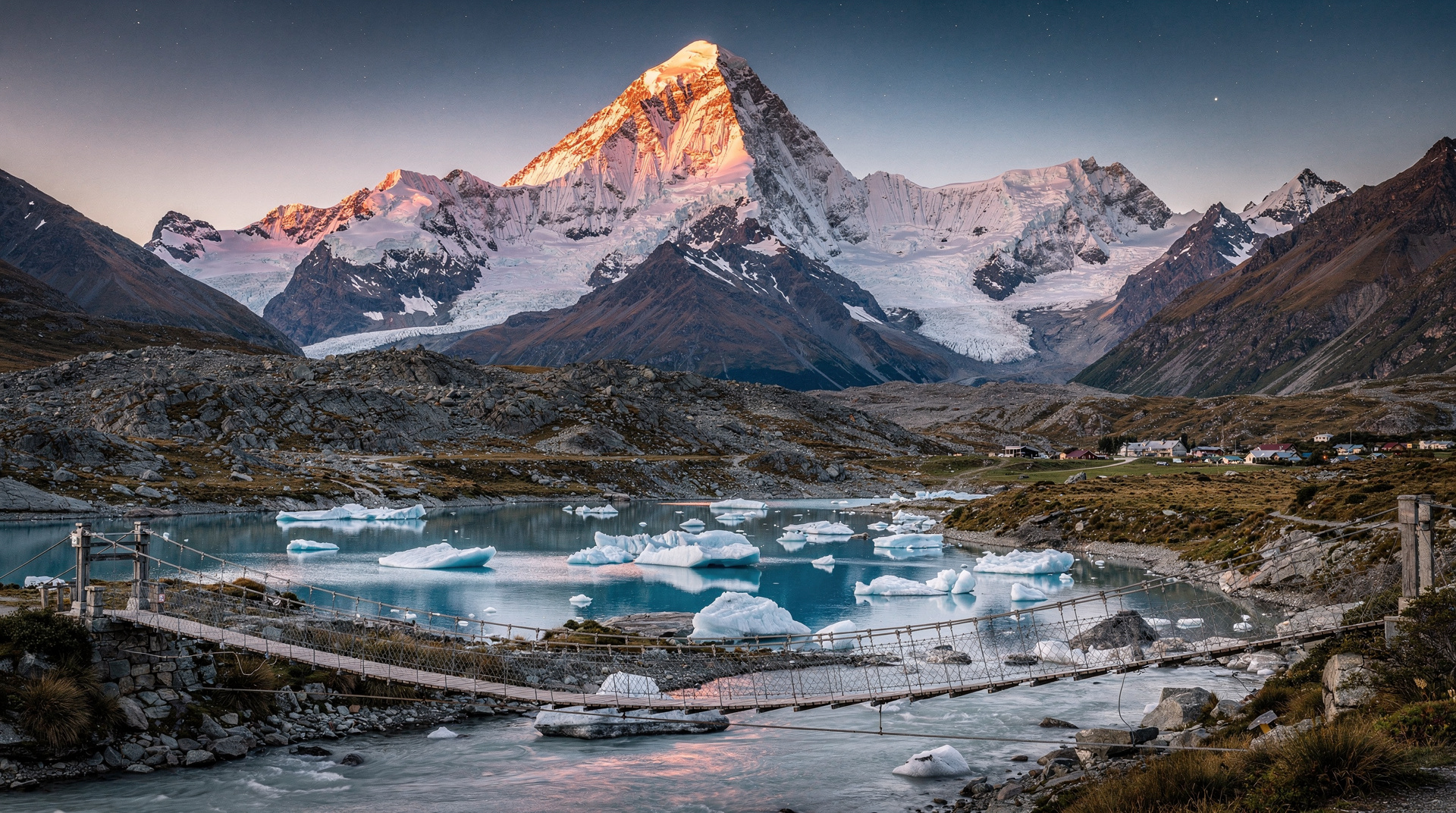
Aoraki/Mt Cook — complete visitor guide
Aoraki/Mt Cook complete guide: Hooker Valley Track, Tasman Glacier heli-hike, stargazing, accommodation. NZ's highest peak 3724m. Plan your visit.
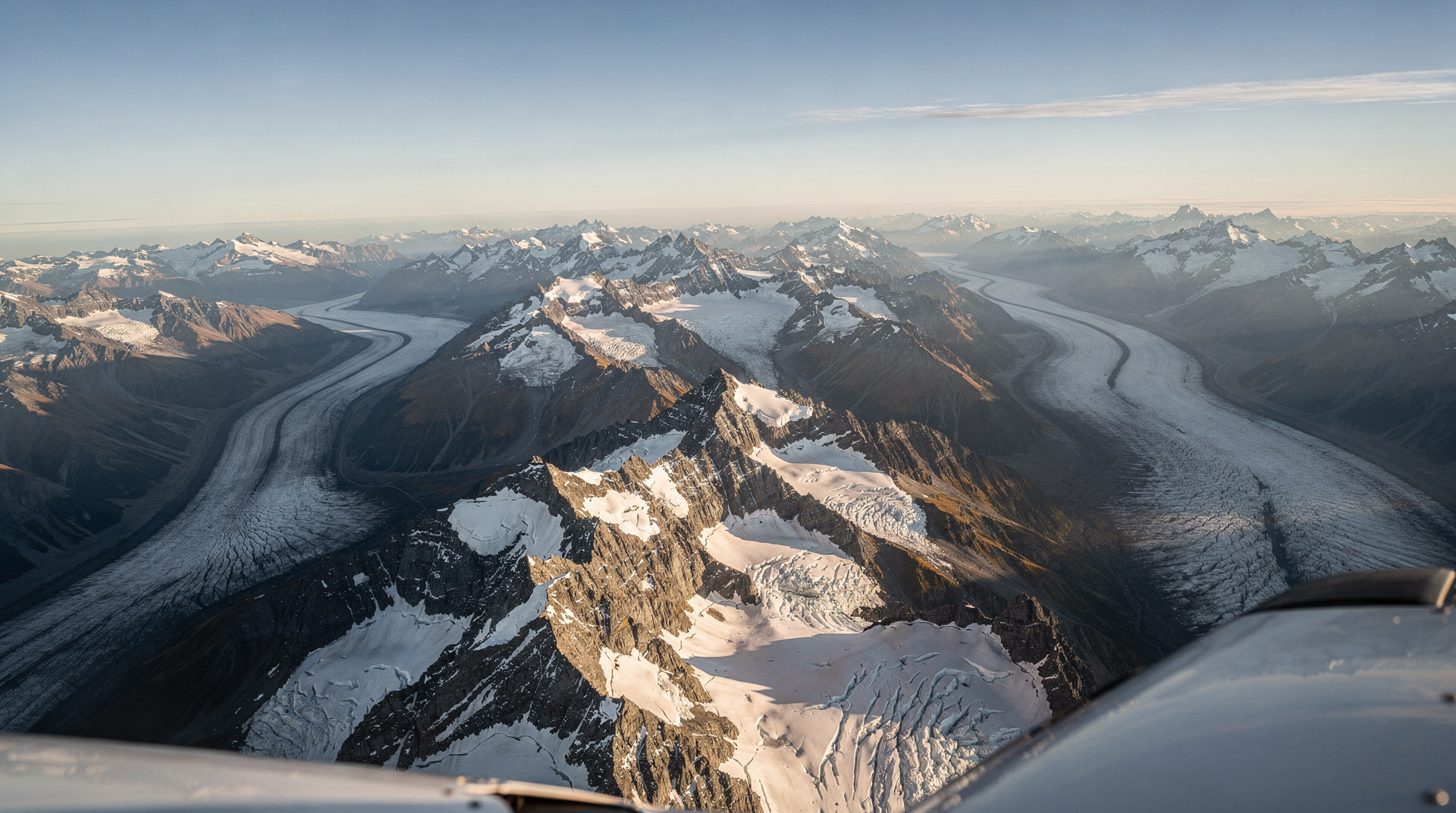
Aoraki/Mt Cook scenic flights and ski planes — the complete guide
Ski planes on Tasman Glacier and helicopters over Aoraki/Mt Cook: operators, NZD/USD/EUR prices, heli-hike options and honest verdict.
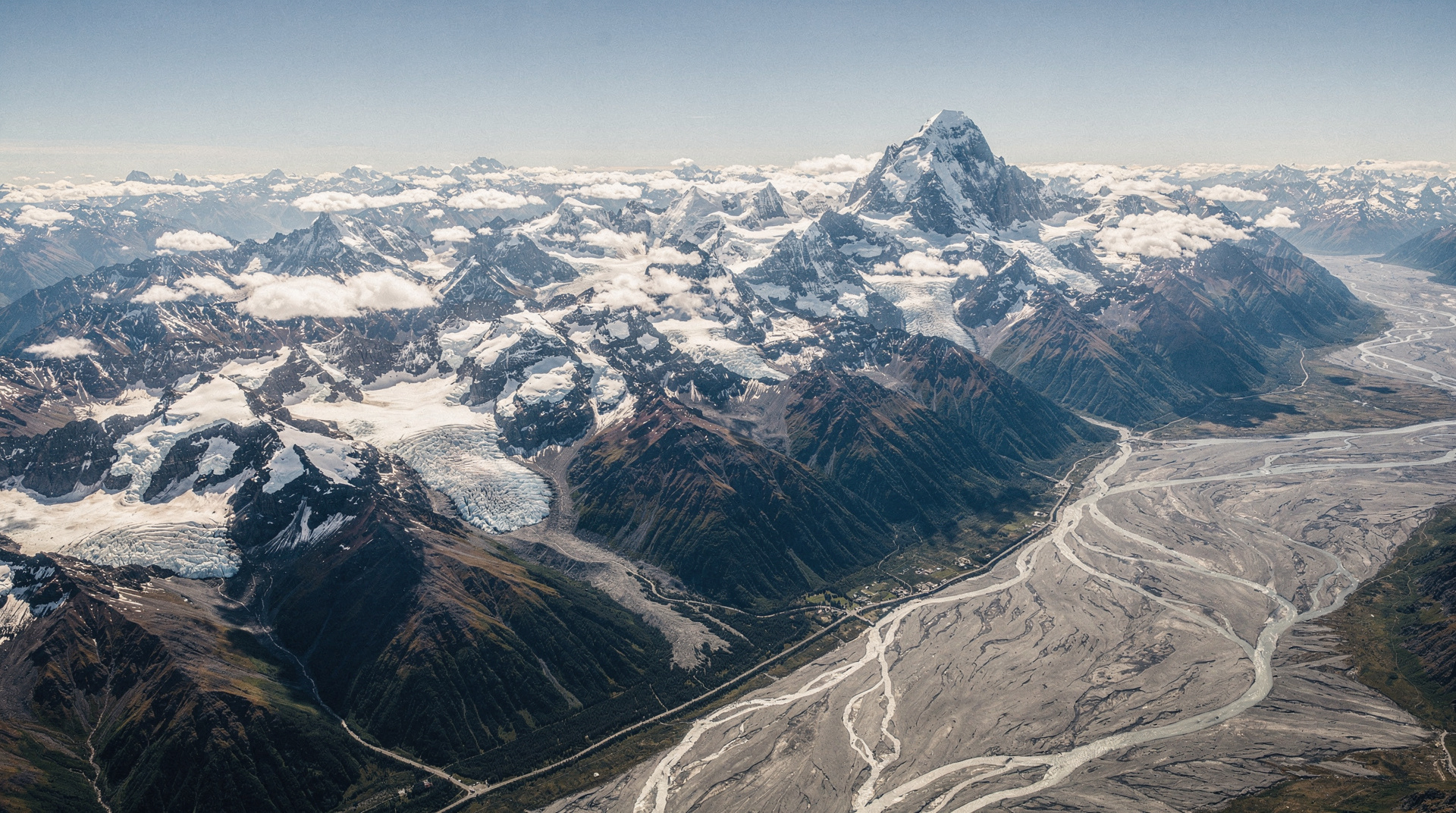
Southern Alps — overview of New Zealand's mountain spine
Southern Alps overview: 500km mountain spine, 19 peaks over 3000m, world's longest non-polar glaciers. How to access, experience, and understand NZ's backbone.
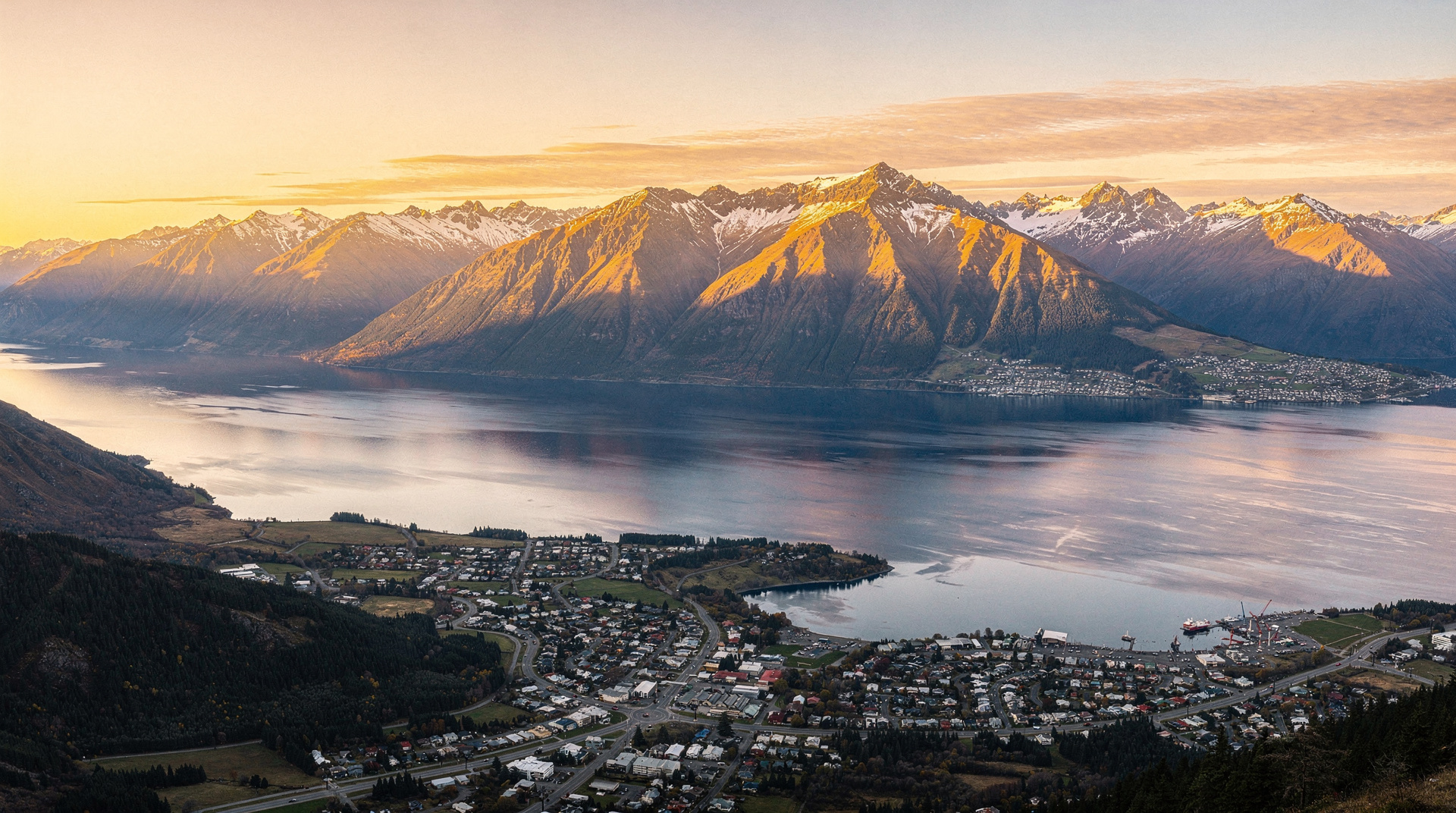
14-day New Zealand itinerary — both islands, grand tour
Honest 14-day NZ grand tour: Auckland, Bay of Islands, Hobbiton, Rotorua, Wellington, ferry, Kaikoura, Christchurch, Queenstown, Milford.
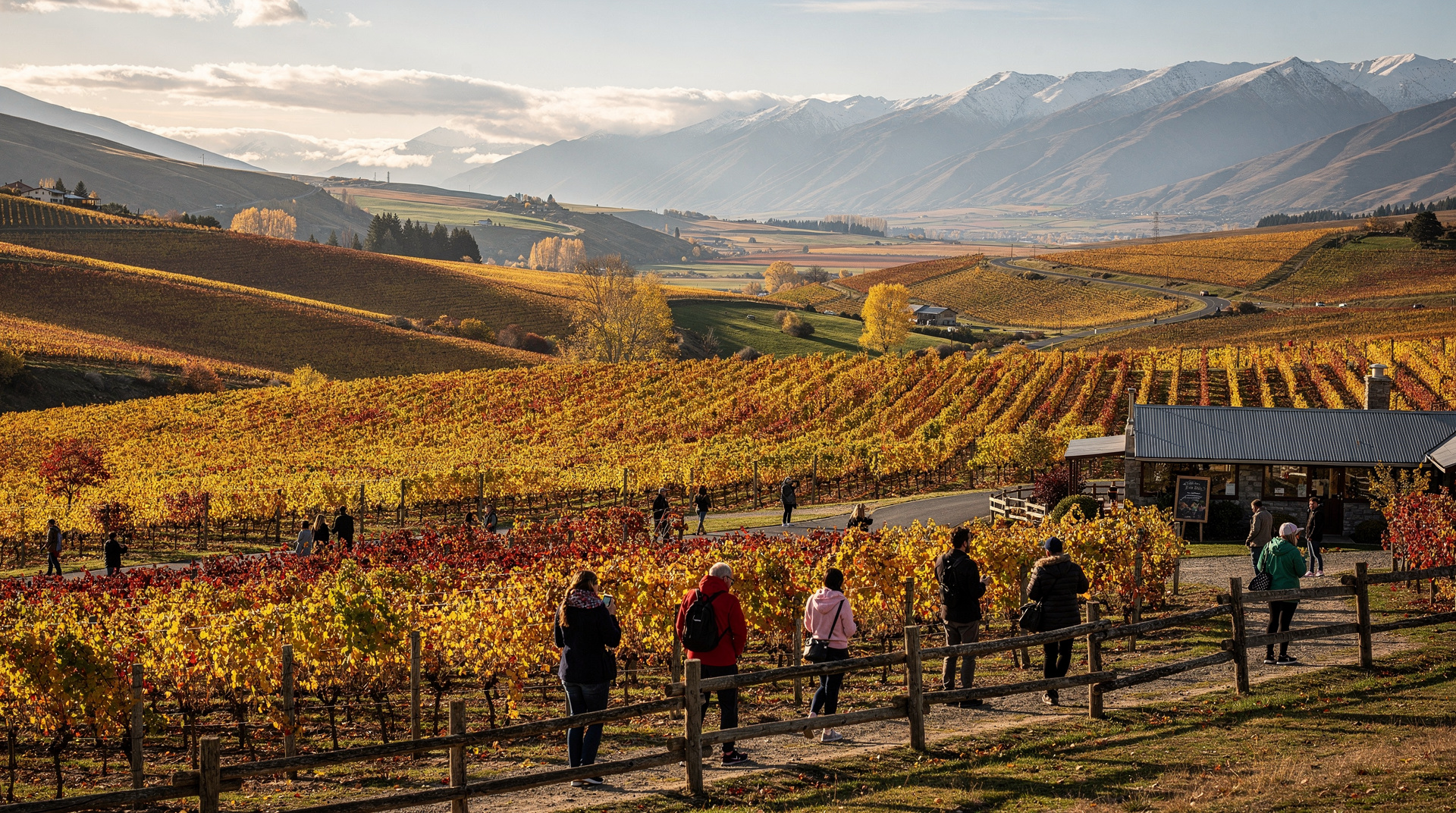
The best shoulder season itinerary for New Zealand — 14 days in autumn
A 14-day New Zealand itinerary designed for March and April: fewer crowds, better light, lower prices, and the same landscapes everyone comes for.
Last reviewed: