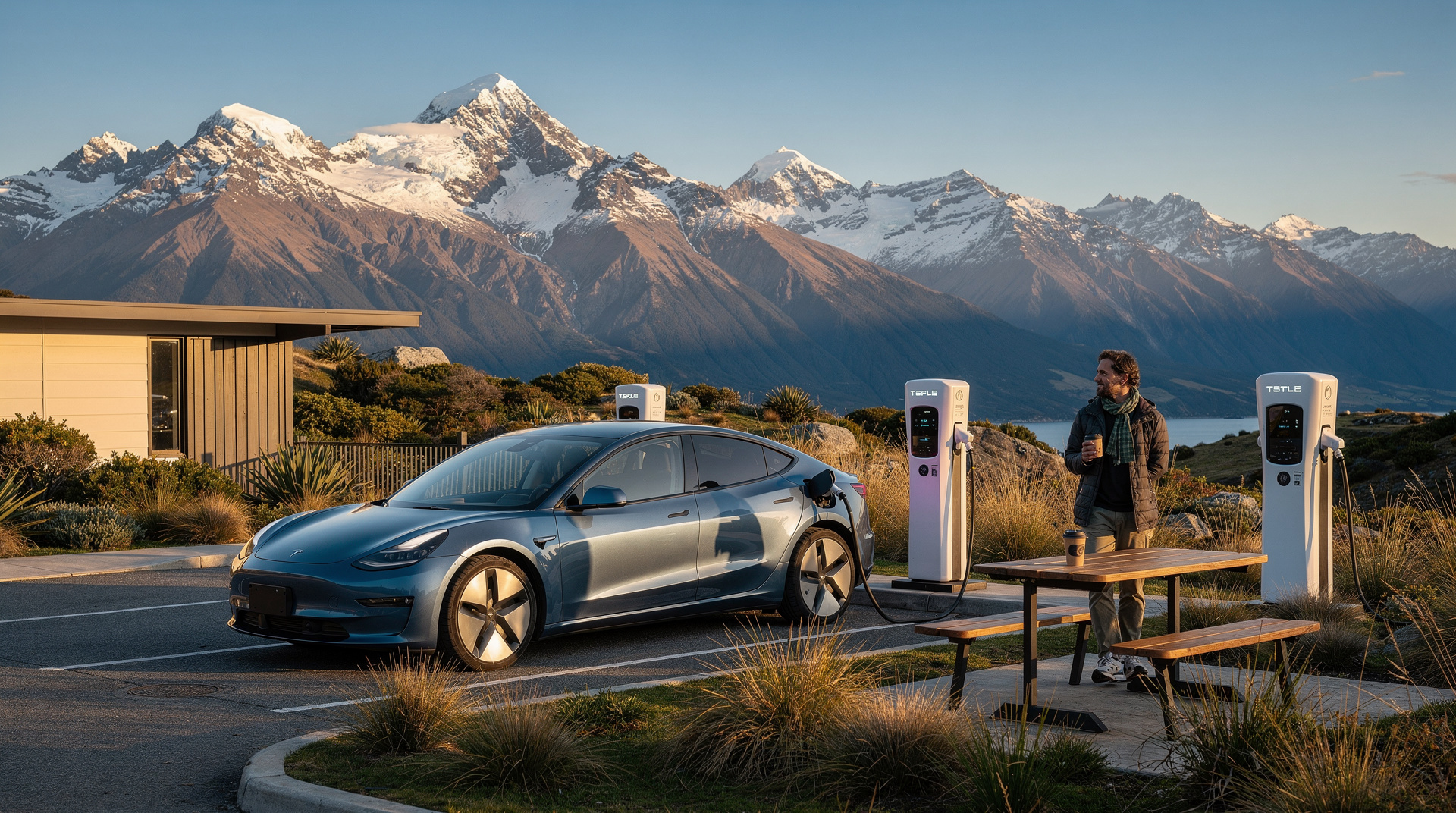
Electric vehicle road trip in New Zealand — the 2026 practical guide
The state of EV charging in New Zealand in 2026
New Zealand’s EV charging network has developed substantially since 2021. The ChargeNet network, which is the dominant charging provider, covers the main tourist routes with a combination of AC (slower, 7-22kW) and DC fast chargers (50-150kW+). The Tesla Supercharger network covers Auckland, Wellington, Christchurch, Queenstown, and the main inter-city corridors. PlugShare is the most useful app for finding all charging options, regardless of network.
The situation in 2026: the North Island main trunk (Auckland to Wellington via SH1 through Hamilton, Taupo, and Palmerston North) is well-served with fast chargers at regular intervals. The South Island main corridor (Christchurch to Queenstown via Lake Tekapo or via the West Coast) has adequate coverage on the Christchurch-Queenstown-Te Anau corridor with some gaps. The West Coast — Franz Josef, Fox Glacier, Hokitika — has improved significantly since 2023 but remains the region requiring most advance planning.
The fundamental question of whether New Zealand is ready for EV road trips has, in 2026, moved from “not quite” to “yes, with planning.”
| North Island | Well-served, minimal planning needed |
| South Island main corridor | Adequate, one long-range charge stop typical |
| West Coast / Fiordland | Manageable but needs pre-checked charger status |
| Charging cost vs petrol | Roughly a third to a half of the fuel cost |
| Best apps | PlugShare, ABRP, ChargeNet app |
The rental EV situation
EV rental availability in New Zealand has grown significantly. Jucy, Ezi Car Rental, GO Rentals, and others now offer EV options — primarily Tesla Model 3, BYD, MG ZS EV, and similar. Rates are comparable to mid-range petrol rentals and sometimes lower due to government incentives and lower operating costs.
The practical advantage: if you’re renting a Tesla, the Supercharger network is seamlessly integrated into the navigation and the network coverage on main routes is excellent. The disadvantage: Tesla’s charging network works only for Teslas (though this is changing gradually), so if you take a non-Tesla EV, you’re on the ChargeNet and other open networks.
Campervans are the current limitation. Purpose-built EV campervans for the New Zealand rental market exist but in limited numbers. The campervan EV market is developing; the current options are mostly converted or adapted rather than purpose-designed. If campervan freedom camping is your goal, a hybrid is more practical than a fully electric vehicle in 2026.
The North Island — manageable
Auckland to Wellington via SH1 is approximately 650km. In a Tesla Model 3 (standard range: approximately 350km per charge), you’d charge once en route — Taupo has a Supercharger and ChargeNet fast chargers that make it a natural break point.
Auckland to Rotorua (230km) is a single charge with range to spare. Rotorua to Taupo (80km) is trivial. The North Island main circuit (Auckland, Bay of Islands, Rotorua, Taupo, Tongariro, Wellington) is entirely viable for EV travel.
The Tongariro area: Whakapapa village has an AC charger at the national park visitor centre. Turangi has a ChargeNet fast charger. The route around the Volcanic Plateau is manageable with planning.
Charging cost comparison (North Island): ChargeNet DC fast charging runs approximately NZD 0.45-0.55 / USD 0.27-0.33 / EUR 0.25-0.30 per kWh. A full charge for a Model 3 from nearly empty costs around NZD 25-30 / USD 15-18 / EUR 14-17. Equivalent petrol cost for a similar range in a typical rental car: approximately NZD 60-80 / USD 36-48 / EUR 33-44.
The South Island — more planning required
The South Island is more challenging for EVs, primarily because the distances are longer and the gap between charging points on secondary routes can be significant.
Christchurch to Queenstown via SH8 (through Fairlie, Tekapo, Twizel): approximately 480km. Lake Tekapo has ChargeNet fast charging. Twizel has AC charging. Queenstown has multiple fast chargers. This route is doable in a long-range EV (350km+ range) with one charge stop. Standard-range EVs need more caution.
Queenstown to Milford Sound: 290km return, via Te Anau. Te Anau has ChargeNet fast charging (this was a significant addition in 2024-2025). The route to Milford Sound adds 120km from Te Anau. Currently, there is no charging at Milford Sound itself. Leaving Te Anau fully charged and monitoring the return carefully is the planning approach; most long-range EVs can manage the Te Anau-Milford-Te Anau leg on a full charge. Our Milford Sound cruise guide and Te Anau vs Queenstown as a Fiordland base are useful for deciding whether to overnight in Te Anau and shorten the return leg.
The West Coast — Franz Josef and Fox Glacier: the most challenging leg. From Queenstown via Haast Pass to Fox Glacier is 170km; Fox to Franz Josef is 25km further. Franz Josef township has had a ChargeNet fast charger since late 2024. Haast itself has AC charging at the DOC visitor centre. The leg is manageable with a long-range EV departing Queenstown fully charged, but it’s a trip that requires the charger at Franz Josef to be functional. Check PlugShare before departing. See the Franz Josef glacier guide for what to do once you arrive.
Greymouth to Christchurch via Arthur’s Pass: 270km. Lewis Pass and Arthur’s Pass itself are under-charged; the Nelson to Christchurch inland route (via Hanmer Springs) has better coverage. The direct Arthur’s Pass route requires a long-range EV or a planned charge in Greymouth before departing — our Arthur’s Pass day trip guide has the route detail if you’re doing it from the Christchurch side instead.
Range anxiety and how to manage it
Range anxiety — the fear of running out of charge — is a real psychological phenomenon for first-time EV travellers. On New Zealand roads, it’s more manageable than the anxiety suggests, provided you plan.
The practical approach:
- Use ABRP (A Better Route Planner) or the PlugShare trip planner to plan your charging stops before any long day.
- Never start a West Coast or Fiordland leg with less than 90% charge.
- Know where the fallback charger is — the one before your planned charger if that one is occupied or non-functional.
- AC chargers at accommodation are slow (overnight charge is fine; 1-hour stop is not meaningful) but are good for topping up at lunch stops or overnight stays.
- The ChargeNet app shows real-time charger status. Check it 30 minutes before you expect to need a charger.
The cost calculation
Fuel savings are genuine. A typical 10-day South Island road trip of approximately 2,500km costs:
- Petrol car: approximately NZD 200-240 / USD 120-144 / EUR 110-132 in fuel
- EV: approximately NZD 70-90 / USD 42-54 / EUR 39-50 in charging costs
The differential (NZD 130-170 / USD 78-102 / EUR 72-94) is meaningful over a long trip, less so over a short one. The bigger consideration is whether the EV rental rate is competitive with the petrol rental rate — increasingly it is, particularly for later-model Teslas.
The sustainable travel argument
New Zealand generates approximately 80-85% of its electricity from renewable sources (hydro, geothermal, wind). This means that driving an EV in New Zealand has a lower carbon intensity than EV driving in most countries. The environmental argument for EV road trips in New Zealand is genuinely stronger than in many destinations.
This matters if sustainable travel is part of your decision-making. The landscape New Zealand offers — the national parks, the coasts, the wilderness — is what you’re there for. Reducing your travel footprint while seeing it is a coherent objective.
Practical checklist for EV road trip planning
- Download PlugShare, ABRP, and the ChargeNet app before arriving.
- When renting, ask specifically about the vehicle’s real-world range (not rated range) and charging speed.
- Check your accommodation for EV charging availability — it’s becoming a standard amenity at mid-range and above.
- Plan West Coast and Fiordland legs with particular care. Have the PlugShare screen showing the route day-before.
- Don’t stress it. New Zealand drivers, locals and tourists alike, have been managing EV road trips for years. The network is sufficient for the main routes. The outliers require planning.
Self-drive EV vs a guided tour
If the charging logistics above sound like more admin than you want on holiday, it’s worth weighing a guided tour against self-drive for the trickier legs — West Coast glaciers and Fiordland in particular. Our self-drive vs guided tour guide breaks down the trade-off generally; for an EV specifically, a hybrid approach works well: self-drive the well-charged North Island and Christchurch-Queenstown corridor, then book a guided day tour for the Milford Sound or glacier legs rather than manage range anxiety on your one shot at seeing them.
Related reading
Related guides

Driving in New Zealand
Honest driving guide for NZ: left-side rules, gravel road etiquette, why GPS lies, fuel costs, one-lane bridges, and what rental companies don't tell you.

Campervan vs car and motel in New Zealand
Campervan vs car and motel in New Zealand: full cost breakdown, when each wins, and the tipping point. NZD/USD/EUR prices for both options.

New Zealand prices in 2025 — an inflation snapshot
What has New Zealand travel cost since 2019? A 2025 price snapshot: accommodation, food, activities, and transport in NZD, USD, and EUR.
Freedom camping in New Zealand — the rules are tightening in 2025
Freedom camping restrictions are spreading across NZ councils. The honest 2025 picture: what's allowed, what's banned, and how to plan around it.
Published: