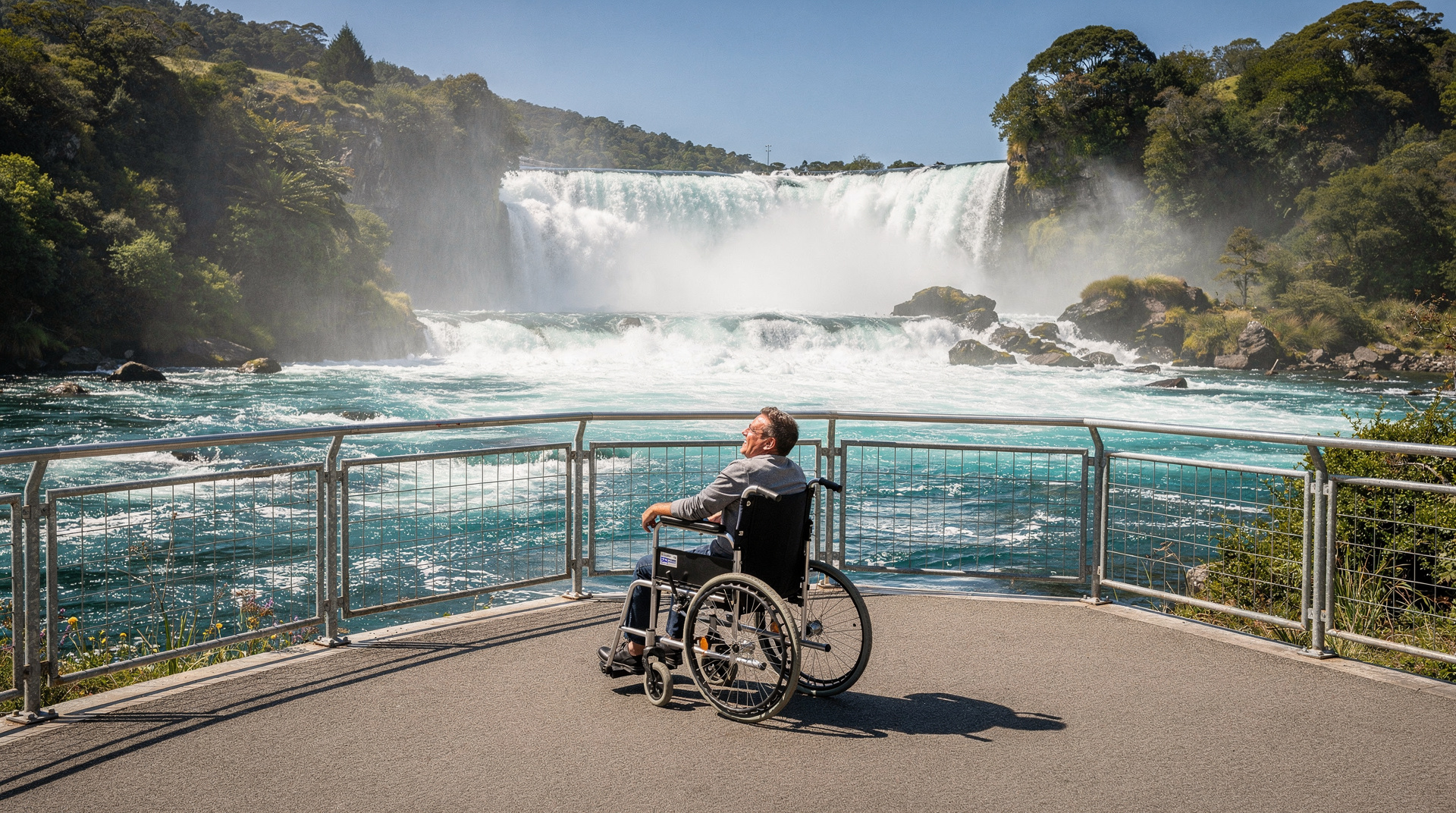
Accessibility in New Zealand
Is New Zealand accessible for wheelchair users and mobility-impaired travellers?
Major cities and main tourist attractions have good accessibility infrastructure. Auckland, Wellington, Christchurch, and Queenstown have accessible public transport, hotel rooms, and many attractions. Remote and rural areas, DOC tracks, and many scenic viewpoints are less accessible. Careful advance planning and booking accessible accommodation is essential.
Accessibility in New Zealand: the realistic overview
New Zealand has made significant progress in accessibility infrastructure over the past 20 years, driven by the Human Rights Act (which includes disability as a protected ground) and the Building Act requirements for accessible buildings. Major cities, international hotels, and popular tourist attractions are generally well-equipped.
The honest caveat: New Zealand’s great outdoors — the element most visitors come for — is often not accessible. Fiordland, the West Coast glaciers, many DOC Great Walks, and backcountry experiences are physically demanding by nature. But a growing number of DOC tracks, scenic viewpoints, and even some adventure activities have made genuine efforts to broaden access.
This guide distinguishes clearly between what is accessible and what is not, to enable realistic planning.
| Most accessible cities | Auckland, Wellington, Christchurch, Queenstown |
| Least accessible | Remote DOC tracks, Fiordland backcountry |
| Wheelchair hire | Auckland, Christchurch, Wellington airports; Red Cross nationwide |
| Planning lead time | 2-4 weeks for rental car hand-controls |
| Best single resource | doc.govt.nz accessibility section |
Transport
Airports:
- Auckland, Christchurch, Wellington, and Queenstown airports all have full wheelchair access, assistance services, and accessible toilets. Contact your airline in advance to arrange wheelchair assistance — this is standard and provided at no charge.
- Auckland’s international-to-domestic connection (covered walkway) is fully accessible.
Public transport in cities:
- Auckland buses and trains: low-floor accessible buses operate on most routes; the City Rail Link is fully accessible with lifts at all stations.
- Wellington buses: mostly low-floor accessible; the Wellington Cable Car has wheelchair access at both stations and limited space for wheelchairs in the cabin (contact Wellingtons Cable Car to confirm).
- Christchurch buses: low-floor accessible fleet.
Rental cars: Major rental companies (Hertz, Avis, Budget) can provide hand-control vehicles with advance notice (typically 2-4 weeks). Confirm directly with the operator — availability is limited. Mobility parking permits from your home country are recognised in New Zealand; apply for a temporary NZ permit through NZTA if needed for the full duration.
Cook Strait ferry: Both Interislander and Bluebridge have accessible facilities. Wheelchair spaces in the passenger areas are available; accessible toilets on board. Contact the operator when booking to confirm arrangements for boarding assistance.
Coaches (InterCity): Wheelchair spaces on InterCity coaches are available on most routes with advance notice. The accessible space accommodates a standard manual wheelchair; electric wheelchairs may not fit — confirm at booking. The driver assists with boarding.
Accommodation
Hotels (4-5 star): All hotels built after 2005 must have at least one wheelchair-accessible room per Building Act requirements. Specify requirements clearly when booking — an “accessible room” can mean anything from a roll-in shower to just a wider bathroom. Request specifics: roll-in shower (vs. bath or standard shower), grab bars, bed height, turning radius. Confirm you need a ground floor or lift-accessible room.
Motels: Accessibility varies widely. Older motels (pre-2005) may have steps to the entrance or bathrooms that are not fully accessible. Book directly and ask specifically about step-free access, bathroom layout, and parking proximity to the room.
Airbnb: Search using the “accessibility features” filter. New Zealand listings that declare accessibility features (step-free access, wide doorways, accessible bathroom) are worth pre-screening by direct message with the host to confirm specifics.
Holiday parks: Holiday park cabins vary. Some have dedicated accessible cabins; others have standard cabins with steps. Powered caravan sites on flat ground are accessible for self-contained wheelchairs-equipped campervans. Contact the park directly.
YHA hostels: Accessibility varies by property. Some YHA properties have accessible rooms (confirm with the specific hostel). The communal kitchen and bathroom facilities at older hostels are often not wheelchair accessible — this is a genuine limitation.
Accessible attractions and experiences
Auckland
- Auckland Museum: Fully accessible with lifts, wheelchair hire available, accessible toilets throughout.
- Sky Tower: Accessible via lifts to the observation deck; wheelchair users can access the main observation level.
- Kelly Tarlton’s Sea Life Aquarium: Step-free access throughout, accessible toilets.
- Waiheke Island ferry: Fullers360 ferries are accessible; contact Fullers to pre-board if needed.
Wellington
- Te Papa museum: Fully accessible; multiple lift systems, accessible toilets, wheelchair hire.
- Zealandia: Some of the sanctuary path is accessible by wheelchair; steeper sections are not. Contact Zealandia directly for current accessible route maps.
Rotorua
- Wai-O-Tapu: Boardwalk access to main features; some areas require more mobility. The Lady Knox Geyser area is accessible. Contact for current accessible route information.
- Te Puia: Accessible paths to the main geothermal area; some gradient. The carving and weaving schools are accessible. The Maori cultural evening is accessible.
- Polynesian Spa: Fully accessible; pool entry aids available. Contact ahead to confirm.
Queenstown
- Skyline Gondola: The gondola terminal and viewing platform are fully accessible.
- TSS Earnslaw: The steamship has accessible boarding ramps; wheelchairs accommodated on the main passenger deck.
- Milford Sound cruises: Most large cruise operators accommodate wheelchairs; confirm with the specific operator when booking.
DOC accessible tracks
DOC has invested in a “Barrier Free Access” programme creating wheelchair-friendly tracks at many major sites. Examples:
- Hooker Valley Track (Aoraki/Mt Cook): Graded surfaces and bridges make most of this track accessible to manual wheelchairs; the final suspension bridge sections may require assistance.
- Lake Matheson Track (Fox Glacier): Accessible sealed path to the famous mirror lake reflection point.
- Kerosene Creek (Rotorua area): Accessible to the pool area.
- Oamaru Blue Penguin Colony: Accessible viewing stands.
- Abel Tasman National Park: Aquataxi access to beaches allows mobility-impaired visitors to reach the park’s coast without the walking tracks.
DOC website: doc.govt.nz has a dedicated accessibility section listing all accessible tracks and visitor facilities. This is the most current and comprehensive source.
Health resources and support
Medical facilities:
- Hospitals in Auckland, Wellington, Christchurch, Dunedin, and Hamilton have full disability-accessible facilities and services.
- Rural hospitals and medical centres are equipped for emergencies but may have less specialised equipment.
Equipment hire:
- Wheelchair hire available at Auckland, Christchurch, and Wellington airports.
- Mobility scooter hire available in Queenstown and Auckland through specialist operators.
- Manual wheelchair hire through the Red Cross (redcross.org.nz/wheelchair-hire) at modest cost for visitors.
Medication and medical supplies:
- Most prescription medications available in New Zealand with a prescription from your home country (pharmacists can assist); bring an adequate supply plus extra.
- CPAP machines and supplies available in major cities.
South Island considerations for mobility-impaired travellers
The South Island’s biggest draws — Milford Sound, the West Coast glaciers, Aoraki/Mt Cook — are also its most physically demanding. Milford Sound itself is reachable by accessible coach and cruise, but the surrounding walks (Routeburn, Milford Track) are not realistic options for wheelchair users or those with significant mobility limitations. The Hooker Valley Track near Aoraki/Mt Cook remains the honest exception — its graded surfaces and bridges make most of the walk genuinely accessible, a rarity for alpine New Zealand.
Queenstown itself is compact and largely accessible in the town centre, with the Skyline Gondola terminal fully wheelchair accessible, but many of the region’s signature adventure activities (bungy, skydiving, jet boating) have their own medical and mobility exclusions — check directly with each operator rather than assuming.
If your trip includes domestic flights between accessible hubs, domestic flights in New Zealand covers wheelchair assistance procedures at each airport, which are more consistent than the ground transport options once you’re outside the four main cities. And because unexpected costs (accessible taxi premiums, adapted equipment hire) can add up, our currency and money guide is worth reading alongside your budget planning.
Frequently asked questions about accessibility in NZ
Can I use my mobility parking permit from home?
Foreign mobility parking permits are recognised in New Zealand for up to 12 months. You can park in designated mobility spaces using your home country permit. NZTA also offers a temporary NZ permit for extended stays.
Is Milford Sound accessible?
The Milford Sound road itself is accessible by vehicle and coach. The major cruise operators have accessible boarding and wheelchair spaces on their vessels. Some operators have stair-only access to higher deck levels; confirm when booking. The road to Milford Sound does not have step-free stops at viewpoints — the road itself is the viewpoint.
Are there accessible hiking options in Fiordland?
Very limited. Fiordland’s terrain is steep, remote, and demanding. The main accessible element is the Milford Sound cruise (on an accessible vessel). Accessible road stops at Mirror Lakes and other roadside viewpoints exist on the Milford road. For genuine accessible wilderness experience in the South Island, the Hooker Valley Track at Aoraki/Mt Cook is more appropriate.
Does New Zealand have disability travel specialists?
Yes. Organisations including Weka (formerly Disability Connect), and tourism operators who have completed the NZTA Accessibility Toolkit training, can assist with planning. Accessible travel NZ directories exist online (search “accessible New Zealand travel”).
Are New Zealand tour operators experienced with wheelchair users?
Varies. Large operators (Milford cruise companies, major Rotorua attractions) are experienced. Smaller adventure operators are less likely to be set up for significant mobility impairments. Advance communication is essential for any tour booking.
Related guides and itineraries
- First time in New Zealand — orientation
- Airport transfers in New Zealand — accessible transport from airports
- New Zealand with kids — related practical travel needs
- Cook Strait ferry guide — accessible crossing
- Packing list for New Zealand — medical supplies
- Best time to visit New Zealand — timing accessibility
Related guides
First time in New Zealand
Complete first-timer's guide to NZ: costs, logistics, Maori culture, what to book early, and how to structure 7–21 days.
Driving in New Zealand
Honest driving guide for NZ: left-side rules, gravel road etiquette, why GPS lies, fuel costs, one-lane bridges, and what rental companies don't tell you.
Airport transfers in New Zealand
Airport transfer options for NZ's main airports: taxis, shuttles, buses, rail. Real costs NZD/USD/EUR for Auckland, Christchurch, Queenstown, and Wellington.
New Zealand with kids — family travel
Honest family travel guide to NZ: best activities for kids by age, avoiding long drives with under-7s, best bases, costs, and what actually works for families.
InterCity bus guide
Complete InterCity bus guide for NZ: main routes, FlexiPass vs point-to-point, actual journey times, and when the bus is smarter than renting a car.
Last reviewed: