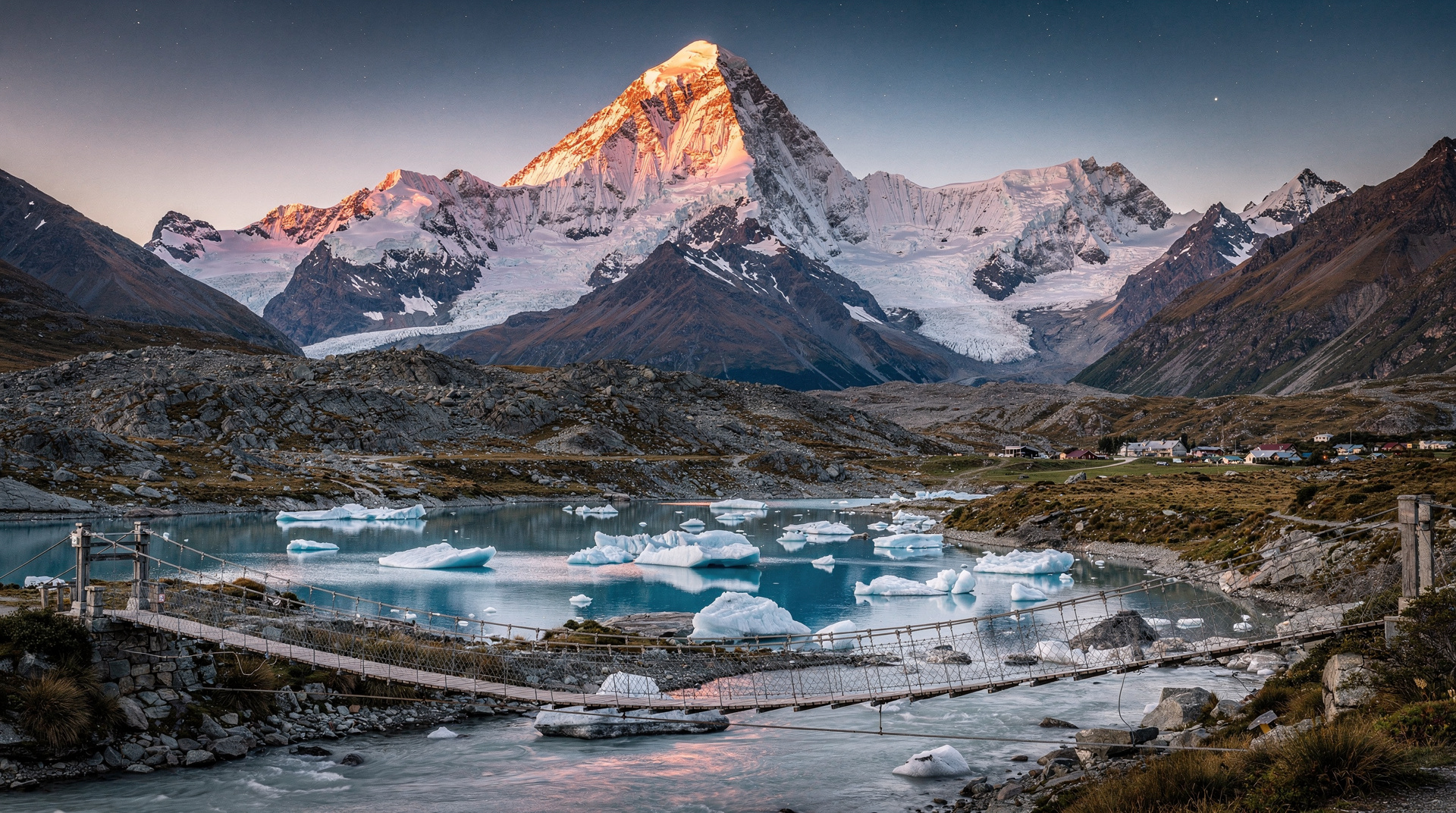
Aoraki/Mt Cook — complete visitor guide
What can you do at Aoraki/Mt Cook without climbing experience?
Plenty: the Hooker Valley Track (10km return, 3-4 hours, no experience needed) reaches a glacial lake with iceberg views. The Tasman Glacier heli-hike lets you land on the glacier by helicopter. Kea Point track (1 hour). Stargazing from the International Dark Sky Reserve is world-class. You don't need to climb to have an extraordinary experience here.
New Zealand’s highest mountain
| Where | Aoraki/Mt Cook National Park, Mackenzie Basin, South Island |
| Cost | Free walks; scenic flights around NZD 295-665 |
| Time needed | 1-2 nights minimum for walks plus a flight or stargazing |
| Getting there | 3.5-4hrs from Christchurch or Queenstown, self-drive or shuttle |
| Best time | December-February for weather odds; year-round for the Hooker Valley walk |
Aoraki/Mt Cook stands at 3,724m — the highest point in New Zealand and the Australasian region outside of New Guinea. The name Aoraki comes from the Ngāi Tahu cosmology in which the mountain represents a petrified canoe (waka) of the ancestor Aoraki, who with his brothers was turned to stone when their canoe capsized. The mountain is tapu (sacred) to Ngāi Tahu, and the name Aoraki is always listed first by convention.
Mt Cook Village sits at the mountain’s base, surrounded by the Aoraki/Mt Cook National Park — a UNESCO World Heritage Site jointly listed with Fiordland and Westland National Parks as Te Wāhipounamu (the place of greenstone). The park contains 19 peaks over 3,000m, 72 named glaciers, and three of the longest glaciers in the southern hemisphere outside Antarctica.
The village itself is tiny — 3-4 hotels, a visitor centre, and a few hundred residents. It is not a resort destination in any conventional sense. What it offers instead is immediate proximity to extraordinary mountain terrain, accessible to non-climbers through a combination of day walks, helicopter experiences, and glacier guided activities.
Getting there
From Christchurch: 3.5-4 hours via SH1 south to Glentanner, then SH80 to the village. The 55 km of SH80 from Lake Pukaki to the village follows the lakeside — one of New Zealand’s finest road approaches to any destination.
From Queenstown: 3.5 hours via Cromwell, Twizel, and Lake Pukaki. An overnight at Mt Cook is strongly recommended over a day trip from Queenstown — 7 hours of driving for a few hours at the destination doesn’t do justice to the place.
Shuttle options: The Tekapo Shuttle: Mt Cook Day Tour via Pukaki & Tasman Lake connects Lake Tekapo, Pukaki, and Mt Cook as a day trip — a good option for visitors without a car. NZD 65-85 / USD 39-51 / EUR 36-47. The Mount Cook & Lake Tekapo Day Tour from Christchurch handles the Christchurch–Tekapo–Mt Cook circuit in a single day. NZD 195-245 / USD 117-147 / EUR 108-135.
Day walks in the national park
Hooker Valley Track (10 km return, 3-4 hours, easy-moderate): The standout walk — three swing bridges, Aoraki/Mt Cook directly overhead, and a glacial lake with floating icebergs at the end. See the dedicated Hooker Valley Track guide.
Kea Point Track (3 km return, 1 hour, easy): Branches from the Hooker Valley Track to a viewpoint above the Mueller Glacier terminal moraine. Named for the kea parrot — commonly seen here.
Governors Bush Walk (1 km loop, 30 min, easy): Native beech forest above the village. Short and excellent for birdwatching.
Sealy Tarns Track (6 km return, 3-4 hours, moderate-challenging): A steep climb via a metal ladder section to alpine tarns (small mountain lakes) at the foot of Mt Sefton. Not as iconic as the Hooker Valley but far less crowded.
Mueller Hut (12 km return, 6-8 hours, challenging): Alpine terrain at 1800m with glacier views. Requires alpine experience or guided support in shoulder season and winter.
Helicopter and glacier experiences
Flying over the mountain is genuinely transformative — the scale of the ice fields and the 3,000m peaks is impossible to appreciate from the valley floor.
The Mount Cook: Scenic Helicopter Flight with Alpine Landing provides a 30-minute flight with a high alpine landing on snow. NZD 395-445 / USD 237-267 / EUR 217-245.
The Mount Cook: 3 Hour Heli Hike to the Tasman Glacier extends the helicopter experience with a guided walk on the Tasman Glacier surface — the longest glacier in New Zealand (29 km). NZD 475-545 / USD 285-327 / EUR 261-300.
For maximum coverage, the Mount Cook: Ski Plane and Helicopter Glacier Combo Flight combines a ski plane landing with a helicopter return — two different aerial perspectives on the same mountain system. NZD 595-665 / USD 357-399 / EUR 327-366.
The Tasman Glacier alone by helicopter: Mt Cook: 35-Minute Tasman Glacier Scenic Helicopter Flight provides a 35-minute scenic with glacier landing. NZD 295-345 / USD 177-207 / EUR 162-190.
Deciding between these options is worth doing carefully — see the dedicated Aoraki/Mt Cook scenic flight review for an honest breakdown of which flight suits which traveller, and the Tasman Glacier guide for ground-level access to New Zealand’s longest glacier without a helicopter at all.
Stargazing at Aoraki Mackenzie International Dark Sky Reserve
The Mackenzie Basin — encompassing Mt Cook, Lake Tekapo, and Lake Pukaki — is one of the largest International Dark Sky Reserves in the world. At Mt Cook Village, with no nearby light pollution and 1,000m altitude, the sky on clear nights is extraordinary.
Basic stargazing is free — simply step outside the hotel after 10pm on a clear night and look up.
For guided stargazing with telescopes: tours operate from Mt Cook Village and Lake Tekapo. The Lake Tekapo: Alpine Stargazing Experience with a Guide at Lake Tekapo (1.5 hours from Mt Cook) is the most developed observatory experience with 1-metre dome telescopes. NZD 155-185 / USD 93-111 / EUR 85-102.
Climbing Aoraki/Mt Cook
The summit of Aoraki/Mt Cook is a serious mountaineering objective. It requires:
- Technical glacier travel (ice axe, crampons, ropes)
- High-altitude experience
- Multi-day commitment (typically summit bids from Plateau Hut or Ball Shelter, accessed by ski plane)
- Guide or partner with equivalent experience
The mountain has a significant fatality record — the combination of objective hazards (crevasses, seracs, avalanche) and rapidly changing Tasman weather makes it a commitment that should not be underestimated.
For those interested in learning glacier skills, guiding companies (Alpine Guides, Mountain Mentors) offer beginner glacier walks and crevasse rescue courses from Mt Cook Village. These are appropriate for motivated non-climbers wanting to engage seriously with the mountain environment.
Where to stay at Mt Cook Village
The Hermitage Hotel: The only full-service hotel at the mountain. From NZD 280/night standard to NZD 600+ for mountain-view suites. The restaurant (Panorama Restaurant) is the best dining option in the village — dinner reservations recommended. The hotel’s location gives direct Aoraki/Mt Cook views from mountain-facing rooms.
Mt Cook Lodge and Motel: More affordable, from NZD 150-220/night / USD 90-132 / EUR 83-121.
YHA Aoraki/Mt Cook: Backpacker-standard dormitory and private rooms from NZD 40 dorm / USD 24 / EUR 22. Popular with climbers.
White Horse Hill Campground: DOC campsite at the Hooker Valley trailhead, NZD 8/person / USD 5 / EUR 4.5.
Book the Hermitage well ahead for December-February — it fills months in advance.
Cost breakdown (NZD / USD / EUR)
| Experience | NZD | USD | EUR |
|---|---|---|---|
| Hooker Valley Track | Free | Free | Free |
| Helicopter with landing (30 min) | 395-445 | 237-267 | 217-245 |
| Heli-hike Tasman Glacier | 475-545 | 285-327 | 261-300 |
| Ski plane + helicopter combo | 595-665 | 357-399 | 327-366 |
| Hermitage Hotel (per night) | 280-600+ | 168-360+ | 154-330+ |
| YHA dormitory | 40-55 | 24-33 | 22-30 |
| DOC campsite | 8/person | 5 | 4.5 |
Frequently asked questions
How many days should I spend at Mt Cook?
Minimum 1 night (to allow for a full day including the Hooker Valley Track and either helicopter or stargazing). Ideally 2 nights for anyone doing a helicopter experience plus full day walk plus stargazing. Three nights is appropriate for those attempting Mueller Hut or glacier activities.
What if the weather is bad?
Mt Cook weather is notoriously unpredictable. Fog and cloud are common even in summer. Helicopter tours operate on weather — if your intended flight day is socked in, operators reschedule at no cost (allow an extra day in your itinerary). The Hooker Valley Track is walkable in light rain with full waterproofs.
Is it possible to see Aoraki/Mt Cook from Lake Pukaki or Lake Tekapo?
Yes. On clear days, the mountain is visible from Lake Pukaki’s shore (90 km from the mountain) and sometimes from Lake Tekapo. The view from the Lake Pukaki dam on a clear morning — turquoise lake in the foreground, Aoraki in the distance — is one of New Zealand’s great photographic moments.
Are there bears or dangerous animals to worry about?
No. The main wildlife hazard is kea — the alpine parrot who will dismantle your bag, windscreen wipers, and anything made of rubber. Amusing and non-dangerous. Lock food away.
When to visit: seasonality
| Season | Weather | Flights | Notes |
|---|---|---|---|
| Summer (Dec-Feb) | Warmest, most stable | Best odds of clear windows | Busiest — book the Hermitage months ahead |
| Autumn (Mar-May) | Cooler, settled spells | Good, fewer crowds | Excellent light for photography |
| Winter (Jun-Aug) | Cold, more storms | Frequent cancellations but spectacular when clear | Low sun angle gives dramatic ice light |
| Spring (Sep-Nov) | Variable, changeable | Moderate | Lambing season in the Mackenzie Basin, fewer visitors |
No season guarantees a clear day at Mt Cook — the mountain generates its own weather regardless of the forecast. Building in a second night is the single most effective way to improve your odds of a flight or a clear stargazing session, whatever month you visit.
Related guides and reading
Related guides
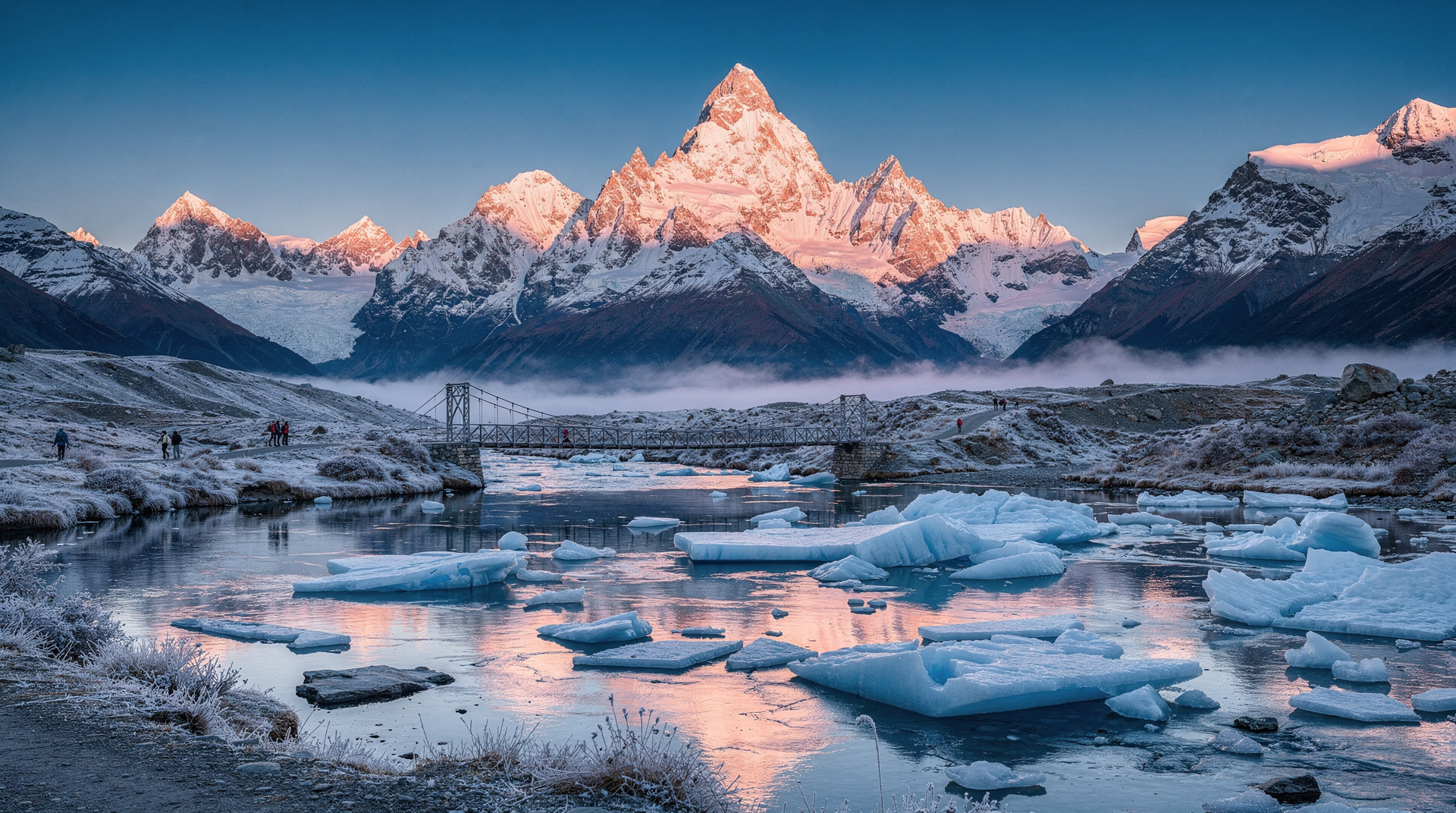
Aoraki / Mount Cook
Honest Aoraki / Mount Cook guide: Hooker Valley Track, Tasman Glacier, scenic flights — real NZD/USD/EUR prices and what to expect in all seasons.
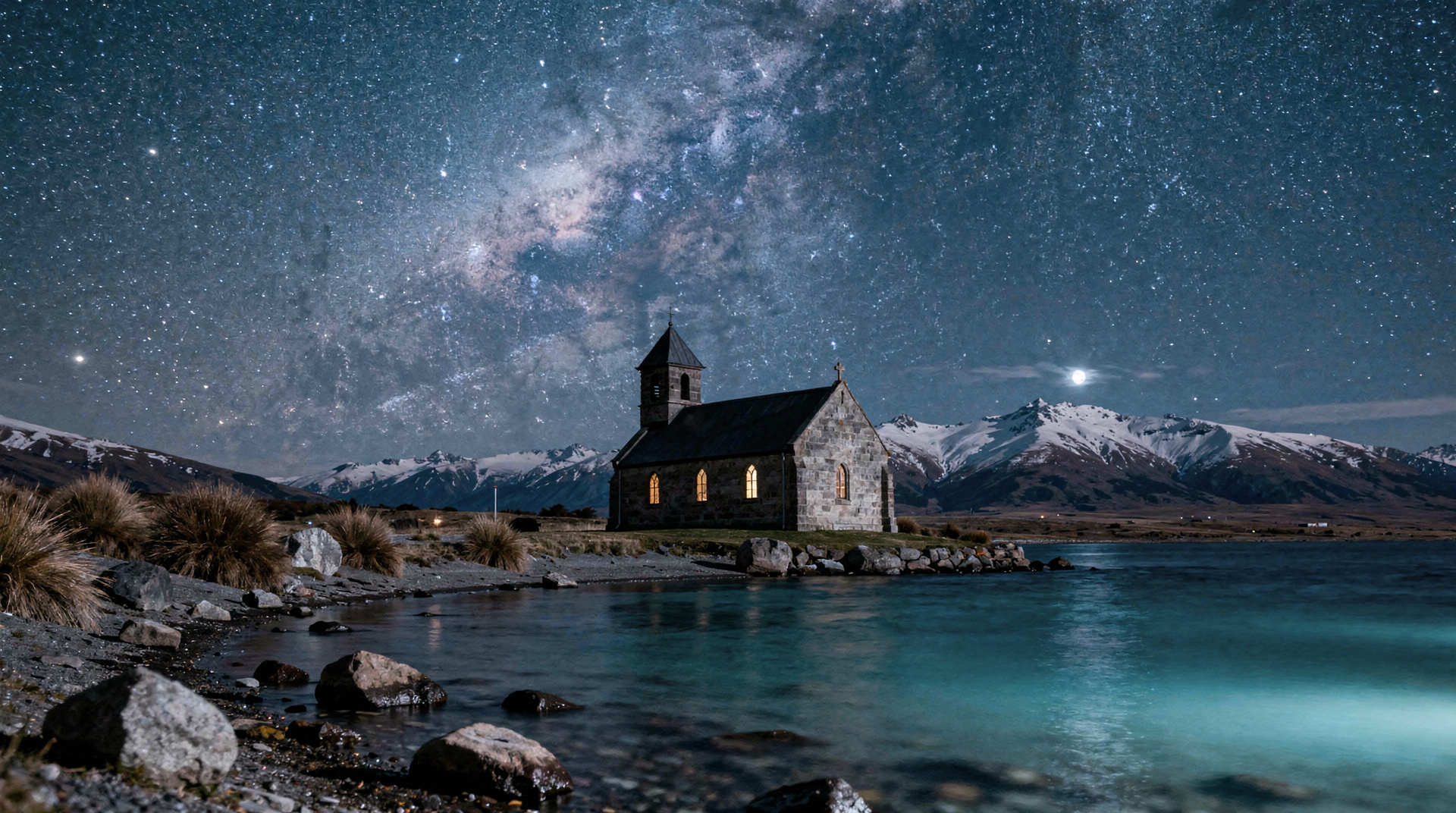
Lake Tekapo
Honest Lake Tekapo guide: stargazing, Church of the Good Shepherd, hot pools — real NZD/USD/EUR costs and how long you actually need here.
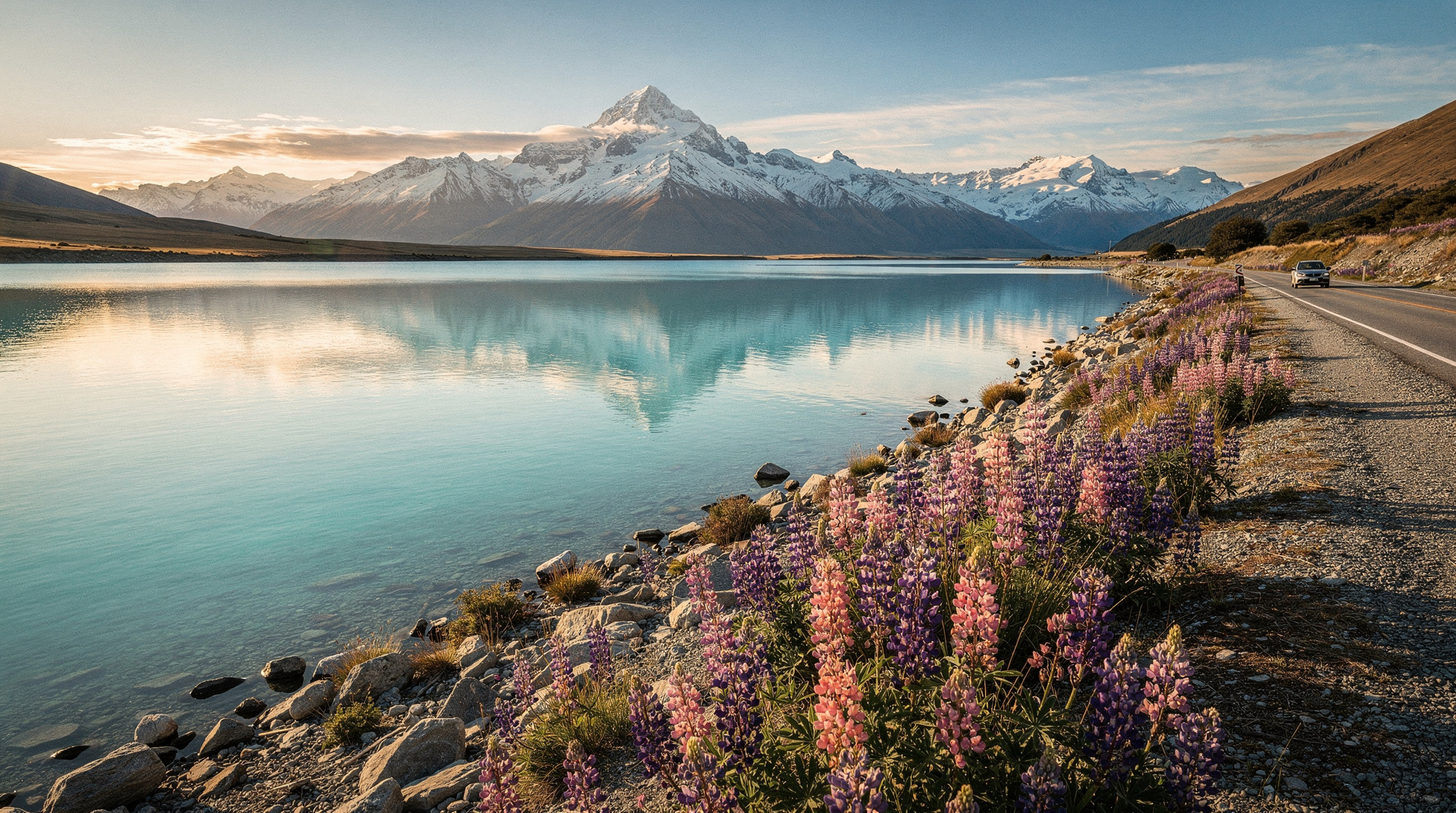
Lake Pukaki — the turquoise gateway to Aoraki/Mt Cook
Lake Pukaki guide: turquoise glacial lake on the road to Aoraki/Mt Cook. The dam viewpoint, SH80 drive, Braemar Station salmon farm, photography guide.
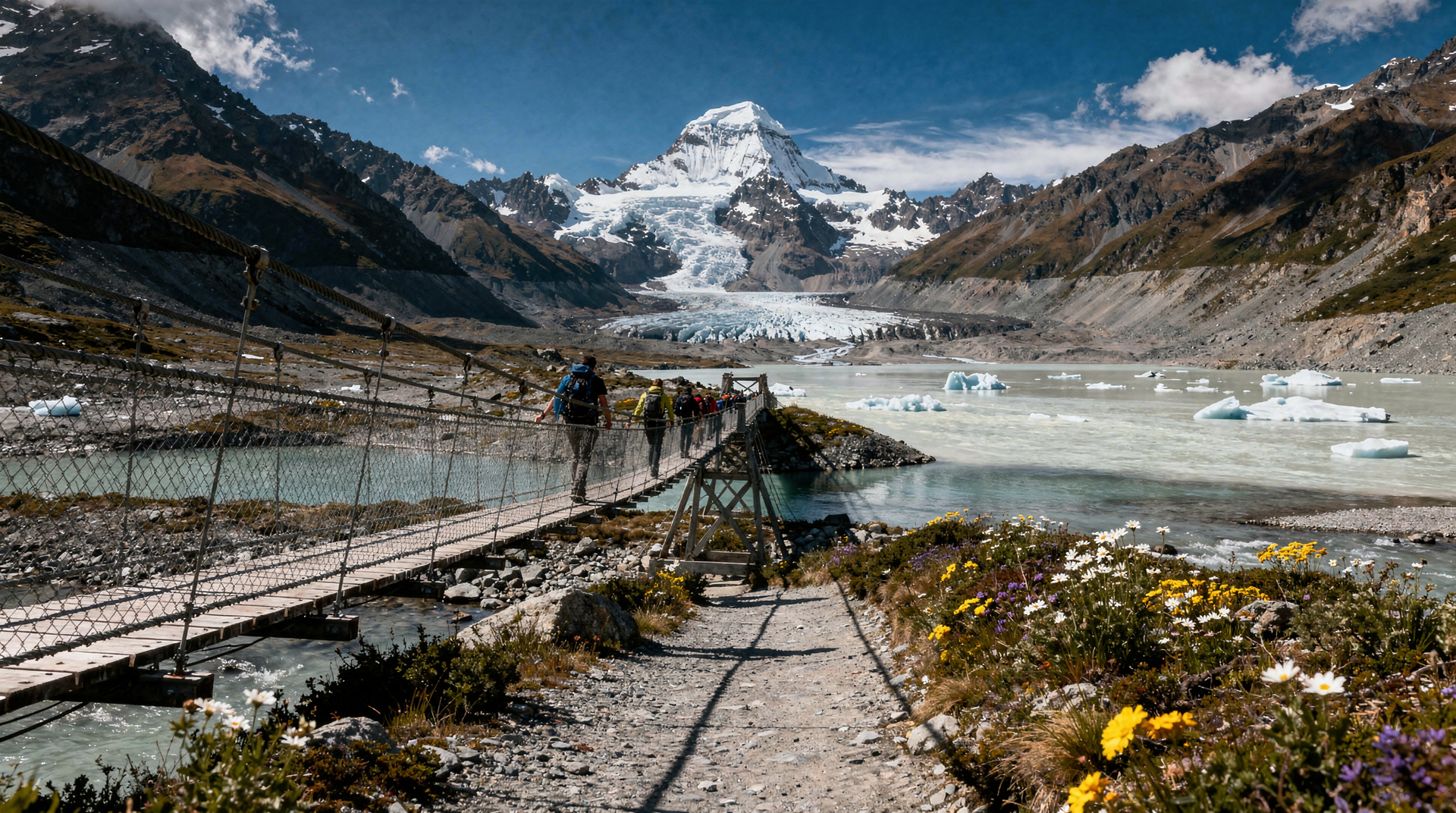
Hooker Valley Track — Aoraki/Mt Cook day walk
Hooker Valley Track: 10km return, easy-moderate, three swing bridges, glacial lake, Aoraki/Mt Cook views. Honest guide with logistics and safety.
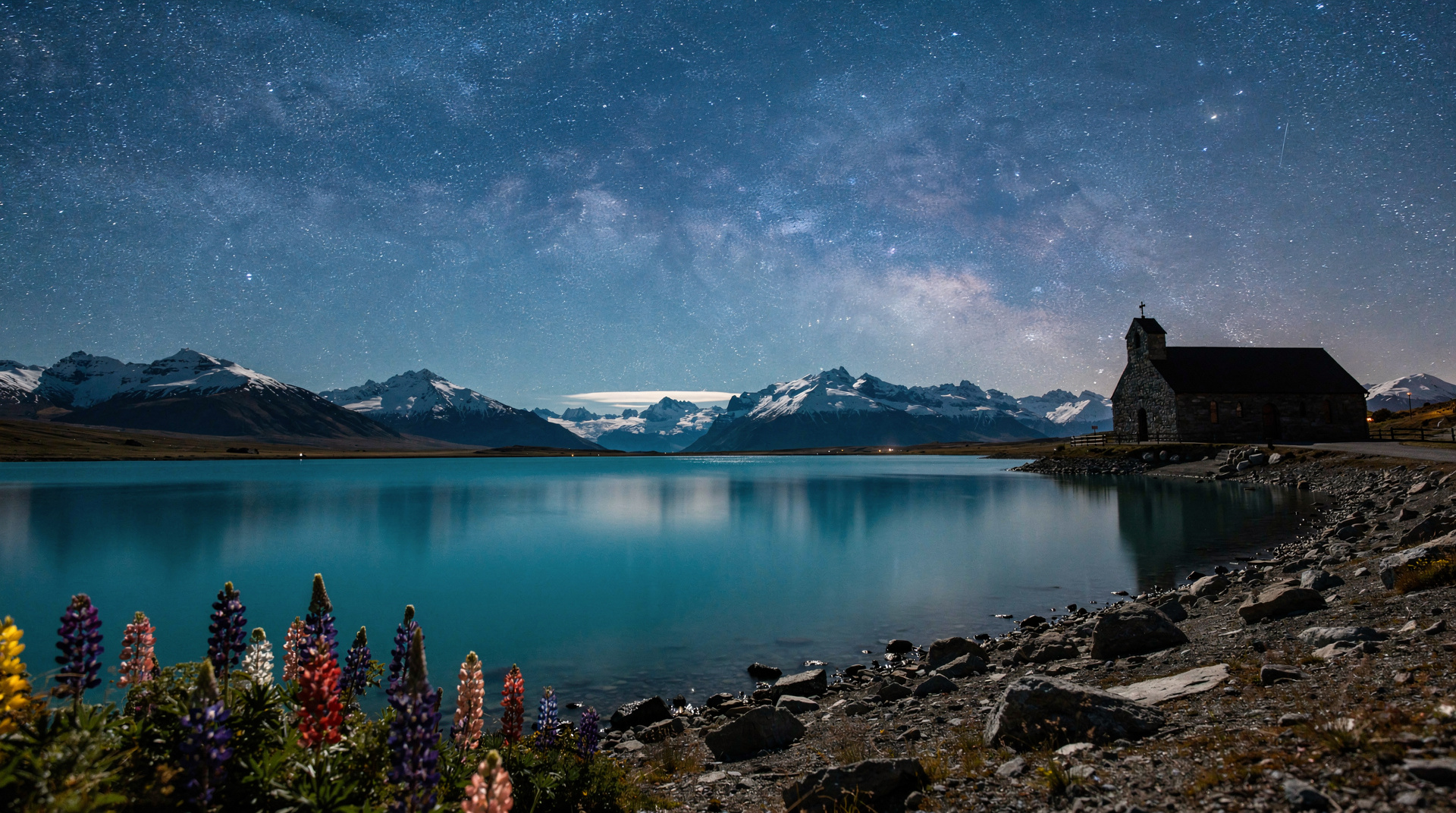
Lake Tekapo — turquoise lake and stargazing guide
Lake Tekapo complete guide: the turquoise glacial lake, International Dark Sky Reserve stargazing, Church of Good Shepherd, hot springs, Mt Cook day trip.
Lake Pukaki — the turquoise gateway to Aoraki/Mt Cook
Lake Pukaki guide: turquoise glacial lake on the road to Aoraki/Mt Cook. The dam viewpoint, SH80 drive, Braemar Station salmon farm, photography guide.
Last reviewed: