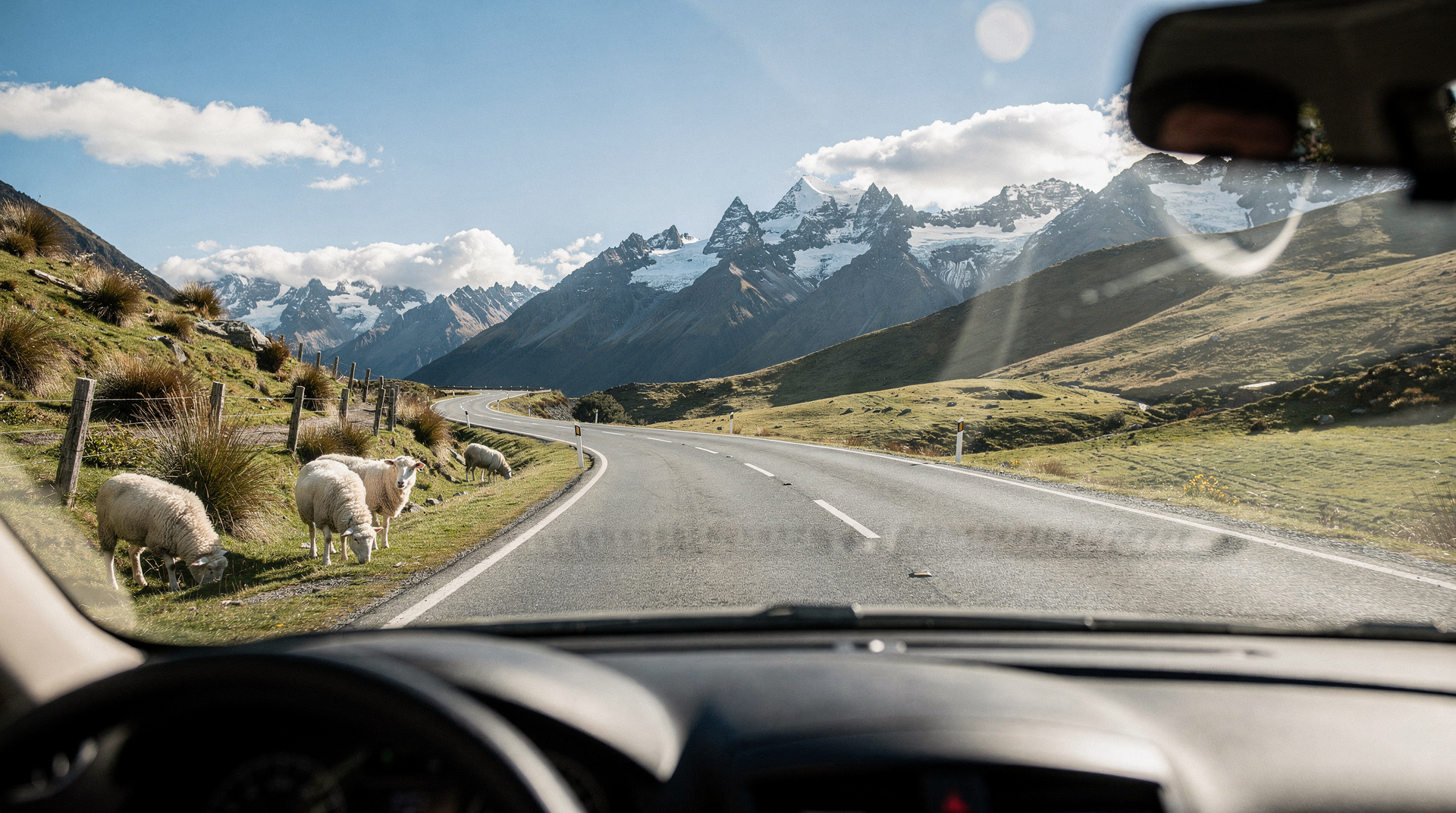
Self-drive vs guided tour New Zealand — honest comparison
Self-drive or guided tour — which should I pick for NZ?
Self-drive if you're under 65, comfortable with manual transmission and left-side driving, and want flexibility. Guided coach tour if you've never driven abroad or want zero logistics, accepting that you'll see Mt Cook from a window and not stop at the place you want.
| Where | Applies nationwide — North and South Island |
| Cost | NZD 25-55/day self-drive vs NZD 280-580/day guided |
| Time needed | Best for trips of 7+ days either way |
| Getting there | Rental car pickup at any airport, or coach tour pickup point |
| Best time | Year-round; conditions vary more than the choice itself |
The honest answer first
| Dimension | Self-drive | Guided coach tour |
|---|---|---|
| Daily transport cost per person | NZD 25–55 (rental car, 2 pax) | NZD 280–580 (included in tour price) |
| Flexibility | Maximum — stop anywhere, change plans freely | Fixed schedule — you're on the bus when the driver says |
| Photo stops | As many as you want, as long as you like | Scheduled stops, usually 10–20 min each |
| Left-side driving required | Yes — you drive on the left | No — driver handles everything |
| Distance fatigue | Yours to manage — NZ routes are long and winding | None — sleep on the coach |
| Hidden gems access | Complete — you can take any side road | Limited to operator-selected stops |
| Who does it suit | Independent travelers, couples, groups under 5 | Seniors, solo non-drivers, first-time international travelers |
| Typical trip length | Any — from 5 to 28 days | 8–22 days (operators rarely do shorter) |
| Book it | Add a guided cruise to your self-drive trip | See a guided coach + cruise example |
Verdict: Self-drive wins for most travelers under 65 who are comfortable with an unfamiliar road. Guided coach wins for those who want zero logistics or cannot drive. The real answer: self-drive with guided day activities layered in.
I’ve spent twelve years leading groups around New Zealand — first as a DOC ranger in the Mackenzie Basin, then as a tour leader for international groups, then independently. I’ve watched people arrive convinced they need a coach tour leave wishing they’d rented a car. I’ve watched confident self-drivers have miserable days because they underestimated how long the West Coast road actually takes. Both modes work. Both have real failure modes. Here’s what I know.
What self-drive actually means in New Zealand
New Zealand is one of the genuinely great self-drive destinations. The infrastructure exists to support independent travelers: well-maintained State Highways, clear signage, comprehensive petrol station coverage on main routes, and a rental car market that’s competitive enough to keep prices reasonable. Outside of Auckland at rush hour, traffic is a non-issue.
The challenges are different from what most people expect. They’re not about difficulty — they’re about time.
State Highway 6 from Greymouth to Queenstown via Haast is one of the most spectacular drives in the world. Google Maps says 4 hours 35 minutes. It takes most visitors 7 to 8 hours because of the viewpoints, the beaches, the fact that you’ve never seen anything quite like a West Coast kahikatea forest before and you stop for twenty minutes to stare at it. This is not a problem. It is the entire point of self-driving. But you need to plan for it.
The same applies to the road from Te Anau to Milford Sound (119 km, officially 2 hours, realistically 3–4 with stops — and you will stop). To the Crown Range between Queenstown and Wanaka. To the Kaikoura Coast. The roads are long, winding, and beautiful in a way that GPS trip planners do not account for.
The left-side rule
New Zealand drives on the left. This is the most frequently cited reason people consider guided tours. It is also, in practice, less daunting than it appears. Within 2–3 hours of driving, the overwhelming majority of visitors have adapted. The critical moments are roundabouts (remember: give way to the right) and the instinct to drift left when turning — the opposite of what left-side driving requires at intersections.
Where it does matter: rural one-lane roads (common on the West Coast and in Fiordland) require pulling into passing bays for oncoming traffic. This is courteous, well-signed, and not stressful once you’ve seen how locals handle it. What genuinely requires care is night driving on unlit mountain roads, which is worth avoiding.
Verdict on left-side driving: Don’t let this be your reason to skip self-driving. It’s real, it requires the first half-day of active attention, and then it becomes normal. ✓ Worth it
Manual vs automatic transmission
New Zealand rental cars default to automatic, which removes the most common additional complication for left-side driving. If you specifically request manual (for cost reasons or preference), you’ll be changing gears with your left hand, which adds mental load in the first days. Automatic is worth the small premium for most international visitors.
Days like Haast to Queenstown or Te Anau to Milford Sound last far longer than the map says, so the rental terms matter more than the daily rate. Check the pick-up and return points, the excess on damage, and the fuel and mileage rules before paying, and reserve early for busy months. You can then compare rental cars on DiscoverCars for the route you plan to drive.
What a guided coach tour actually means
Grand Pacific Tours, AAT Kings, Insight Vacations, Scenic Luxury Trains & Cruises, Trafalgar, Intrepid — these are the main operators running multi-day guided New Zealand itineraries. Group sizes range from 10 (small-group premium) to 46 (full coach). Most itineraries run 10–22 days and follow similar circuits: Auckland → Rotorua → Taupo → Wellington → Marlborough → Kaikoura → Christchurch → Queenstown, with variations.
What you get: a professional driver-guide who handles all logistics, accommodation pre-booked, meals often included or easily arranged, and commentary on every notable feature you pass. What you give up: the ability to spend three hours at Lake Pukaki because the light was perfect this morning, the ability to take the side road to Arrowtown on a whim, the ability to change your plans when you discover Wanaka was actually where you wanted to be all along.
The photo stop problem is real and worth understanding before you commit. Guided tours include photo stops at the major viewpoints — the Church of the Good Shepherd at Lake Tekapo, the Hooker Valley carpark at Aoraki/Mt Cook, the Mirror Lakes on the Milford Road. These stops are typically 15–20 minutes. You will get the postcard shot. You will not stand at the lakeside until the colour changes, or arrive at dawn before the tour buses.
Coach tour demographics skew heavily toward the 60+ market. Not exclusively — Intrepid and G Adventures attract younger travelers with their active itineraries — but the major operators (Grand Pacific, AAT Kings, Scenic) are explicitly designed around an older traveler’s needs: premium accommodation, included meals, no physical challenges beyond light walking, luggage handling. If you’re 35 and want to hike the Tongariro Alpine Crossing, a coach tour will bring you to the Tongariro National Park Visitor Centre and let you look at the mountain.
From Queenstown: Milford Sound Cruise and Coach Day Trip
Milford Sound coach and cruise day trip from Queenstown — the most popular single-day guided experience in NZ, and a good test of whether the format suits you.
From NZD 185–225 / USD 111–135 / EUR 102–124
Where self-drive wins decisively
You’re traveling 7 or more days. The break-even point where self-drive’s flexibility advantage clearly outweighs its logistical complexity is around day 5. On a 12-day trip, the ability to spend an extra night in Kaikōura because the whale watching was exceptional, or to cut short a planned day in Christchurch because you’d rather be in the Mackenzie Basin, is worth more than any guided commentary.
You want the Milford Road at dawn. The Milford Sound road (SH94 from Te Anau) is one of the most beautiful in New Zealand, and the best way to experience it is to leave Te Anau at 6am, drive in near-silence through Homer Tunnel as the light comes up, and arrive at Milford before the first coach tour buses. This is not possible on a coach tour. Once you’re there, a guided nature cruise is the right way to see the fiord itself — self-drive gets you there, a cruise gets you onto the water.
Milford Sound: Nature Cruise on a Modern Catamaran
Milford Sound nature cruise — the right way to see the fiord once you've self-driven to Te Anau. Book the cruise; drive the road yourself.
From NZD 85–115 / USD 51–69 / EUR 47–63
You’re traveling with children. Coach tours are largely impractical for families with children under 12. Children need to move, eat unpredictably, and have interests that change. Self-drive with a flexible itinerary is the only workable approach for most families. New Zealand’s holiday parks (motor camps) offer excellent facilities designed around families, and most are only bookable independently.
You want to include Great Walks. If you’re planning to hike the Milford Track, Routeburn, Kepler, or Abel Tasman, your logistics are already independently managed. Coach tours don’t integrate Great Walk bookings — you’d be rebooking around the tour, which defeats the purpose.
Budget is a consideration. The self-drive cost gap is substantial. See the cost breakdown below.
You want Central Otago wines. The Cromwell Basin, Bannockburn, and Gibbston Valley cellar doors are mostly accessible only by car. Coach tours visit selected wineries on brief stops. If wine is a priority, rent a car — or at minimum, add a dedicated wine tour from Queenstown as a guided day activity.
You want to linger. This is the non-negotiable point. New Zealand rewards lingering. The person who spends two hours sitting on the shore of Lake Ohau watching the light change on the Southern Alps sees something that no coach tour can provide. Self-drive is the only format that allows this.
Where guided coach tours win
You genuinely cannot drive abroad. Medical reasons, vision issues, age-related confidence concerns — these are legitimate reasons to use a guide. Not “I’m a bit nervous about left-side driving” (that passes quickly) but genuine inability to drive an unfamiliar road system safely.
You’re traveling solo and the cost arithmetic changes. A rental car at NZD 50/day doesn’t look cheap when you’re the only one paying it. A coach tour at NZD 400/day is still expensive as a solo traveler, but it includes accommodation and eliminates the logistical overhead of single-occupancy planning. Solo travelers on tight budgets are often better served by shuttle buses between hubs and activity-based guided experiences than by either a rental car or a coach tour.
Zero logistics is a priority. If the planning is the least enjoyable part of travel, if you want to arrive at the airport and have someone hand you a schedule, if you find the admin of booking 12 nights of accommodation across 12 towns genuinely stressful — coach tours solve this. All of it. You pay a premium, but you’re buying real relief from real friction.
You’ve had a recent health event. Coach tours with premium operators like Scenic Luxury offer genuine accessibility: luggage handling from room to bus, accessible coaches, and itineraries designed around minimizing physical demands. This isn’t about age — it’s about what the body can reliably do.
You want the West Coast without driving it. SH6 between Greymouth and Queenstown via Haast is 4.5 hours of continuous driving on winding, occasionally one-lane coastal and mountain roads. In poor weather, it demands consistent attention. Some travelers — particularly those who’ve found mountain driving stressful elsewhere — are genuinely better served by the coach, which navigates it regardless. The scenery through the bus window is still magnificent.
The hybrid approach (what most experienced visitors do)
Rent a car or campervan for the overall routing. Book guided day activities for the specific experiences that most benefit from expert guidance. This gives you the freedom of self-drive with the specialist knowledge of guides at exactly the moments it matters.
The specific experiences that consistently work better guided than self-driven:
Glacier heli-hiking at Franz Josef. This is always a guided experience regardless of transport — you cannot hike on an active glacier without a qualified guide. Franz Josef half-day glacier helicopter and hiking tour — NZD 405–465 / USD 243–279 / EUR 223–256 — requires no car; the operator picks up from Franz Josef township.
Milford Sound cruise. The cruise itself is always guided. Self-drive to Te Anau the night before, drive the Milford Road in the morning, board the cruise. The Milford Sound wildlife nature cruise — NZD 85–115 / USD 51–69 / EUR 47–63 — is the right companion to a self-drive approach.
Waitomo Glowworm Caves. The caves require guided access — you cannot enter independently. Waitomo glowworm caves 45-minute guided tour — NZD 55–75 / USD 33–45 / EUR 30–41 — is bookable as a day stop on an Auckland-to-Rotorua or Auckland-to-Wellington self-drive.
Maori cultural experiences. The quality difference between guided and unguided Maori cultural experiences is significant. Te Puia, Mitai, and the other major Rotorua operators are structured as guided tours regardless of how you arrived. Mitai Maori Village evening cultural experience — NZD 115–145 / USD 69–87 / EUR 63–80 — is a standalone booking; self-drive to Rotorua, book this separately.
Campervan as a third option
Neither pure self-drive-with-hotels nor guided coach quite covers the campervan crowd, and it’s worth addressing separately because it changes the calculus. A campervan combines self-drive’s flexibility with built-in accommodation — you’re not searching for a motel each evening, and freedom camping (where legal, and increasingly restricted — see the current rules before you plan around it) can meaningfully cut costs on a longer trip. The trade-off is a bigger, slower vehicle: campervans are harder to park in central Queenstown or Wellington, use more fuel, and the driving adaptation curve (left-side rules plus a larger vehicle) is steeper than a standard rental car.
For couples or families doing 10+ days who want self-drive’s flexibility without booking accommodation every night, a campervan is genuinely worth comparing against a car-and-motel combination. The campervan vs car and motel guide and campervan vs car rental both break down the cost and practicality trade-offs in more depth than fits here.
What experienced repeat visitors actually do differently
People on their second or third New Zealand trip rarely book a full coach tour, and they rarely do a purely improvised self-drive either. The pattern that shows up again and again: rent a car, pre-book the handful of experiences that are genuinely better guided (glacier access, Milford cruise, a Great Walk if time allows), and leave the rest of the itinerary loose enough to change based on weather and how they’re feeling. This isn’t a hedge — it’s a recognition that New Zealand’s best moments are frequently unplanned (the beach you stopped at because the light was good, the extra hour at a lookout), and a schedule that’s too tightly booked, guided or not, tends to crowd those moments out.
The second pattern: they fly between the islands or between distant hubs (Auckland to Queenstown, for instance) rather than driving the full length of the country, using the saved days for slower exploration of a smaller area. First-time visitors often try to see everything and end up seeing all of it briefly; repeat visitors pick two or three regions and go deeper. This applies regardless of whether you’re self-driving or using guided day activities layered on top.
Insurance and breakdown cover for self-drivers
If you choose self-drive, don’t skip proper insurance — New Zealand’s winding roads and occasional gravel sections catch out visitors who assume basic rental cover is sufficient. Full comprehensive cover with a low excess (or an excess-reduction add-on) is worth the extra cost given how remote some routes are; a breakdown on the West Coast or in Fiordland can mean a very long wait for assistance without adequate cover. Most reputable rental companies include 24-hour roadside assistance as standard — confirm this explicitly rather than assuming it. See driving in New Zealand for the fuller rundown on road rules, conditions, and what rental companies typically include.
Where to go next once you’ve chosen
Whichever format you pick, the next decision is how much country to attempt. The how many days in New Zealand guide is a good place to calibrate, and the 10-day New Zealand itinerary and self-drive itinerary show what a realistic pace looks like behind the wheel. If you’re leaning towards leaving the car at home, travelling New Zealand without a car covers the middle ground between a full coach tour and a rental.
Self-drivers heading south will find the Christchurch to Queenstown drive one of the most useful routes to plan around, since it links Lake Tekapo and Aoraki/Mt Cook with the lakes of Central Otago. Those basing themselves in Fiordland can compare the Te Anau and Queenstown bases before deciding where to sleep before the Milford Road.
If the main appeal of a guided trip is having someone else handle the long distances, remember that domestic flights in New Zealand and the TranzAlpine train are two more ways to cover ground without driving, and both combine well with guided day activities.
Cost breakdown
Cost breakdown
| Item | NZD | USD | EUR | Verdict |
|---|---|---|---|---|
| — | — | |||
| — | — | |||
| — | — | |||
| — | — | |||
| — | — | |||
| — | — | |||
| — | — |
The gap is real: a 14-day guided coach tour typically costs 2–3× the equivalent self-drive trip per person. Premium operators (Scenic Luxury, Grand Pacific) run higher still. For that premium, you receive: zero logistics, included accommodation, professional commentary, and no driving.
Verdict by traveler type
✓ Worth it Self-drive if you’re comfortable driving, traveling as a couple or group, have 7+ days, and want to control your pace. This is the right choice for the majority of international visitors to New Zealand.
✓ Worth it Guided coach tour if you cannot drive, are traveling solo and find logistics stressful, or specifically want a premium structured experience with all decisions made for you.
◆ Hidden gem Hybrid — self-drive base with guided day activities — for almost everyone who can drive. This is what experienced New Zealand travelers consistently recommend. Drive the roads yourself. Let an expert take you onto the glacier, into the fiord, and through the cave.
Frequently asked questions about Self-drive vs guided tour New Zealand — honest comparison
Is self-driving in New Zealand difficult for first-time visitors?
No, but it requires adaptation. The left-side rule is the main adjustment, and most visitors are comfortable within 2–3 hours. The bigger challenge is time management: New Zealand’s distances are greater than they appear on a map, roads are winding, and the scenery demands stops. Allow 20–30% more time than Google Maps estimates on mountain routes, and build one or two buffer days into any itinerary longer than 10 days.
Can I combine a coach tour and self-drive sections?
In theory, yes. In practice, this is logistically awkward — rental car depots are not at coach tour hotels, and coach tour operators don’t structure their itineraries around rental car flexibility. The cleaner combination is to use shuttle buses (Queenstown–Te Anau, Christchurch–Kaikoura, Auckland–Waitomo) as point-to-point transport within a broadly self-directed trip, booking these when you want transportation without the driving.
Do coach tours cover the South Island’s best sights?
Yes, the main ones — Milford Sound (usually as a cruise included in the tour), Queenstown, Lake Tekapo, Aoraki/Mt Cook viewpoint, Kaikoura. What they typically don’t include: the Milford Road itself experienced slowly, the back roads of the Mackenzie Basin, Doubtful Sound (which requires a full day and is rarely included in coach tours), the Catlins, Stewart Island/Rakiura, or any off-road experience.
Are there guided tours that offer more flexibility?
Small-group active tours — Intrepid, G Adventures, World Expeditions — offer more flexibility than traditional coach tours and attract a younger demographic. Group sizes are 6–12, activities are more physical (Great Walks, cycling, kayaking), and the pace is faster. These are meaningfully different from the Grand Pacific / AAT Kings model and worth considering separately if you want some logistics handled but more physical activity.
Does travel insurance cover rental car excess either way?
Not automatically — standard travel insurance policies often exclude vehicle excess unless you’ve specifically added rental car cover, or purchased the rental company’s own excess-reduction product. Check your policy’s fine print before relying on it, and factor the cost of proper excess cover into your self-drive budget rather than treating it as optional. Guided coach tours sidestep this entirely since you’re never behind the wheel.
What’s the best strategy for a 10-day first visit?
Rent a car. Book flights on Air New Zealand from Auckland to Queenstown or Christchurch (saves 2–3 days of driving). Use that car to cover the South Island’s main circuit (Queenstown, Milford Sound, Tekapo, Christchurch) at your own pace. Book 2–3 guided day activities (glacier hike, fiord cruise, one Maori cultural experience). Do not attempt a fully-guided coach tour on a first 10-day visit — the format is designed for 16–22 day itineraries.
Related comparisons and guides
Related guides
Driving in New Zealand
Honest driving guide for NZ: left-side rules, gravel road etiquette, why GPS lies, fuel costs, one-lane bridges, and what rental companies don't tell you.
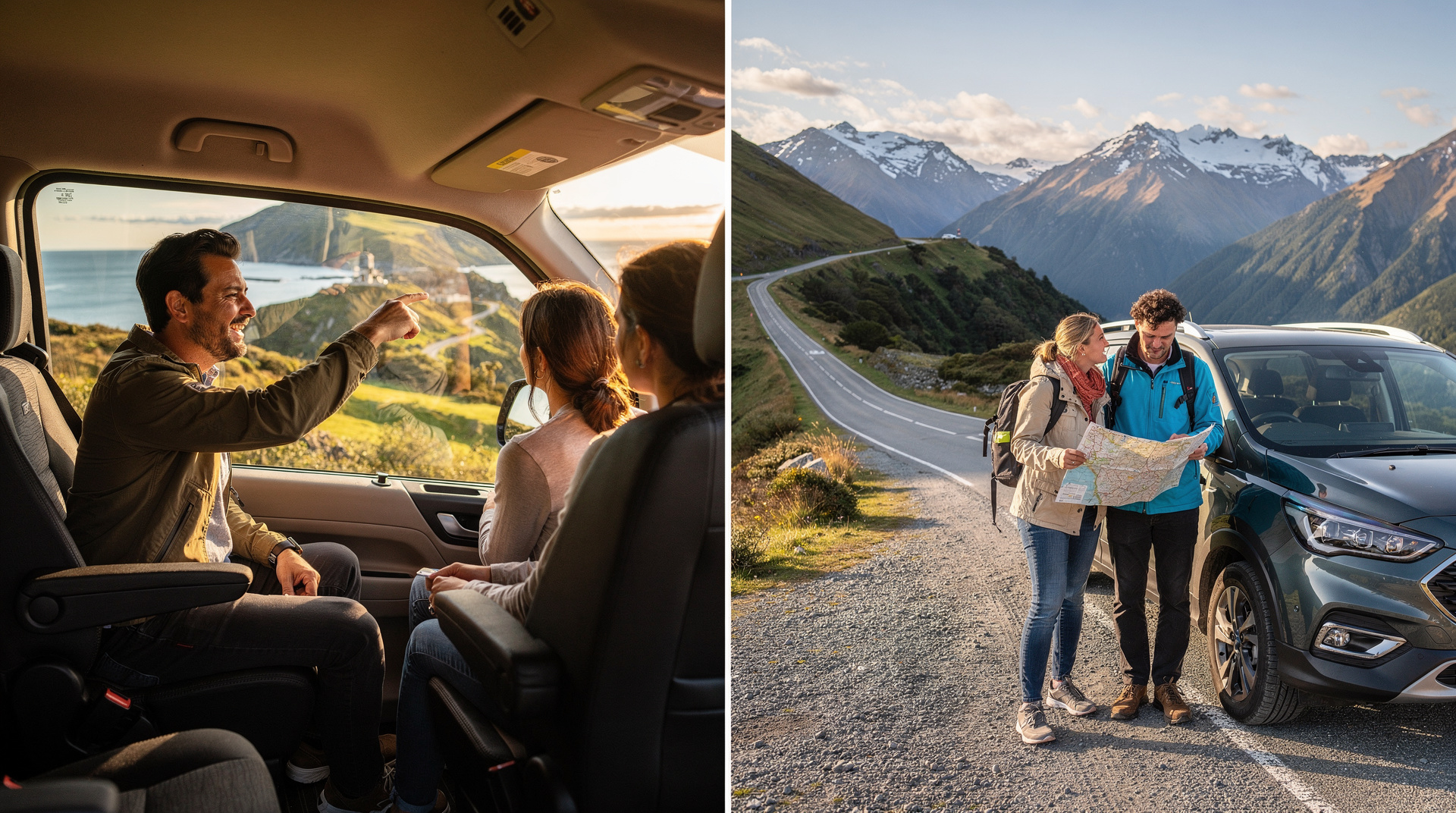
Private tour vs self-drive in New Zealand
Private tour vs self-drive in New Zealand: honest cost breakdown, when each wins, and how to combine both. NZD/USD/EUR prices throughout.
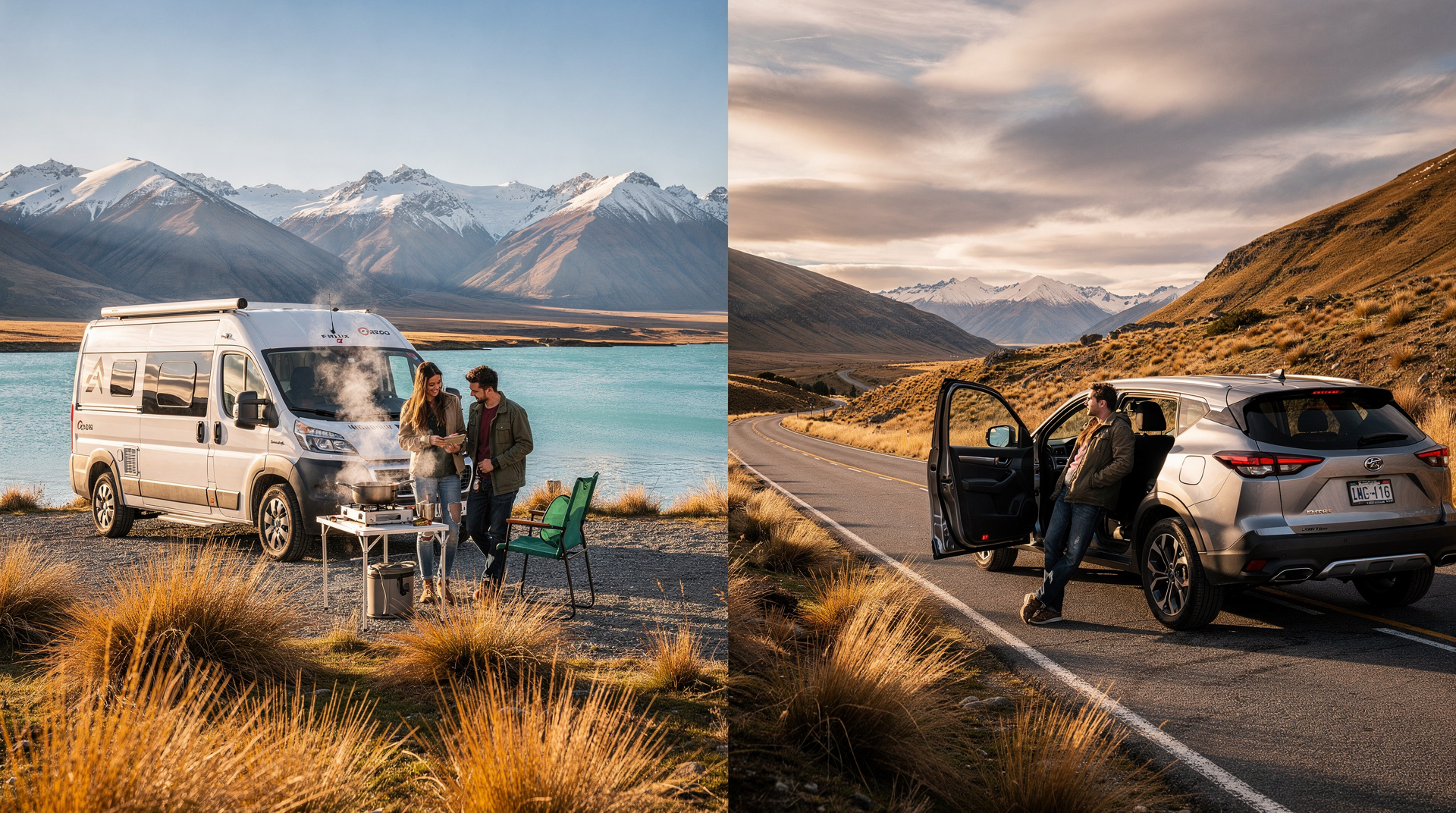
Campervan vs car rental in New Zealand
Honest campervan vs car rental comparison for NZ: real costs, freedom camping rules, who should choose each, and what the brochures don't tell you.
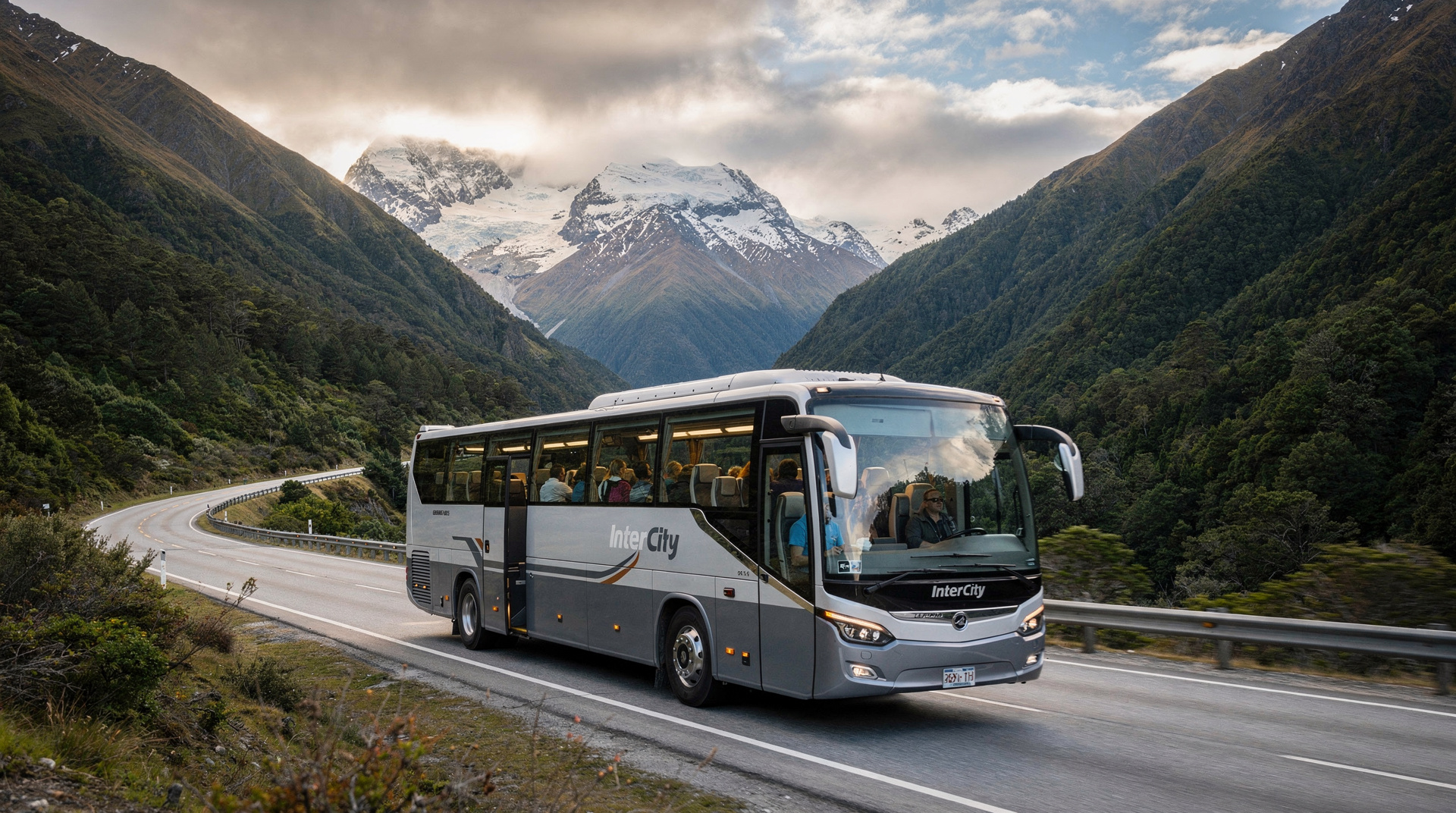
InterCity bus guide
Complete InterCity bus guide for NZ: main routes, FlexiPass vs point-to-point, actual journey times, and when the bus is smarter than renting a car.

First time in New Zealand
Complete first-timer's guide to NZ: costs, logistics, Maori culture, what to book early, and how to structure 7–21 days.
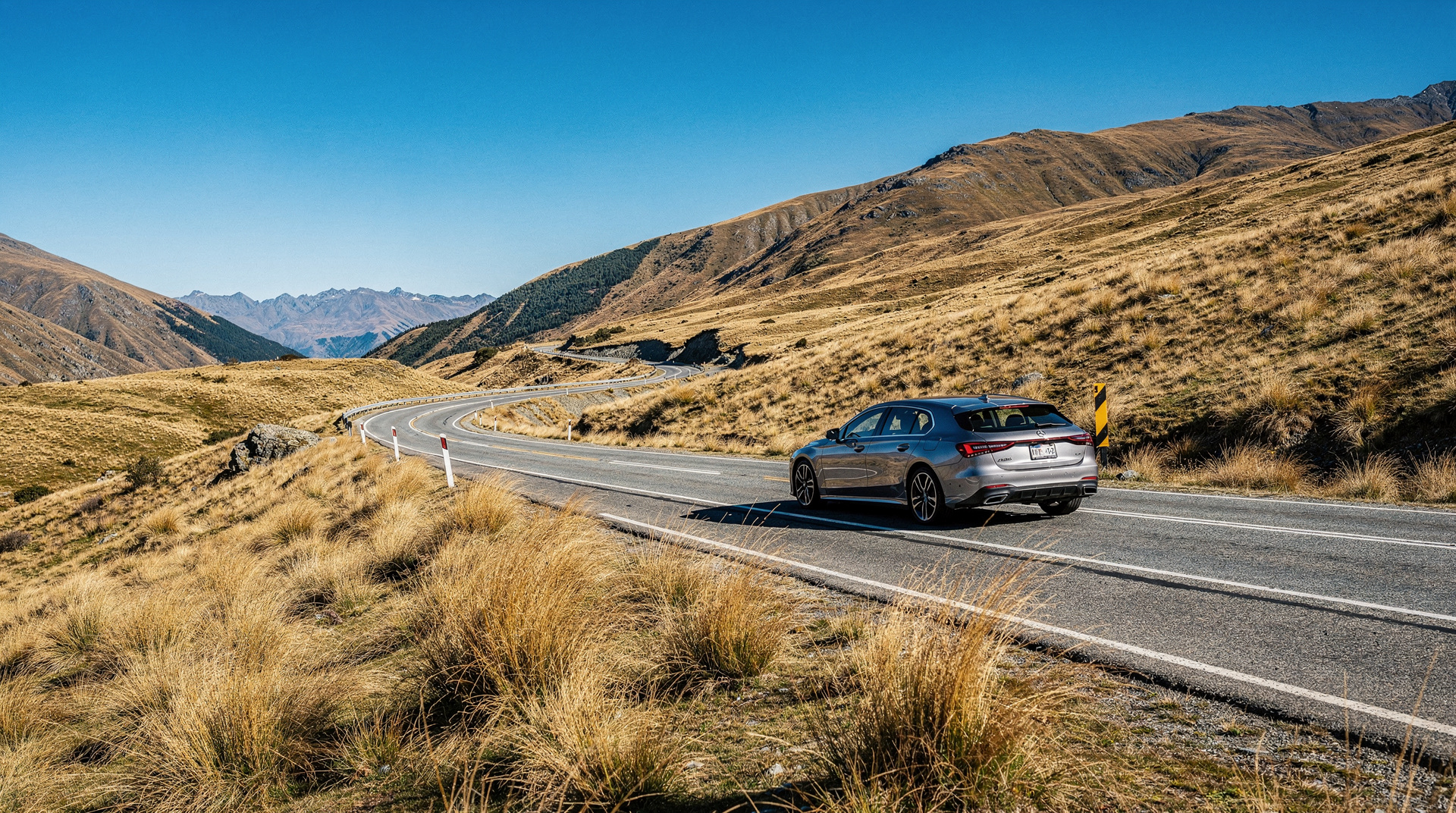
New Zealand self-drive itinerary — 14 days, car and motel
The classic 14-day NZ self-drive road trip by rental car and motels: both islands, ferry crossing, honest road times and costs in NZD, USD, and EUR.