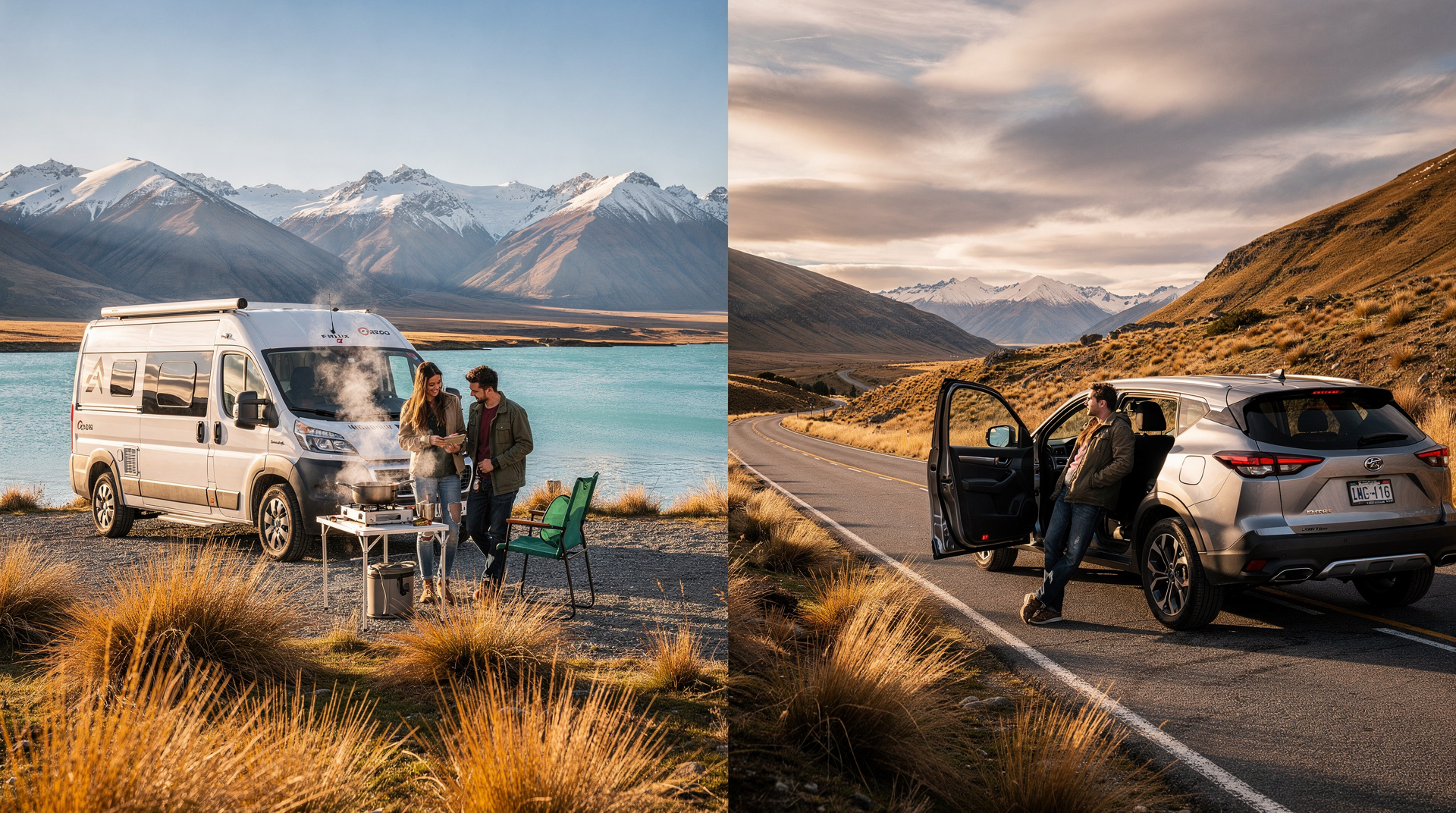
Campervan vs car rental in New Zealand
Is a campervan or a rental car better for New Zealand?
Campervans win for couples or pairs doing 10+ days who want flexibility and nature access. Cars plus accommodation win for solo travellers, groups of 3-4, or anyone who values comfort and showers. The cost break-even is roughly 10 days for two people. Below that, or travelling solo, car wins on cost almost every time.
The question every New Zealand trip planning starts with
“Should we rent a campervan?” New Zealand has one of the most developed campervanning cultures in the world — the country genuinely suits it. Mountains, lakes, coastal pull-offs, freedom camping areas, and a network of holiday parks (campgrounds) exist precisely for this style of travel.
But the campervan dream and the campervan reality have diverged significantly over the past decade. Freedom camping restrictions have tightened dramatically since the Freedom Camping Act was amended in 2022. Holiday parks have increased prices. Campervan hire costs have risen with global supply constraints. And the romance of “sleeping wherever you want” has been complicated by enforcement patrols in popular areas.
This guide gives you the honest calculation: who should hire a campervan, who should rent a car, and what it actually costs in 2026.
| Best for | Couples/pairs, 10+ days, nature-heavy South Island or Northland routes |
| Break-even | Roughly 10 days for two people sharing |
| Cost (2 people, per day) | Around NZD 160-210 campervan vs NZD 190-250 car + motel |
| Booking window | 3-6 months ahead for December-February |
| Licence needed | Standard car licence (under 6,000kg GVM) |
Cost comparison: base numbers
All costs per person per day (NZD + USD + EUR), based on a 14-day trip for two people. April 2026 market rates.
Campervan route
| Cost item | NZD/day | USD/day | EUR/day |
|---|---|---|---|
| Campervan hire (2-berth, compact) | 110-160 | 66-96 | 61-88 |
| Fuel (diesel, ~150km/day) | 40-60 | 24-36 | 22-33 |
| Holiday park site | 30-50 | 18-30 | 17-28 |
| Freedom camping (eligible nights) | 0 | 0 | 0 |
| Food (self-catering) | 40-55 per person | 24-33 | 22-30 |
| Activities (same as car) | Variable | — | — |
| Total per person (2 sharing) | ~NZD 160-210 | ~USD 96-126 | ~EUR 88-116 |
Car + accommodation route
| Cost item | NZD/day | USD/day | EUR/day |
|---|---|---|---|
| Small sedan rental | 55-90 | 33-54 | 30-50 |
| Fuel (petrol, ~150km/day) | 30-50 | 18-30 | 17-28 |
| Budget motel/hostel | 80-130 per person | 48-78 | 44-72 |
| Food (mix eating in/out) | 55-80 per person | 33-48 | 30-44 |
| Activities (same) | Variable | — | — |
| Total per person | ~NZD 190-250 | ~USD 114-150 | ~EUR 105-138 |
Reading the numbers: For two people, campervanning is cheaper per person per day than car + mid-range accommodation — but only once the van cost is split two ways. Solo: completely different calculation (see below).
When campervanning wins
Two people, 10+ days, primarily South Island or Northland: This is the sweet spot. Two people splitting a compact campervan hire, doing 50-60% of nights at freedom camping locations (free) and the rest at holiday parks (NZD 35-55/night for a site), eating mostly self-catered, and focusing on nature-heavy itineraries.
Itineraries where campervanning shines:
- Northland loop (Cape Reinga, Bay of Islands, Hokianga)
- West Coast South Island (Hokitika, Franz Josef, Fox, Haast)
- Catlins (south of Dunedin — isolated, beautiful, terrible hotel options)
- Aoraki/Mt Cook area (no town infrastructure; holiday parks are the primary accommodation)
- Nelson-Abel Tasman corridor
Freedom: You can stop anywhere legal. A stunning lake view at sunset, an unexpected waterfall, a wool-shed thunderstorm — a campervan absorbs all of this; a hotel forces you to pre-plan and pay cancellation fees.
When car + accommodation wins
Solo travellers: A campervan hire for one person costs the same as for two — NZD 100-180/day. Divided by one person, that is double the per-person cost. A solo traveller sleeping in a hostel dorm (NZD 35-55/night) and driving a small sedan (NZD 55-90/day) pays far less.
Groups of 3-4: A large campervan (4-6 berth) for a group sounds logical but costs NZD 180-280/day in hire. At that price point, Airbnbs or motels shared among 4 people are comparable in cost and substantially more comfortable.
Short trips (under 10 days): The setup costs of campervanning (orientation time, holiday park logistics, cooking in a small kitchen) eat into efficiency on a short trip. A 7-day North Island highlights trip from Auckland is better done with a car, given the hotel infrastructure in Rotorua and Wellington.
Travellers who prioritise showers and Wi-Fi: Honest statement: campervans smell after 10 days. The showering at holiday parks works fine, but it requires time and coin-operated systems (NZD 1 per 3 minutes, typically). If a long hot shower at the end of a hiking day is essential to your wellbeing, factor this in.
Winter travel: Campervanning in winter (June-August) on the South Island is cold. Well-equipped campervans have diesel heaters, but poorly specified models rely on the engine heater. Check the heater specification carefully when booking.
Freedom camping: the rule change
Pre-2022, freedom camping (sleeping outside designated holiday parks) was relatively liberal in New Zealand. Post-2022 Freedom Camping Act amendments gave councils far more power to restrict it.
Current status (2026):
- Freedom camping is legal only in designated areas
- Most areas adjacent to popular tourist towns (Queenstown, Wanaka, Te Anau) are now restricted
- North Island freedom camping is generally more restricted than South Island
- Penalties for illegal freedom camping: NZD 200-400 fine per night
Self-containment certification: A certified self-contained campervan (with a toilet and grey water tank) has access to more freedom camping areas than a non-certified van. When hiring, ask specifically about self-containment certification (look for the NZ Motorcaravan Association sticker).
Finding legal freedom camping spots: The CamperMate app is the most comprehensive free resource, updated regularly with DOC freedom camping areas, council restrictions, and community reviews.
Campervan types and costs
| Type | Best for | Hire cost/day (NZD) |
|---|---|---|
| Compact 2-berth (Toyota HiAce conversion) | Couples, budget | NZD 100-150 |
| Medium 2-berth (purpose-built, self-contained) | Couples, more comfort | NZD 140-200 |
| Large 4-berth (Maui/Britz style) | Families or 3-4 people | NZD 180-280 |
| Luxury motorhome | Premium travellers | NZD 300-500+ |
Major operators:
- Jucy (budget, younger traveller focus, good value)
- Maui (mid-range, reliable fleet, slightly older clientele)
- Britz (Maui sister brand, similar quality)
- Wilderness (premium self-contained, eco-focused)
- United Campervans (competitive pricing, good reviews)
Book 3-6 months ahead for peak season (December-February). October-November and March-April offer 20-30% lower hire rates and fewer crowd issues at holiday parks.
One-way rentals
One-way hire (pick up Auckland, drop off Christchurch after the Cook Strait ferry) typically incurs a relocation fee of NZD 200-500 depending on operator and season. This is often worth paying for a linear North-to-South itinerary rather than backtracking. Check operator pricing for both ways — sometimes one direction is cheaper than the other due to fleet imbalances.
Insurance and excess — the cost most people forget
Base campervan hire rates rarely include full insurance. Standard excess on a compact campervan runs NZD 3,500-5,000 per incident unless you buy it down. Excess reduction packages typically cost NZD 25-45/day and bring the liability down to NZD 0-500. For a 14-day hire, that is NZD 350-630 added to the headline rental price — a number that rarely appears in the marketing comparison between campervan and car costs, but changes the calculation meaningfully. Car rentals carry the same logic but the excess amounts are usually lower (NZD 1,500-3,000) because the vehicles are smaller and cheaper to repair.
Windscreen and single-vehicle accident cover: Gravel roads (common on the West Coast and in Central Otago) chip windscreens routinely. Check whether the excess reduction package covers windscreen and tyre damage separately — some operators exclude these and charge full replacement cost even with the “reduced” excess purchased.
Credit card travel insurance: Some premium credit cards include rental vehicle excess cover, which can save the daily excess-reduction fee. Confirm the policy explicitly covers campervans/motorhomes in New Zealand, as some policies exclude vehicles over a certain size or value.
Electric and hybrid options
Full electric campervans remain rare in NZ hire fleets as of 2026 — charging infrastructure in remote areas (Catlins, Fiordland approaches, West Coast) is still patchy enough that most operators stick with diesel for range confidence. Hybrid rental cars, by contrast, are now mainstream and worth requesting: fuel savings of 30-40% on the Christchurch-Queenstown or Auckland-Bay of Islands corridors add up over a two-week trip, and hybrids are readily available from the major agencies at a similar price to standard petrol cars.
If a genuinely electric road trip matters to you, a car (not a campervan) plugged into the growing public fast-charger network is the more realistic 2026 option — see the driving in New Zealand guide for charger coverage by region.
The Cook Strait crossing with a campervan
Both Interislander and Bluebridge carry campervans. A standard campervan (under 7.3m length, under 2.5m height) fits on the standard vehicle rate. Book ahead — campervans take more space on the vehicle deck and peak-season sailings fill with motorhomes. Vehicle rate approximately NZD 300-400 one-way for a standard campervan.
See the Cook Strait ferry guide for full details.
Frequently asked questions about campervanning in NZ
Do I need a special licence to drive a campervan?
No. Standard car licence covers campervans under 6,000kg GVM (all standard hire campervans). For very large motorhomes (some 6-berth models), check if they exceed 6,000kg — a heavy vehicle endorsement may be needed, but this is rare for tourist hire vehicles.
Can I use Airbnb instead of holiday parks?
Yes, and increasingly popular. Airbnb with driveway or off-street parking where hosts permit overnight vehicle stay. The Campermate app also lists some private property parking arrangements. This is not the same as freedom camping and is arranged with the property owner’s consent.
What about cooking: is campervan self-catering realistic?
Very realistic. Two-burner gas hobs are standard. The limitation is refrigerator size (typically 40-60 litres) and bench space. Supermarkets (Countdown/Woolworths NZ, New World, Pak’nSave) are in all significant towns and most small towns. Self-catering for two people costs NZD 70-100/day for good food. Restaurant meals for two would cost NZD 80-150/day — so the saving is meaningful over a 2-week trip.
Are campervans reliable?
From major operators: generally yes, particularly for purpose-built modern vans. From budget operators or converted older vehicles: variable. Check reviews on CamperMate and Google for specific operators before booking. A breakdown in remote South Island is a serious inconvenience; ask what the operator’s breakdown cover includes and how quickly they can reach you.
Is it cheaper to do a campervan and car combo — say, car for the North Island, campervan for the South?
Yes, and this is an underused strategy. Many travellers do a 5-7 day North Island loop by car (better hotel/motel infrastructure in Auckland, Rotorua, and Wellington makes a car more efficient there) and switch to a campervan for the South Island, where freedom camping areas and holiday parks are denser and the nature-heavy itinerary suits van life. The main friction is the Cook Strait ferry logistics of returning one vehicle and picking up another — plan an extra half-day in Wellington or Picton for the handover.
Related guides and itineraries
- Driving in New Zealand — left-side rules, gravel roads
- Cook Strait ferry guide — taking a campervan between islands
- New Zealand on a budget — full cost breakdown
- 14-day New Zealand itinerary
- West Coast guide — prime campervan territory
- Freedom camping in New Zealand — what to pack for van life
- Best time to visit New Zealand — when prices are lowest
Related guides
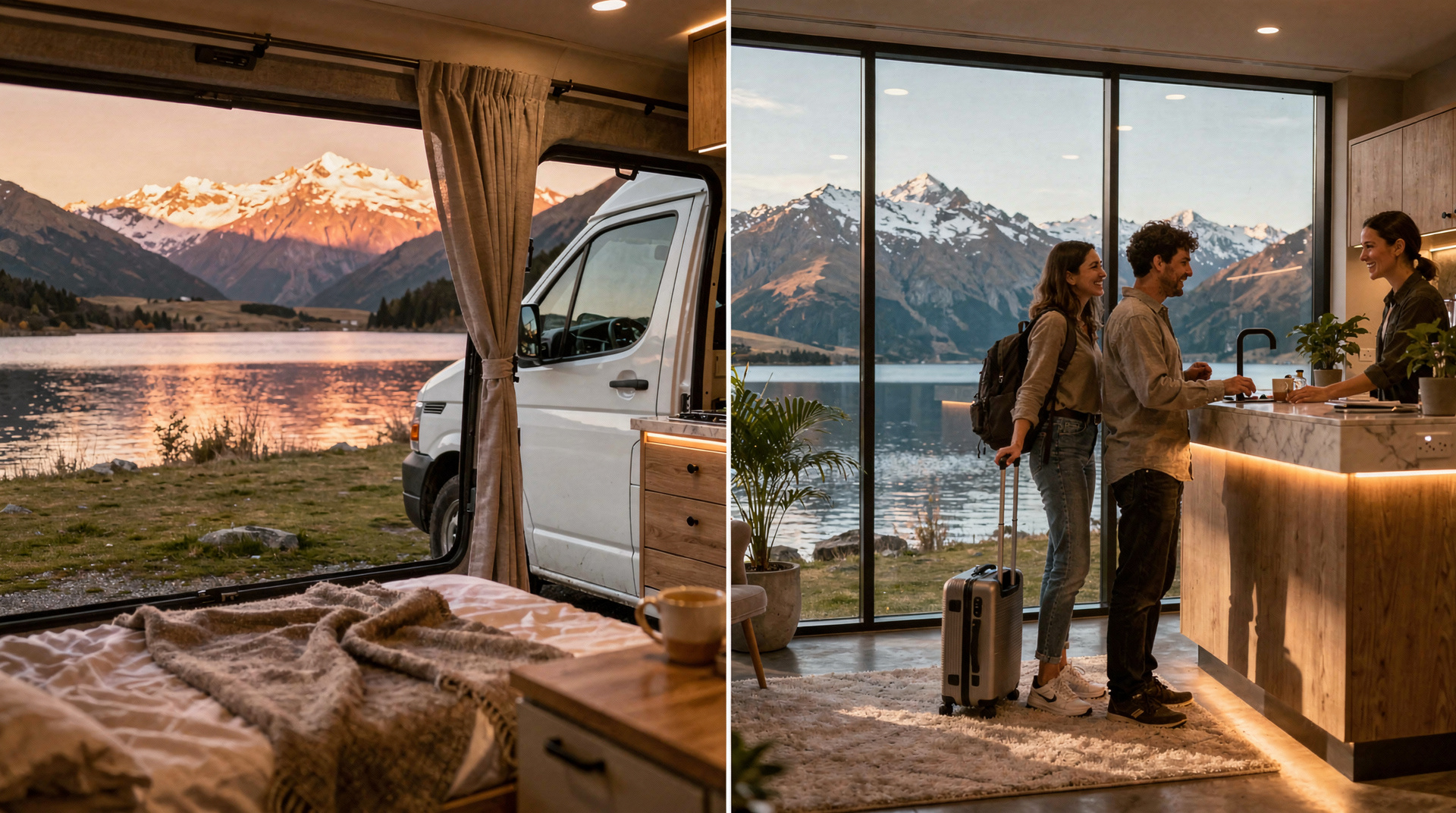
Campervan vs car and motel in New Zealand
Campervan vs car and motel in New Zealand: full cost breakdown, when each wins, and the tipping point. NZD/USD/EUR prices for both options.
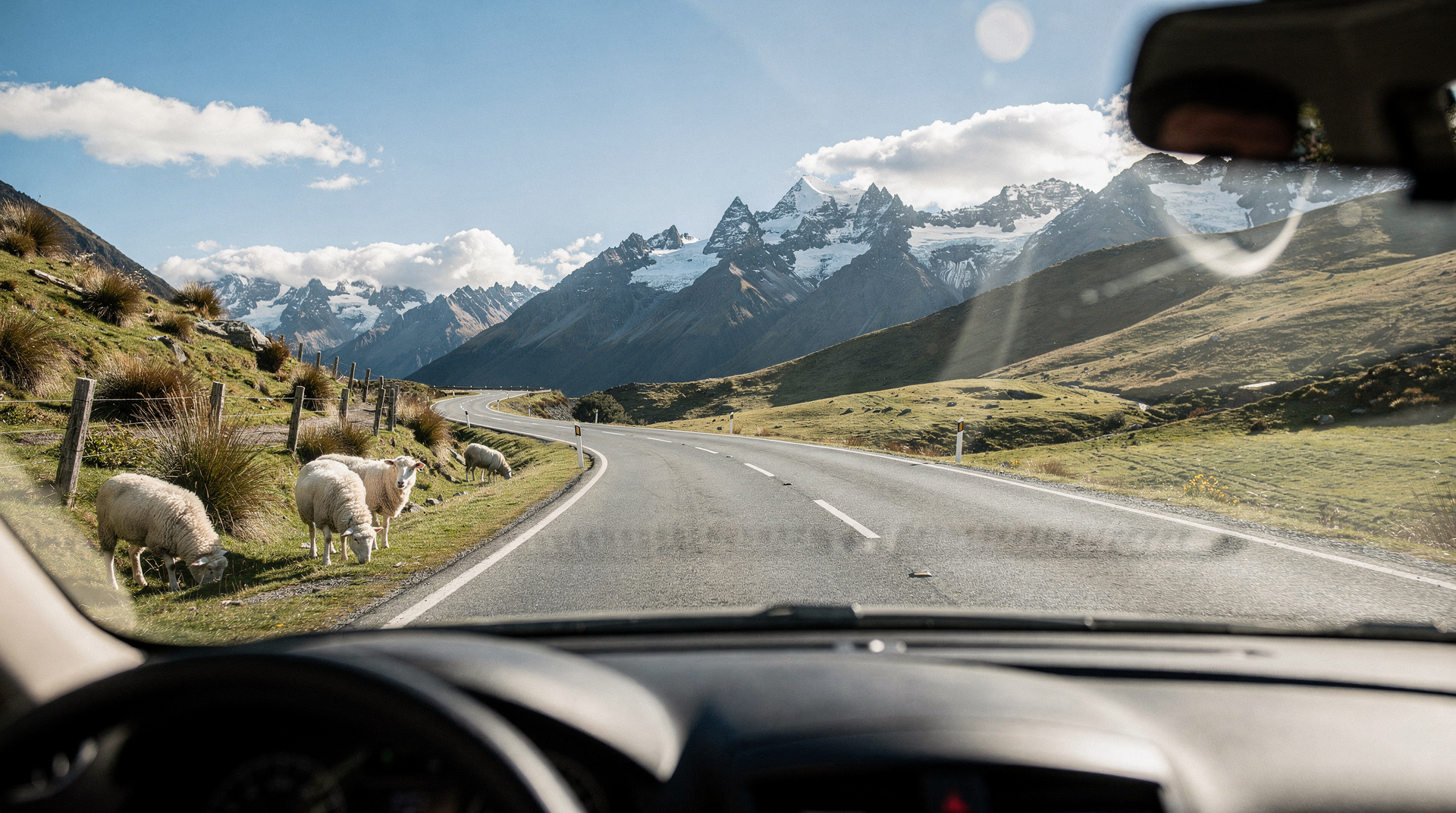
Driving in New Zealand
Honest driving guide for NZ: left-side rules, gravel road etiquette, why GPS lies, fuel costs, one-lane bridges, and what rental companies don't tell you.
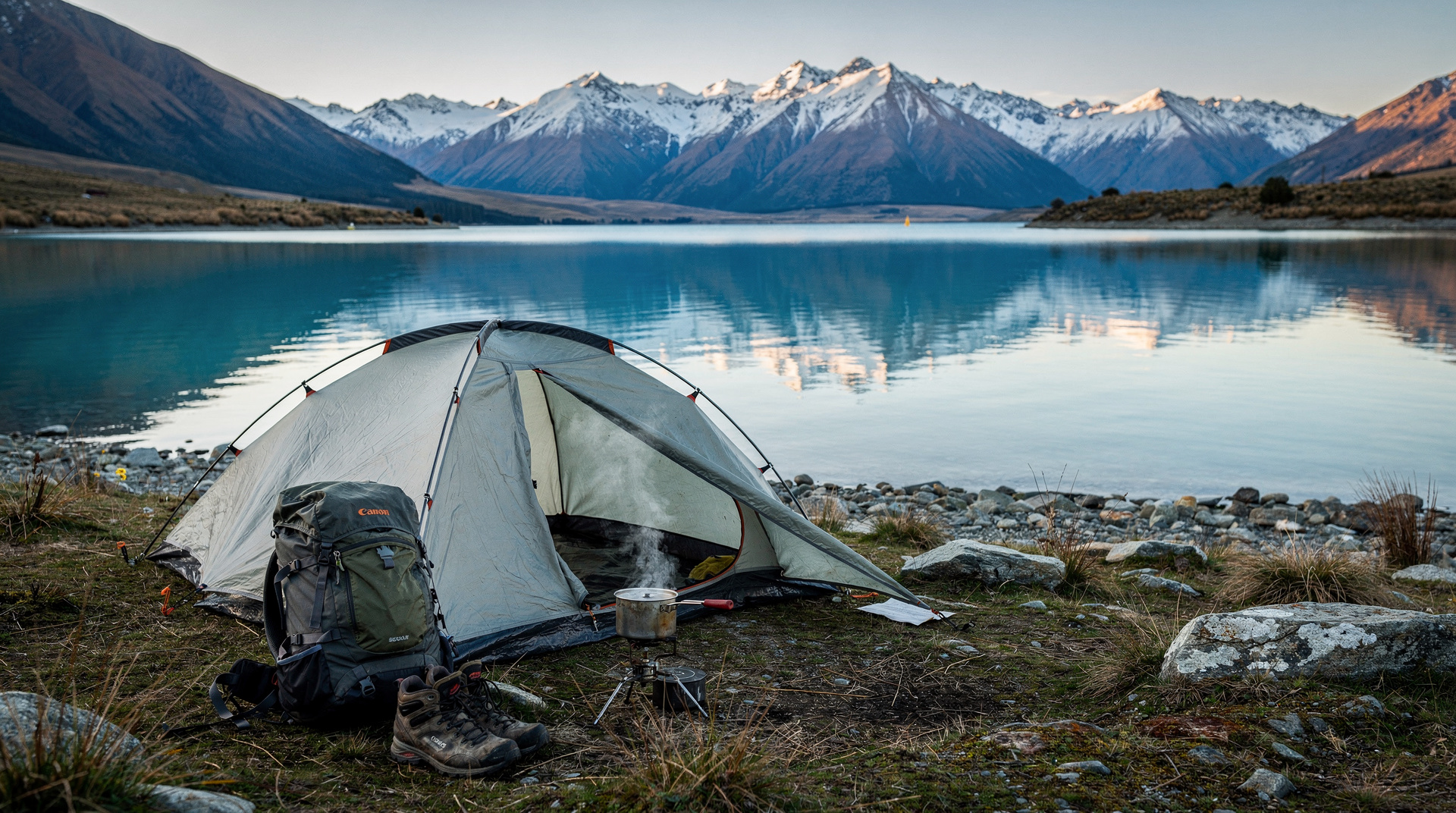
New Zealand on a budget
Honest budget guide to NZ: real daily costs, where to save, where not to cheap out, free things, and how to stretch NZD on a backpacker or mid-range budget.
Domestic flights in New Zealand
Guide to flying domestically in NZ: Air New Zealand vs Jetstar, cheapest routes, Auckland-Queenstown timing, and when flying beats 10 hours of driving.
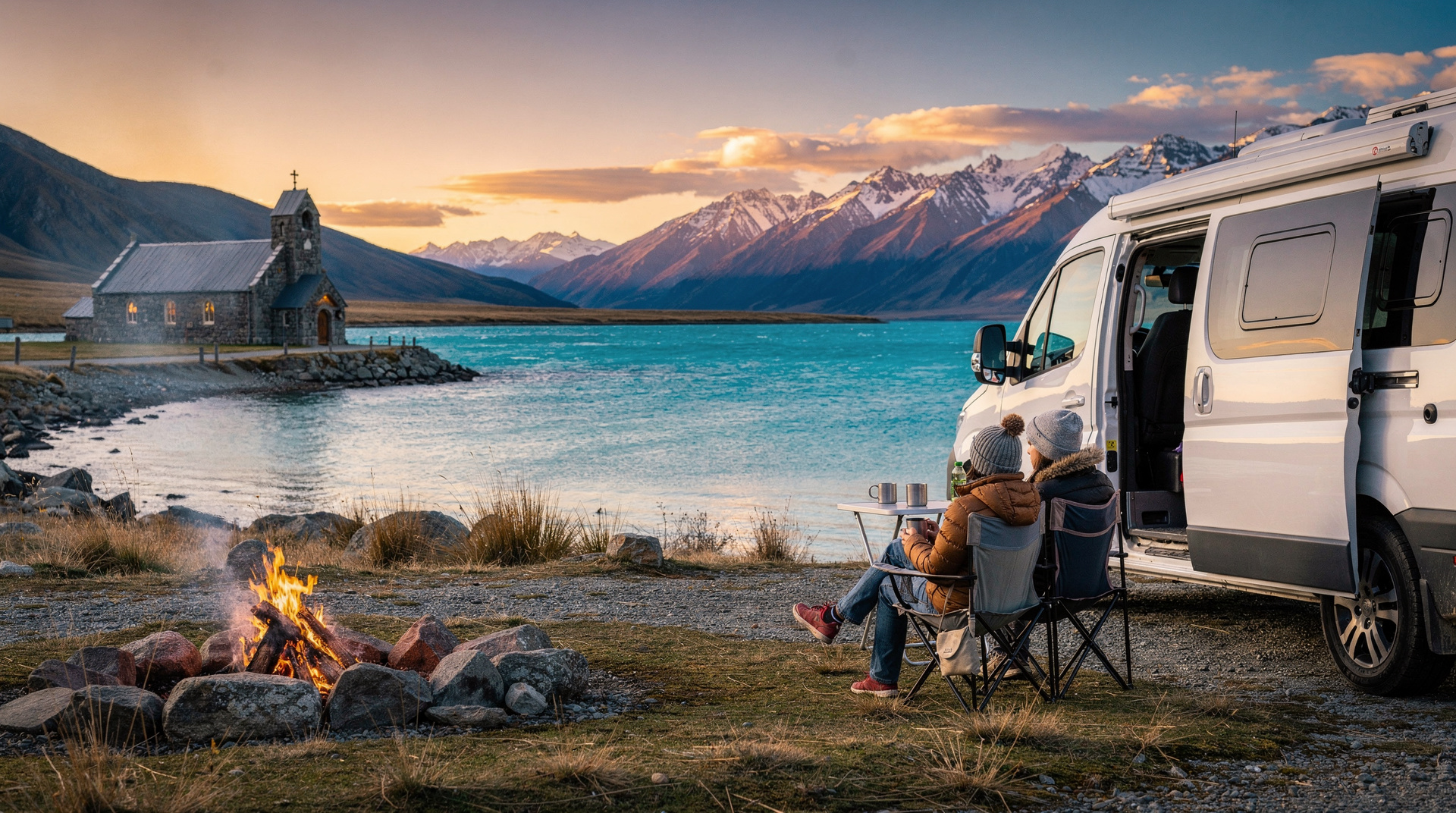
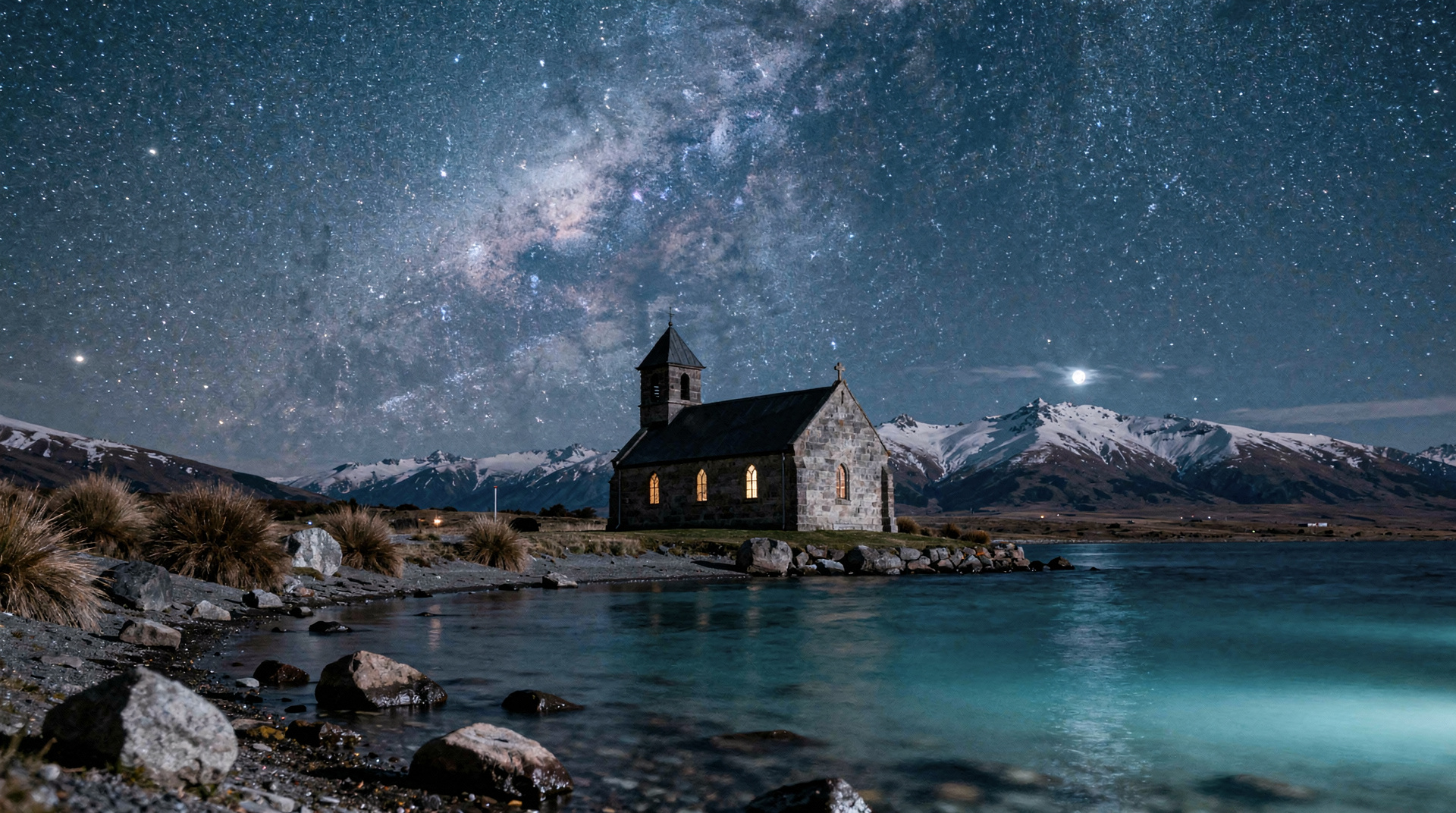
New Zealand campervan road trip — 21 days, both islands
21-day NZ campervan road trip covering both islands: freedom camping rules, dump stations, powered sites, and the best scenic stops. Real NZD/USD/EUR costs.
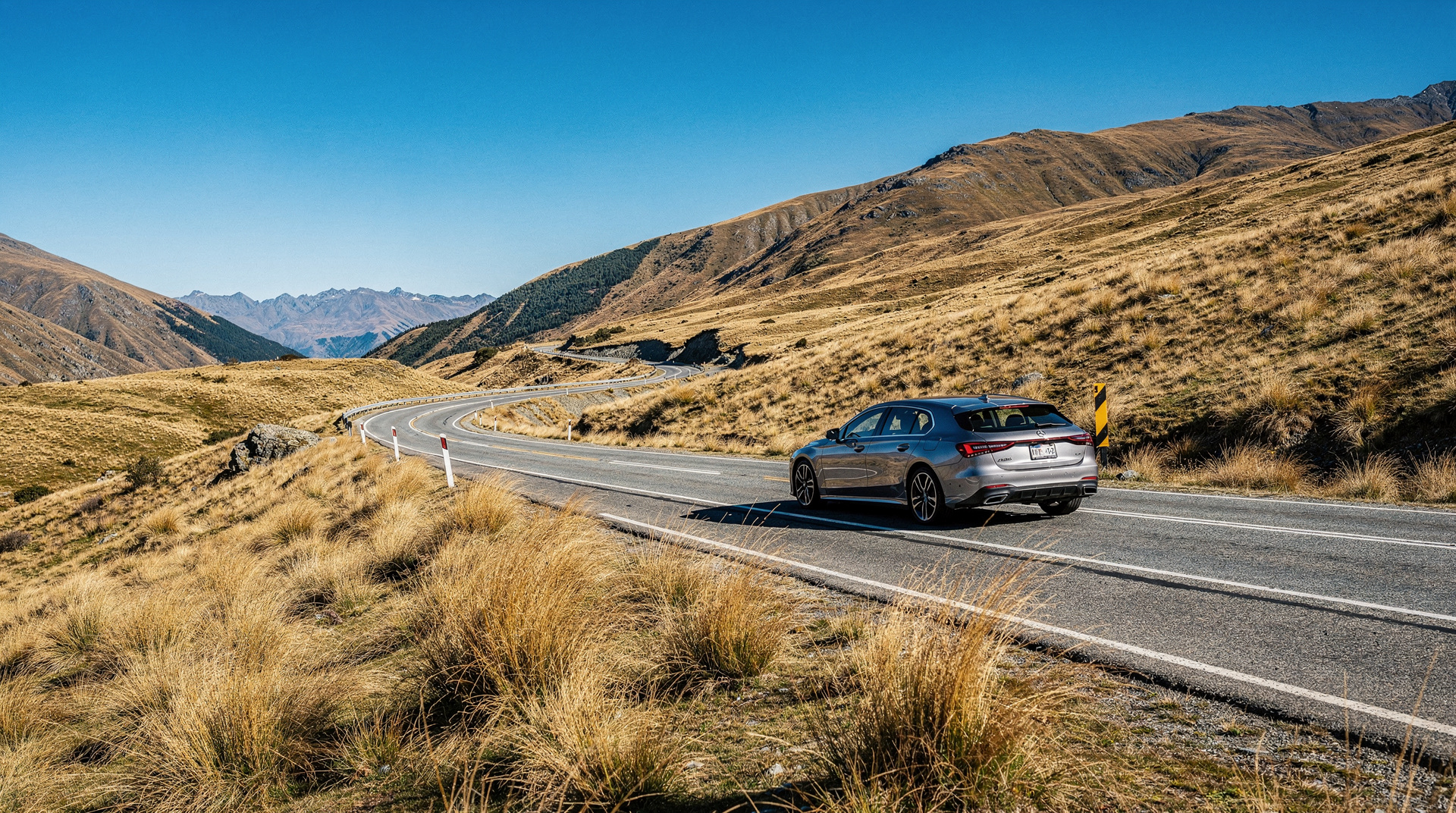
New Zealand self-drive itinerary — 14 days, car and motel
The classic 14-day NZ self-drive road trip by rental car and motels: both islands, ferry crossing, honest road times and costs in NZD, USD, and EUR.
Last reviewed: