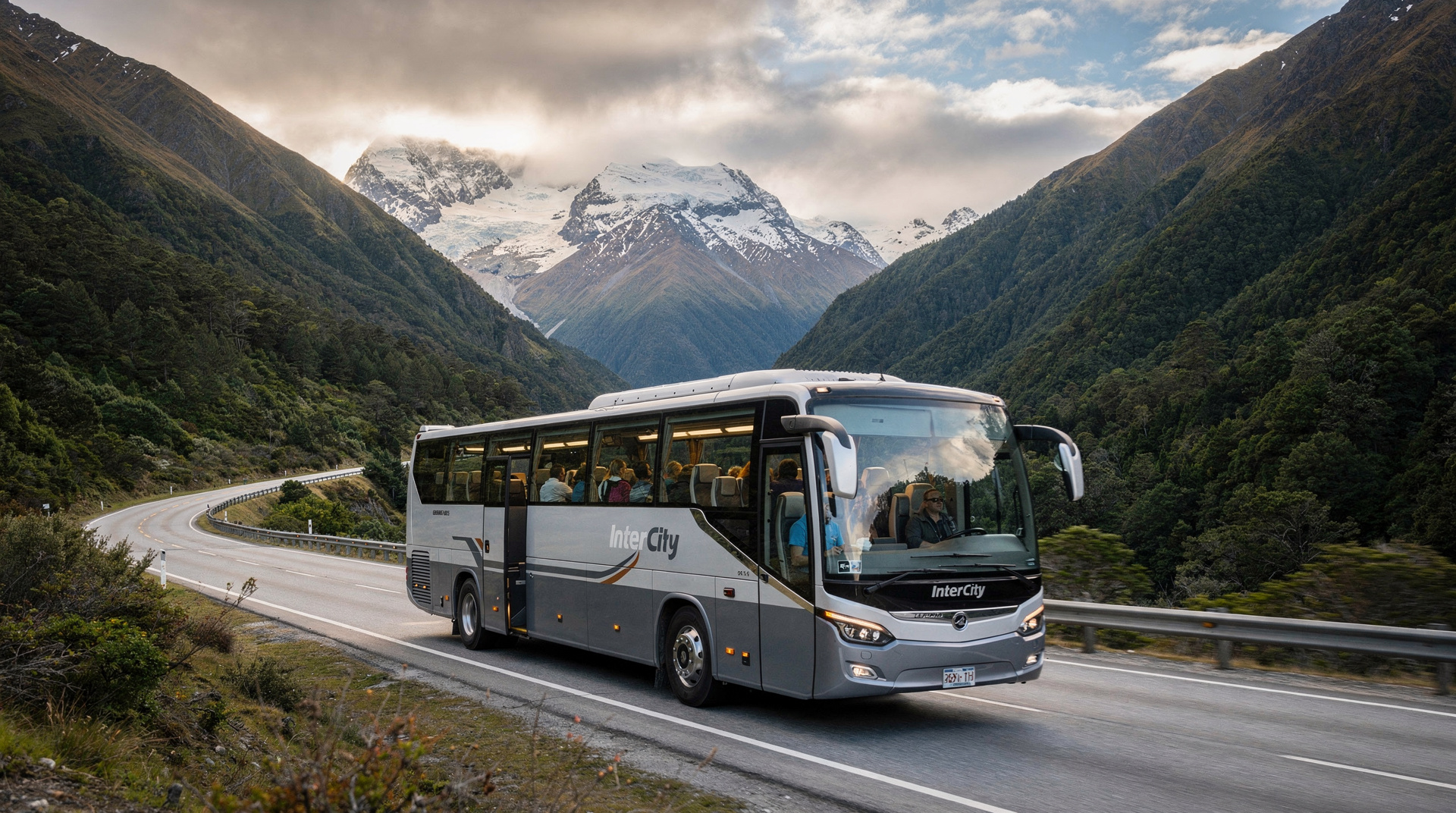
InterCity bus guide
Is InterCity bus a good way to travel New Zealand?
Yes, for backpackers and travellers without a driving licence. InterCity covers most main tourist routes at reasonable prices (NZD 20-55 per leg). The FlexiPass (pay for hours of travel, not specific routes) offers good flexibility. Downsides: long journey times, infrequent services to some towns, and you lose the freedom to stop spontaneously.
Bus travel in New Zealand: realistic expectations
New Zealand’s intercity bus network is dominated by InterCity Group, which operates under the InterCity and Newmans Coach Lines brands. It is the most comprehensive national bus network covering both islands, with connections to most major tourist destinations.
The honest reality: bus travel in New Zealand is slower, less flexible, and only modestly cheaper than flying on busy routes. But for travellers without driving licences, those on extended Working Holiday Visas, or backpackers who prefer not to stress about right-hand driving, it is a perfectly functional way to move around the country.
The FlexiPass system, in particular, offers genuine flexibility that suits people whose itineraries evolve as they travel — a rare flexibility among point-to-point transport options.
| Where | Nationwide — both islands, most main tourist routes |
| Cost | around NZD 20-90 per leg point-to-point; FlexiPass from NZD 195 |
| Time needed | longer than driving — Auckland-Wellington runs 8-9 hours |
| Getting there | book online at intercity.co.nz or through GYG |
| Best for | non-drivers, backpackers, Working Holiday Visa travellers |
Main InterCity routes
North Island key connections:
- Auckland → Rotorua: 4h15 (via Matamata/Hobbiton connection)
- Auckland → Wellington: 8h-9h (via Hamilton and Palmerston North)
- Auckland → Paihia/Bay of Islands: 3h45
- Wellington → Palmerston North: 2h
- Rotorua → Wellington: 5h30
South Island key connections:
- Christchurch → Queenstown: 6h30 (via Dunedin or via SH8 inland)
- Christchurch → Dunedin: 5h15
- Christchurch → Greymouth: 4h30 (the road version of the TranzAlpine route)
- Queenstown → Milford Sound: not directly served (shuttle operators separately)
- Queenstown → Dunedin: 5h
- Picton → Christchurch: 5h30 (connects with the Cook Strait ferry)
- Nelson → Christchurch: 5h30
Note on Milford Sound: InterCity does not serve Milford Sound directly. Dedicated shuttle bus operators from Te Anau (the primary gateway) operate separately. See the Te Anau section below.
Pricing: point-to-point vs FlexiPass
Point-to-point fares are booked for specific routes and departure times. These are generally cheapest when booked 2-4 weeks ahead.
Typical fares (advance booking, one-way):
- Auckland to Rotorua: NZD 25-45 (USD 15-27 / EUR 14-25)
- Auckland to Wellington: NZD 55-90 (USD 33-54 / EUR 30-50)
- Christchurch to Queenstown: NZD 55-90 (USD 33-54 / EUR 30-50)
- Christchurch to Dunedin: NZD 40-70 (USD 24-42 / EUR 22-39)
FlexiPass is a prepaid block of travel hours that can be applied to any InterCity route in any order. You buy hours, then book routes as you decide. No commitment to specific dates when you purchase.
| FlexiPass Hours | Cost (NZD) | Approx. USD | Approx. EUR |
|---|---|---|---|
| 15 hours | NZD 195 | USD 117 | EUR 107 |
| 20 hours | NZD 249 | USD 149 | EUR 137 |
| 30 hours | NZD 359 | USD 215 | EUR 198 |
| 60 hours | NZD 639 | USD 383 | EUR 352 |
How to estimate hours needed: Auckland to Rotorua uses ~4 hours of pass time; Christchurch to Queenstown uses ~6 hours. A typical North Island circuit (Auckland, Bay of Islands, Rotorua, Wellington) uses 15-20 hours; South Island highlights (Christchurch, Queenstown, Dunedin, back to Christchurch) uses 20-30 hours.
Is FlexiPass worth it? Only if your itinerary is genuinely undecided. If you know your route in advance, point-to-point bookings 2-3 weeks ahead are usually cheaper than FlexiPass hour-rates. FlexiPass earns its value for Working Holiday travellers who might stay in a place longer than expected, or backpackers who follow weather or new friends.
The Naked Bus alternative
Naked Bus was once the main budget alternative to InterCity, but it has significantly reduced operations and reliability since the mid-2010s. As of 2026, most travellers default to InterCity. Mana Bus operates a Wellington-Palmerston North service as a budget option. Neither covers the full network.
For the most route coverage across NZ, InterCity remains the default.
Hop-On Hop-Off passes
InterCity’s hop-on hop-off passes (sold through Stray Bus and Kiwi Experience) are popular with backpackers doing laps of the country. These differ from FlexiPass in that they follow set routes with fixed stops — more like guided group travel than independent bus use. If you want to meet other backpackers and prefer a social travel environment, Kiwi Experience (which makes specific stops at backpacker lodges and activities) is worth considering. If you want to travel independently and quietly, the standard InterCity network is better.
Journey experience on InterCity
InterCity coaches are modern, air-conditioned, with reclining seats and USB charging points. Wi-Fi is available on most services (speed is adequate for browsing; video streaming is generally poor). Toilets are on board (coach-style, small but functional). One piece of checked luggage plus carry-on are included.
Comfort reality: A 9-hour overnight Auckland to Wellington bus is a long journey. The seats recline partially, but this is not the same as a lie-flat experience. Most travellers on this route prefer the morning bus (departs Auckland around 7-8am) to arrive Wellington mid-afternoon in daylight, rather than an overnight option.
Stops: InterCity coaches make intermediate stops at most towns along the route — useful if you are hopping off in, say, Matamata for Hobbiton before continuing south.
Shuttle buses for specific routes
Beyond InterCity’s network, specialist shuttles serve tourist-specific corridors:
- Tongariro Alpine Crossing: Several shuttle operators run from National Park Village, Whakapapa, Turangi, and Ohakune. Not InterCity.
- Milford Sound from Queenstown: Multiple operators run Queenstown to Milford Sound (passing Te Anau), typically leaving 7-8am and returning 7-8pm — a very long day. An overnight in Te Anau is strongly recommended instead.
- Abel Tasman National Park: Water taxis and shuttle buses from Nelson/Motueka serve the park. Not InterCity.
- Franz Josef/Fox Glacier: Some InterCity service, but many travellers use hop-on/hop-off passes for the West Coast.
Comparing bus vs. car rental
| Factor | InterCity bus | Rental car |
|---|---|---|
| Cost (14 days, 2 people) | NZD 400-640 for passes | NZD 900-1,800 for car + fuel |
| Flexibility | Low-medium (must book stops) | High |
| Rural access | Only where routes go | Everywhere with sealed road |
| Driving stress | None | Left-side adaptation required |
| Spontaneity | Low | High |
| Best for | Non-drivers, backpackers | Couples, families, independents |
The cost advantage of buses for two people is less clear-cut than for one: a car divided between two people is competitive with two bus passes. For solo travellers, bus nearly always beats a solo rental car on cost. The driving in New Zealand guide and campervan vs car rental comparison go deeper on the self-drive side of this decision.
Doing New Zealand entirely without a car
A growing number of travellers — particularly solo backpackers and Working Holiday Visa holders — plan a full New Zealand trip around InterCity, hop-on hop-off passes, and the Cook Strait ferry, with no rental car at all. It’s genuinely workable if you accept the trade-offs: rural attractions off the main routes (many Great Walk trailheads, some wineries, most beaches beyond the main towns) become harder to reach without a shuttle or a booked tour, and your schedule is dictated by bus timetables rather than your own pace.
The NZ without a car itinerary lays out a full route built entirely around InterCity and the ferry — useful as a planning template even if you end up mixing in a few local tours or shuttles for the harder-to-reach spots. Combine it with the airport transfers in New Zealand guide for the first and last mile at each end of domestic flights, since InterCity doesn’t run airport-specific services on every route.
For Working Holiday Visa travellers specifically, InterCity’s FlexiPass is genuinely well suited to the way a WHV year unfolds — see the Working Holiday Visa New Zealand guide for how bus travel typically fits around seasonal work stops.
Frequently asked questions about InterCity buses
Does InterCity go to Milford Sound?
Not directly. The closest InterCity can get you is Queenstown or Te Anau. From Te Anau, separate shuttle and tour operators run to Milford Sound. The Milford Sound coaches from Queenstown (multiple operators) are not InterCity services.
Can I take a bicycle on InterCity buses?
Yes, as a booked extra (NZD 10-20 per trip). Bikes must be in a bag or box; contact InterCity before booking to confirm space is available on your route.
What happens if my InterCity bus is late for a ferry connection?
InterCity does not guarantee ferry connections. If you are relying on an InterCity bus to reach the Interislander or Bluebridge terminal in Wellington, book the bus that arrives at least 90-120 minutes before your ferry departure. Allow buffer — don’t book the closest connection.
Is there an overnight bus option?
Some routes have evening departures that arrive in the morning (Auckland to Wellington being the key example). These are overnight by default given journey length, not marketed as dedicated overnight services with sleeping facilities.
Does InterCity cover the West Coast of the South Island?
Yes, partially. Christchurch to Greymouth is covered. Greymouth to Hokitika to Franz Josef has some service frequency, though less than the main routes. From Franz Josef south to Haast and Queenstown, services are less frequent — check the website for current schedules, as this corridor can have limited options in shoulder season.
Can I plan an entire New Zealand trip without renting a car?
Yes, though it requires more planning around timetables and accepting that some rural attractions are harder to reach. See the NZ without a car itinerary for a route built entirely around InterCity and the ferry, and the New Zealand on a budget guide for how bus travel fits into a lower-cost trip overall.
Is InterCity cheaper than a domestic flight?
For short-to-medium routes booked well ahead, InterCity is usually cheaper than flying, though the time cost is significantly higher — Auckland to Wellington is 8-9 hours by bus versus roughly 1.5 hours flying. For longer routes (Auckland-Queenstown, for example), a well-timed domestic flight can be competitive on price once you value your time. See the domestic flights in New Zealand guide for a direct cost and time comparison.
Related guides and itineraries
- Driving in New Zealand — car alternative
- Domestic flights in New Zealand — faster for key routes
- Cook Strait ferry guide — the North-South crossing
- Airport transfers in New Zealand — first and last mile
- New Zealand on a budget — bus fits budget travel
- Working Holiday Visa New Zealand — bus is popular for WHV holders
- First time in New Zealand — transport overview
Related guides

Driving in New Zealand
Honest driving guide for NZ: left-side rules, gravel road etiquette, why GPS lies, fuel costs, one-lane bridges, and what rental companies don't tell you.
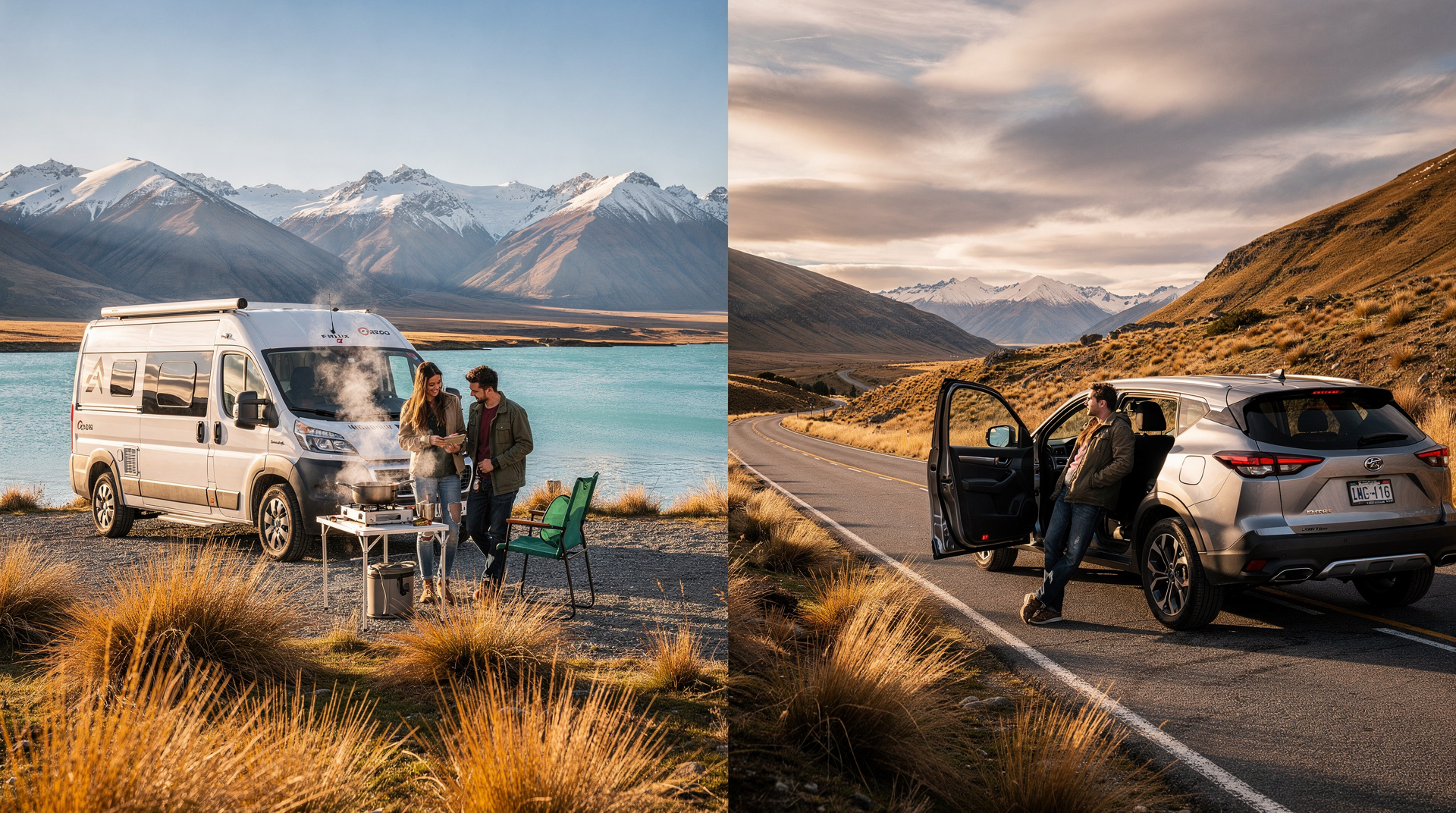
Campervan vs car rental in New Zealand
Honest campervan vs car rental comparison for NZ: real costs, freedom camping rules, who should choose each, and what the brochures don't tell you.

Domestic flights in New Zealand
Guide to flying domestically in NZ: Air New Zealand vs Jetstar, cheapest routes, Auckland-Queenstown timing, and when flying beats 10 hours of driving.

New Zealand on a budget
Honest budget guide to NZ: real daily costs, where to save, where not to cheap out, free things, and how to stretch NZD on a backpacker or mid-range budget.
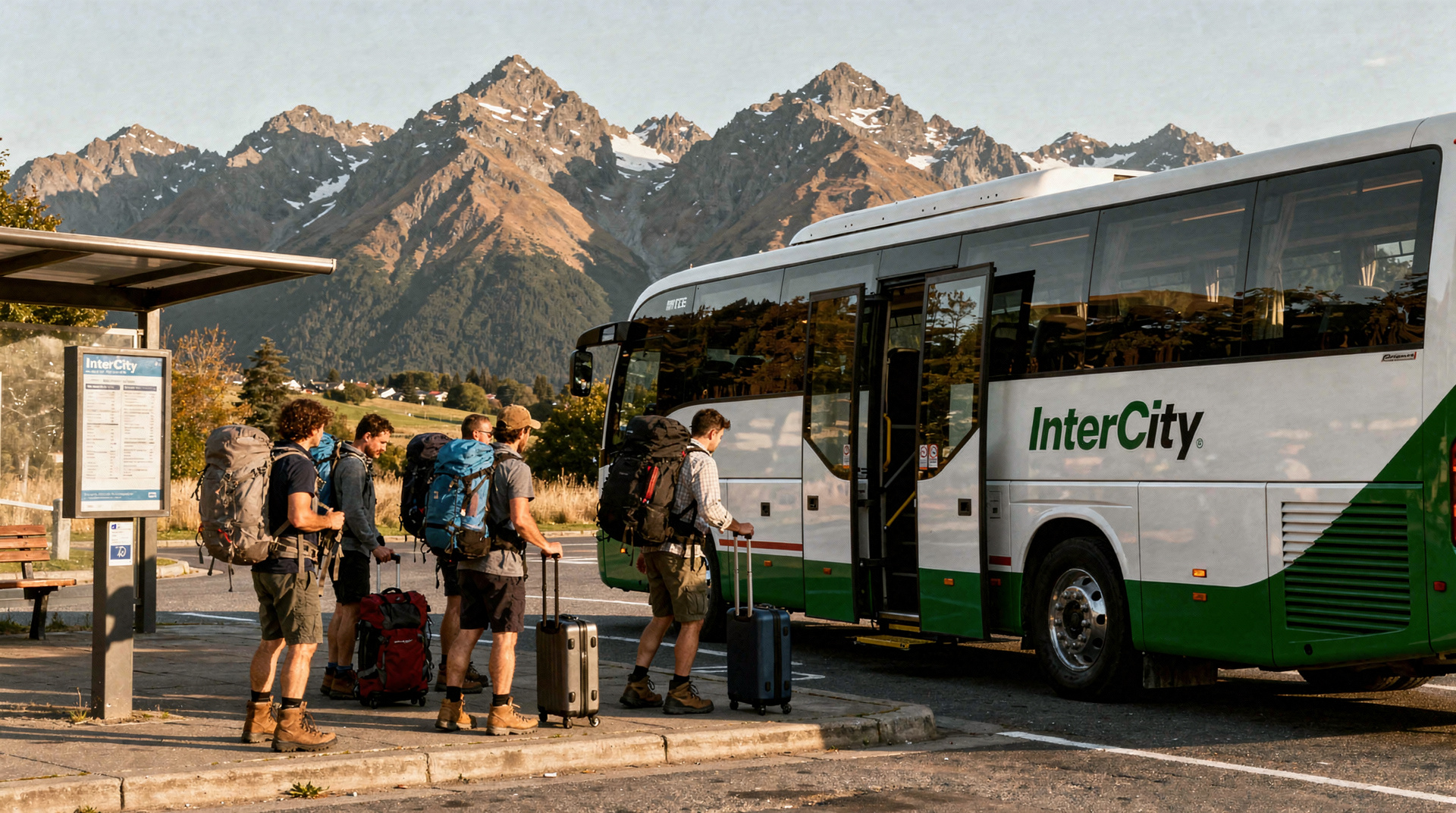
New Zealand without a car — 14 days by train, bus, and plane
14 days in New Zealand without a car: scenic trains, InterCity buses, domestic flights, and ferries. Real NZD/USD/EUR costs and honest trade-offs.

Working Holiday Visa New Zealand
Complete guide to the NZ Working Holiday Visa: age limits by nationality, costs, how to apply, what work you can do, and realistic expectations.
Last reviewed: