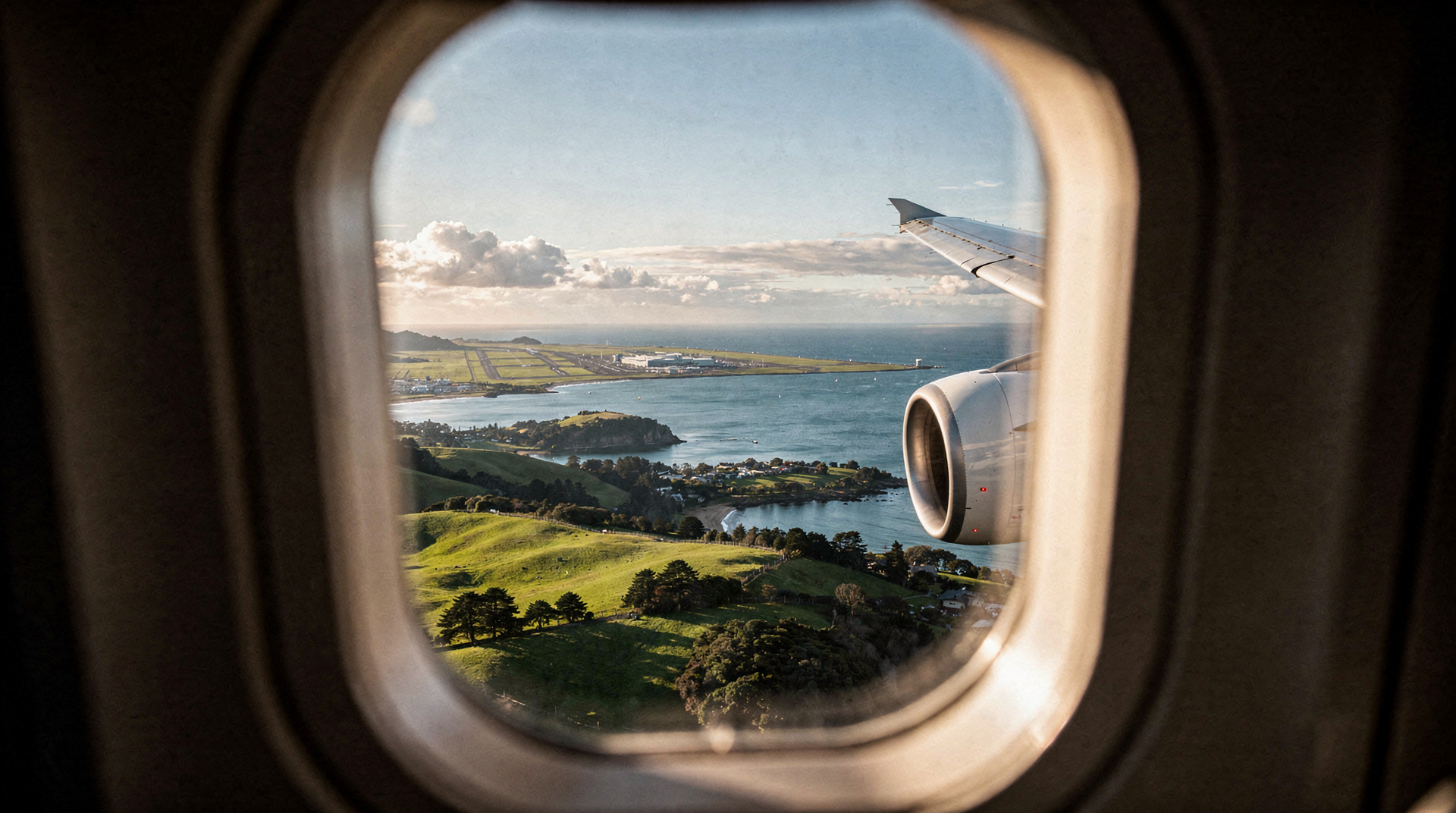
Why New Zealand is worth the flight
| Flight time from Europe | 22-26 hours door to door, via Dubai, Singapore, or Hong Kong |
| Minimum trip length | 14 days to feel like you’ve seen the shape of the country |
| Mid-range daily budget | Around NZD 350-550/couple, incl. accommodation, meals, activities |
| Best value season | Shoulder (March–May, September–November) for cheaper fares |
| Jet lag buffer | 2 full days before any early-start activity |
The flight that almost talked me out of going
Paris to Auckland. Twenty-four hours and forty minutes in the air, plus layovers, plus the numb stupor of an airport transit hall at 3am. I almost convinced myself it wasn’t worth it the first time. The second trip, I didn’t hesitate. By the third, I was calculating dates on the plane home.
This is an honest accounting of what New Zealand costs in time, money, and effort from a European starting point — and why the answer is still yes, if you do it right.
The flight math, honestly
From most major European cities, you’re looking at 22–26 hours of total travel time, door to door, depending on your layover city. The common routes go through Dubai (Emirates), Singapore (Singapore Airlines), or Hong Kong/Shanghai (Cathay, China Eastern). Auckland is the usual entry point; Christchurch is an option if you’re planning to start in the South Island.
Return fares from Paris, Amsterdam, or Frankfurt fluctuate wildly. In high season (December–February, which is New Zealand summer), expect NZD 2,800–4,200 / USD 1,680–2,520 / EUR 1,540–2,310 in economy. Shoulder season (March–May, September–November) drops that range significantly — I’ve paid as little as NZD 1,900 / USD 1,140 / EUR 1,045 booking six months out. Business class exists but puts the trip firmly into mortgage territory.
The practical reality: jet lag from a 10–13 hour time difference is non-trivial. Give yourself two full days on arrival before attempting the Tongariro Alpine Crossing or a 5am whale-watching departure from Kaikoura. This isn’t a weekend long-haul like London to New York. It is, in every meaningful sense, the other side of the world.
What you get for that investment
The honest answer is that New Zealand delivers on the landscape in a way that very few places do. The combination of fjords, volcanoes, glaciers, subtropical forests, golden beaches, and wine regions within a territory roughly the size of the United Kingdom is genuinely unusual. You can drive from a geothermal field to a skifield in three hours. That is not marketing copy — it is geography.
The cultural dimension is also underplayed in most travel content. Maori culture is not a museum exhibit; it’s a living presence in place names, in the haka performed before rugby matches, in the artists and chefs and guides you’ll meet throughout the country. The dual-name convention — Aoraki/Mt Cook, Whakaari/White Island, Rakiura/Stewart Island — is a small signal of something more substantial.
Wildlife access is another genuine differentiator. Sperm whales year-round off Kaikoura. Royal albatross colonies you can walk to on the Otago Peninsula. Kiwi spotting on Rakiura/Stewart Island, at night, in its natural habitat. These aren’t zoo encounters.
The cost-per-day question
This is where I want to be direct, because a lot of travel content is vague about money.
New Zealand is not cheap. As of early 2018, a backpacker spending carefully can manage on NZD 90–120 / USD 65–87 / EUR 58–77 per day (hostel, self-catering, limited paid activities). A mid-range couple needs to budget NZD 350–550 / USD 253–398 / EUR 225–354 per day including accommodation, meals, one or two activities, and petrol for a rental car. Add the flight cost amortized over a typical two-week trip and the total comes to somewhere between EUR 2,500–5,000 per person.
That sounds like a lot. Compared to a European city break, it is. Compared to a three-week trip to Southeast Asia, it’s expensive per day but not dramatically more in total once you account for flights.
The question I’ve come to ask instead is: what is this specific experience worth to me? The Milford Sound at 7am with low cloud on the fiord walls. Standing on the summit of the Tongariro Crossing looking into the Emerald Lakes. The silence of Rakiura/Stewart Island where kiwi are more common than cars. These aren’t experiences with direct substitutes.
When it doesn’t add up
There are trips for which New Zealand isn’t the right answer.
If you have fewer than 10 days, the flight cost and jet lag make the maths difficult. You’ll spend two days adjusting on each end, leaving six days of functional travel — not enough to see both islands and do them justice. Consider either a North Island-only or South Island-only trip with a hard focus, or save New Zealand for when you can commit 14–21 days.
If your travel motivation is primarily food and urban culture, New Zealand will satisfy but won’t overwhelm. Auckland and Wellington have good restaurant scenes; neither is Paris, Tokyo, or San Sebastián. The draw here is the outdoors.
If budget is genuinely tight, the combination of expensive flights, expensive accommodation, and expensive activities (a single helicopter glacier hike in Franz Josef runs NZD 480–600 / USD 347–434 / EUR 309–387) can add up to a stressful trip rather than a fulfilling one. Better to do it properly when finances allow.
What actually makes it work
Three things have made each of my trips worth the plane ticket:
Staying long enough. Fourteen days is the minimum to feel like you’ve seen the shape of the country. Twenty-one days starts to feel like actual travel rather than ticking boxes.
Resisting the urge to see everything. The South Island alone could consume three weeks if you move at walking pace. Pick your priorities and go deep on them. I’ve never regretted spending an extra day in Glenorchy instead of rushing to the next destination.
Booking in advance but leaving space. The most popular Great Walk huts, the helicopter flights in Franz Josef, accommodation in Queenstown in January — these fill months ahead. But the best moments I’ve had in New Zealand were unplanned. A conversation with a DOC ranger. A farm track that led to a view I couldn’t find on any map.
Matching trip length to budget
| Trip length | Who it suits | Realistic focus |
|---|---|---|
| 10 days | Tight schedules, one island only | 10-day itinerary — pick North or South, not both |
| 14 days | Most first-time visitors | 14-day itinerary — the minimum for both islands done well |
| 21 days | Depth over checklist-ticking | 21-day itinerary — room for slow travel and detours |
Family trips have their own calculus around pacing and jet lag recovery — the family itinerary tips guide is worth reading before you book flights, and the solo vs couple vs family itinerary comparison helps calibrate how much ground is realistic for your group.
Milford Sound nature cruiseFAQ
How many days do you need to make a New Zealand trip worth the flight? Fourteen days is the practical minimum to see the shape of the country without feeling rushed; under 10 days, the flight cost and jet lag adjustment eat too much of the trip.
Is New Zealand worth visiting if I only care about food and city culture? It will satisfy but won’t overwhelm — Auckland and Wellington have solid dining scenes, but New Zealand’s real draw is the landscape and outdoor access, not urban culture.
What this means for your trip
The cost-benefit of New Zealand only works if you treat it as a trip you build around the country’s strengths, not a checklist to complete. The flight is long. The country is expensive. Neither of those things goes away.
What goes away, pretty quickly, is the feeling that you shouldn’t have come.
Related reading
Related guides
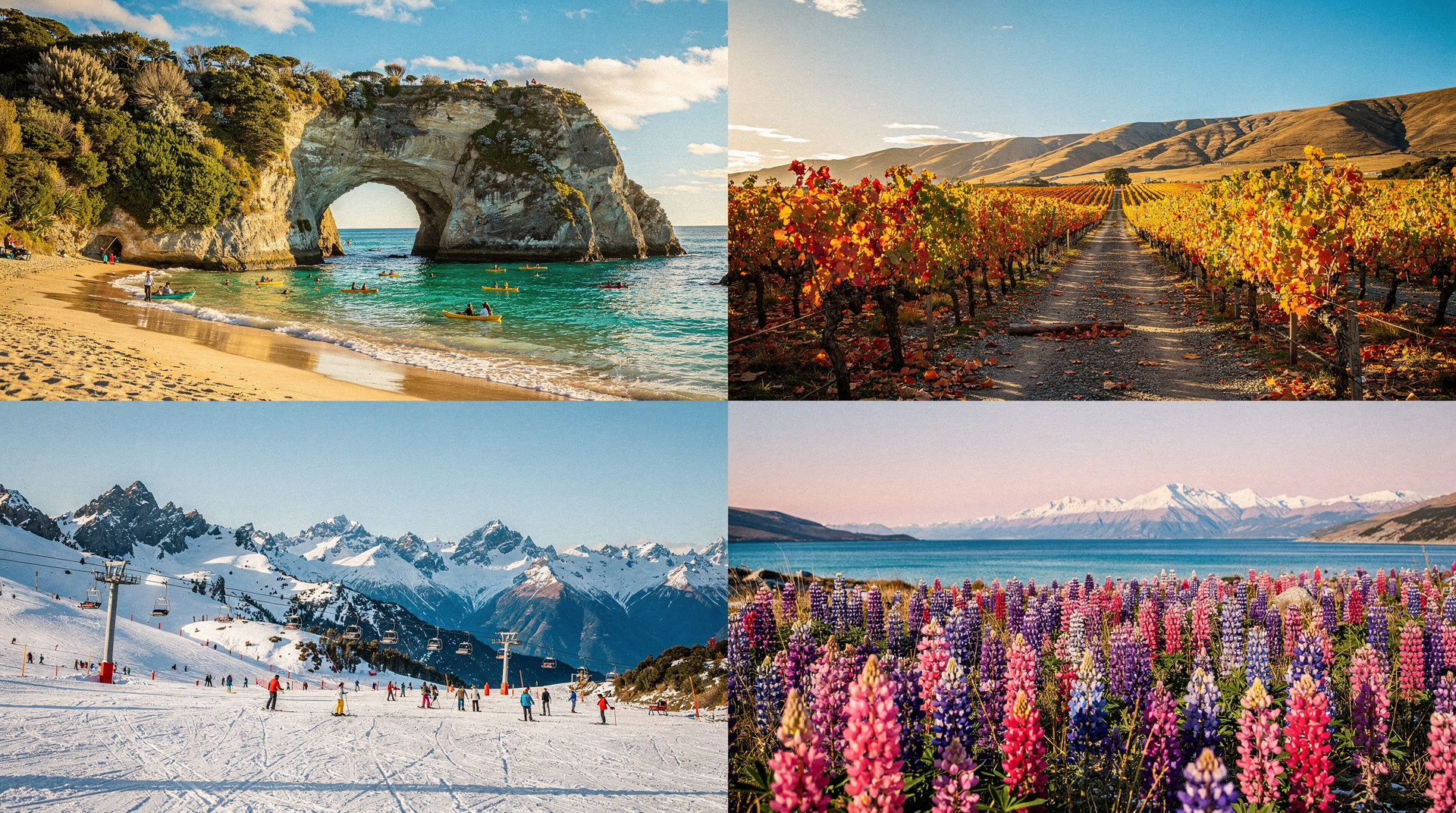
Best time to visit New Zealand
When to visit New Zealand: honest breakdown by season, region, and activity type. Summer is not always best. Spring and autumn often outperform the peak season.
How many days do you need in New Zealand
7 days, 14 days, or 3 weeks? Honest guide to how much time you need for New Zealand, island by island, with sample day-counts by priority and travel style.
New Zealand on a budget
Honest budget guide to NZ: real daily costs, where to save, where not to cheap out, free things, and how to stretch NZD on a backpacker or mid-range budget.

First time in New Zealand
Complete first-timer's guide to NZ: costs, logistics, Maori culture, what to book early, and how to structure 7–21 days.
Last reviewed: · Published: