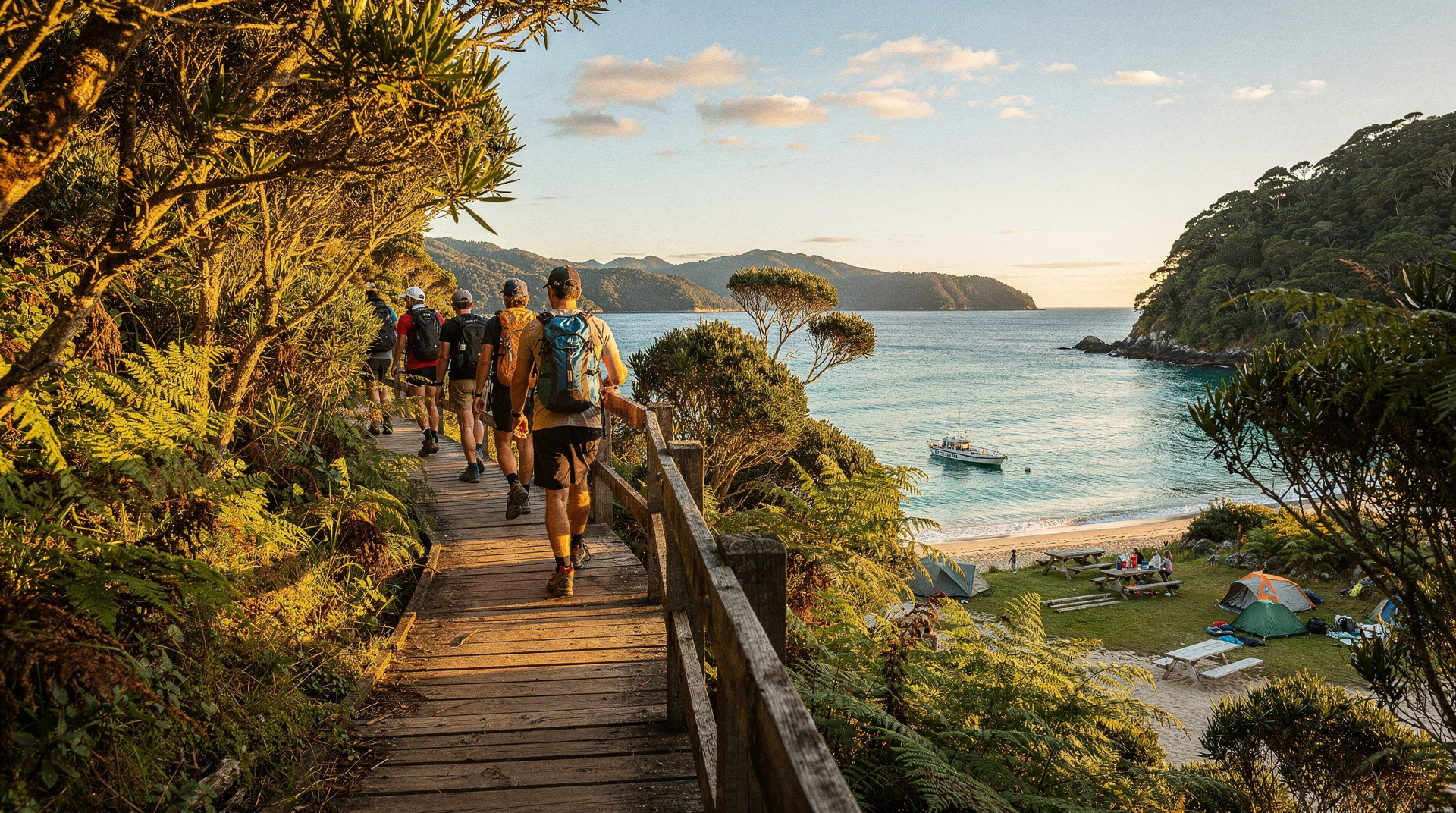
Abel Tasman Coast Track — Great Walk guide
How do you book the Abel Tasman Coast Track?
Book huts and campsites via DOC (doc.govt.nz) from June for the following season. Huts cost NZD 102/night (Great Walk season Oct-Apr), campsites NZD 32/night. The track is 60km, typically walked in 3-5 days. Water taxis allow you to start, finish, or exit at any point — you don't have to walk the full distance.
New Zealand’s most-loved Great Walk
Popular experiences here
The Abel Tasman Coast Track is the most popular of New Zealand’s eleven Great Walks, and once you’ve seen it, you understand why. The track winds 60 kilometres along the coast of the Abel Tasman National Park, passing 26 golden-sand beaches, turquoise tidal inlets, and forested headlands with seal colonies — all in a micro-climate that consistently offers the most sunshine hours in New Zealand.
It is also the most flexible of the Great Walks. Water taxis thread between the beaches throughout the day, meaning you can walk any segment, exit at any point, or arrive by kayak rather than trail. The combination of walking, kayaking, and water taxi travel in the same park is unique among New Zealand’s Great Walks.
The honest note: Abel Tasman is not wilderness in the way that Milford Track or Kepler Track are wilderness. The beaches bring day visitors, the huts are busy, and the occasional boat motor breaks the silence. What it offers instead is coastal beauty of a very high order, moderate walking conditions, and an experience that connects rather than isolates.
Quick stats
| Detail | Value |
|---|---|
| Total distance | 60.4 km |
| Total climb | 1155m |
| Typical duration | 3-5 days |
| Hut fee (Great Walk season) | NZD 102/night (USD 61 / EUR 56) |
| Campsite fee (Great Walk season) | NZD 32/night (USD 19 / EUR 18) |
| Great Walk season | October to April |
| Off-season (May-September) | Track open, standard backcountry hut fee NZD 15/night |
| Bookings open | June for following season |
The five huts (north to south)
| Hut | Distance from Wainui | Bunks | Facilities |
|---|---|---|---|
| Awapoto | 12 km | 40 | Flush toilets, solar power |
| Bark Bay | 24 km | 34 | Flush toilets, water heaters |
| Adult | 38 km | 24 | Flush toilets |
| Torrent Bay | 42.5 km | 36 | Flush toilets, water heaters |
| Anchorage | 49 km | 48 | Flush toilets, water heaters (largest) |
Campsite options exist at most hut locations and additionally at several beach locations. Anchorage is the most popular overnight point due to its beach setting and facilities.
Booking: the critical information
Abel Tasman is extremely popular. The most desirable hut nights (Anchorage, Bark Bay) book out within days of the June booking window opening. The booking approach:
- Create a DOC account at doc.govt.nz before June.
- Decide your itinerary — which huts, which dates — before the booking window opens.
- Log in at opening time (bookings open at 8am NZT on 7 June for the following season).
- Book each night in sequence. Have backup hut options ready if your first choice is full.
Cancellations do appear throughout the season — check weekly if your preferred dates are initially unavailable. The off-season (May-September) requires only standard backcountry bookings, which are much easier to secure.
Walking directions and segments
The track runs north to south from Wainui Inlet to Marahau (or south to north — both are equally popular). The majority of walkers do south to north, ending at Wainui and returning to Nelson or Motueka via water taxi.
Marahau to Anchorage (13.5 km, 4-5 hours): The classic first day. Clear water, sculptured granite headlands, and the Torrent Bay estuary crossing (timing-dependent on tides — check tide tables).
Anchorage to Bark Bay (14.5 km, 4-5 hours): Passes Te Pukatea Bay and Frenchman’s Bay. Bark Bay suspension bridge and the long golden Bark Bay beach are highlights.
Bark Bay to Awaroa (18 km, 6 hours): The longest and most remote section. Passes Tonga Arches and the Tonga Island Marine Reserve seal colony. Awaroa Inlet crossing must be timed to ±2 hours of low tide — get this wrong and you’re wading thigh-deep.
Awaroa to Wainui (14.4 km, 4 hours): Passes Totaranui (accessible by road — facilities including toilets and a large campsite) and the more remote Whariwharangi Bay.
The water taxi and kayak option
The Abel Tasman’s defining feature is the ability to mix walking with water transport. Water taxis run regularly from Marahau, calling at every major beach along the track. Options:
- Walk one section, water taxi the rest: Many visitors walk only their favourite section (usually Marahau to Bark Bay or Bark Bay to Awaroa) and water taxi the remainder.
- Kayak self-guided: Launch from Marahau and paddle the coast independently, camping or hut-staying overnight. Requires paddling experience and knowledge of tidal patterns.
- Guided kayak: ✓ Worth it The guided 3-day kayak + walk tour combines kayaking and walking over three days with a guide — the best introduction to the park’s full range.
Abel Tasman Kayaks: 3 Day Kayak and Walk North (from Marahau)
3-day guided kayak and walk through the park — the definitive Abel Tasman experience.
From NZD 695–850 / USD 417–510 / EUR 382–468
Day visitors from Nelson can access the park via water taxi without booking huts at all.
Abel Tasman National Park: Day Sailing Adventure with Lunch
Full day on the water from Nelson — access to the park's best beaches with lunch included.
From NZD 155–185 / USD 93–111 / EUR 85–102
For those wanting to walk one segment only, the shuttle + walk combo handles transport logistics including water taxi and road transfer.
Abel Tasman: Sea Shuttle Cruise and Walking Tour Combo
Walk your chosen segment — transport and water taxi logistics handled for you.
From NZD 95–140 / USD 57–84 / EUR 52–77
Getting to Marahau (southern trailhead)
Marahau is 67 km from Nelson, approximately 1 hour by road. From Motueka (15 km north of Marahau), shuttle buses connect to Nelson and Blenheim. There is no public bus service directly to Marahau — shuttles and water taxis are the primary transport.
From Nelson, the drive via Motueka passes the Tasman wine region — consider stopping at Neudorf or Seifried Estate on your return.
What to pack for the Abel Tasman
The Abel Tasman’s mild climate means lighter packing than most NZ multi-day tracks, but the coastal environment adds specific requirements:
- Sandals or water shoes (river and estuary crossings)
- Swimwear (every hut has a beach accessible for swimming)
- Sunscreen — the UV in the Nelson-Tasman region is severe; the track is open and coastal
- Sandfly repellent (essential — Abel Tasman sandflies are numerous and persistent)
- 2-3 day food supply (resupply options are limited mid-track)
- Standard hut gear: sleeping bag liner (huts have mattresses but not sheets), headlamp, first aid kit
Cost breakdown (NZD / USD / EUR)
Cost breakdown
Prices approximate 2026. DOC hut fees as per doc.govt.nz.
| Item | NZD | USD | EUR | Verdict |
|---|---|---|---|---|
| Hut night (Great Walk season) | NZD 102 | USD 61 | EUR 56 | ✓ Worth it |
| Campsite/night (Great Walk season) | NZD 32 | USD 19 | EUR 18 | ✓ Worth it |
| 4-night hut-based trip (huts only) | NZD 408 | USD 245 | EUR 224 | |
| Water taxi Marahau to Awaroa (one way) Allows flexible start/finish at any beach | NZD 55–75 | USD 33–45 | EUR 30–41 | ✓ Worth it |
| Guided 3-day kayak tour | NZD 695–850 | USD 417–510 | EUR 382–468 | ★ Splurge |
| Bus/shuttle Nelson to Marahau | NZD 25–35 | USD 15–21 | EUR 14–19 |
Seasonal considerations
Great Walk season (October-April): Huts are staffed and well-maintained. Facilities (flush toilets, water heaters) are operational. Full hut fees apply. Water taxis run daily.
Off-season (May-September): Track remains open and uncrowded. Hut fees drop to NZD 15/night (standard backcountry fee). Water taxis operate on reduced schedules. Weather is more variable, but the track’s coastal character remains excellent.
The Awaroa Inlet tidal crossing applies year-round. Regardless of season, download tide tables before departure.
If you can’t get huts, or don’t want to walk
Not everyone who wants the Abel Tasman experience needs the full multi-day walk. If the June booking window has closed out the nights you want, or if the idea of carrying a full pack for four days doesn’t appeal, the park is still very much accessible. Sea kayaking in Abel Tasman covers the same coastline from the water — fur seals at eye level, beaches you’d otherwise walk past, and no hut booking required for day trips. It’s a genuinely different way to experience the park, not a consolation prize.
For a shorter time commitment again, a water taxi day trip from Marahau or Kaiteriteri lets you hop between beaches without walking or paddling at all — ask your accommodation in Nelson about the current schedules. And if you’re weighing this park against Nelson-Tasman’s other big walk, the Abel Tasman vs Kahurangi comparison lays out exactly when the quieter, wilder Heaphy Track in Kahurangi National Park is the better choice instead.
Fitness and pace: what the grading doesn’t tell you
DOC grades the Coast Track “easy/intermediate,” which undersells how much the heat and humidity of a Nelson-Tasman summer affects pace. The track itself has gentle gradients — nothing like the alpine climbs of Milford Track or Routeburn Track — but walkers regularly underestimate how much slower they move in full sun with a loaded pack on exposed headland sections. Budget more time than the DOC signposted estimates suggest, particularly on the Awaroa to Wainui section where there’s little shade.
Fitness aside, the real pacing constraint is the tide, not your legs — arriving at Torrent Bay or Awaroa outside the safe crossing window means a multi-hour wait regardless of how fast you walk.
Frequently asked questions
Can I do the Abel Tasman Coast Track without booking months ahead?
Only in the off-season (May-September), where standard backcountry hut bookings can usually be secured with a week’s notice. Great Walk season huts (October-April) require booking in June for popular nights. Day visits via water taxi or kayak tours require no DOC hut booking.
Is the Abel Tasman suitable for families?
Yes — it’s one of the most family-friendly Great Walks. The grades are moderate, the distances are flexible (water taxis allow custom distances), and the beaches make it inherently engaging for children. The Marahau to Anchorage section (13.5 km) is manageable for older children aged 10+.
How does it compare to the Milford Track?
The Milford Track is more dramatic, more remote, and more difficult logistically. The Abel Tasman is more accessible, more flexible, and more forgiving of mixed-fitness groups. Both are worth doing, but they serve different travel styles. See our Abel Tasman vs Kahurangi Track comparison.
What is the Awaroa tidal crossing?
Awaroa Inlet must be crossed on foot between Bark Bay and Awaroa huts. The inlet is a wide estuary that’s impassable at high tide — you must cross within two hours either side of low tide. DOC provides current tide times at each hut and in their pre-booking information. Misjudging the tide means either wading thigh-deep or waiting several hours.
Can I kayak the full track without walking?
Yes. Self-guided kayakers can paddle the full coastline, camping or staying in huts (with advance booking). Kayak rental from Marahau includes essential safety gear and tide/weather briefing. Paddling experience is required — the open coast sections between headlands can be choppy in wind.
Related guides and reading
- Abel Tasman National Park destination guide
- Abel Tasman vs Kahurangi comparison
- Heaphy Track guide — the Kahurangi National Park Great Walk
- Nelson destination guide — closest major town
- Nelson vs Marlborough comparison
Related guides
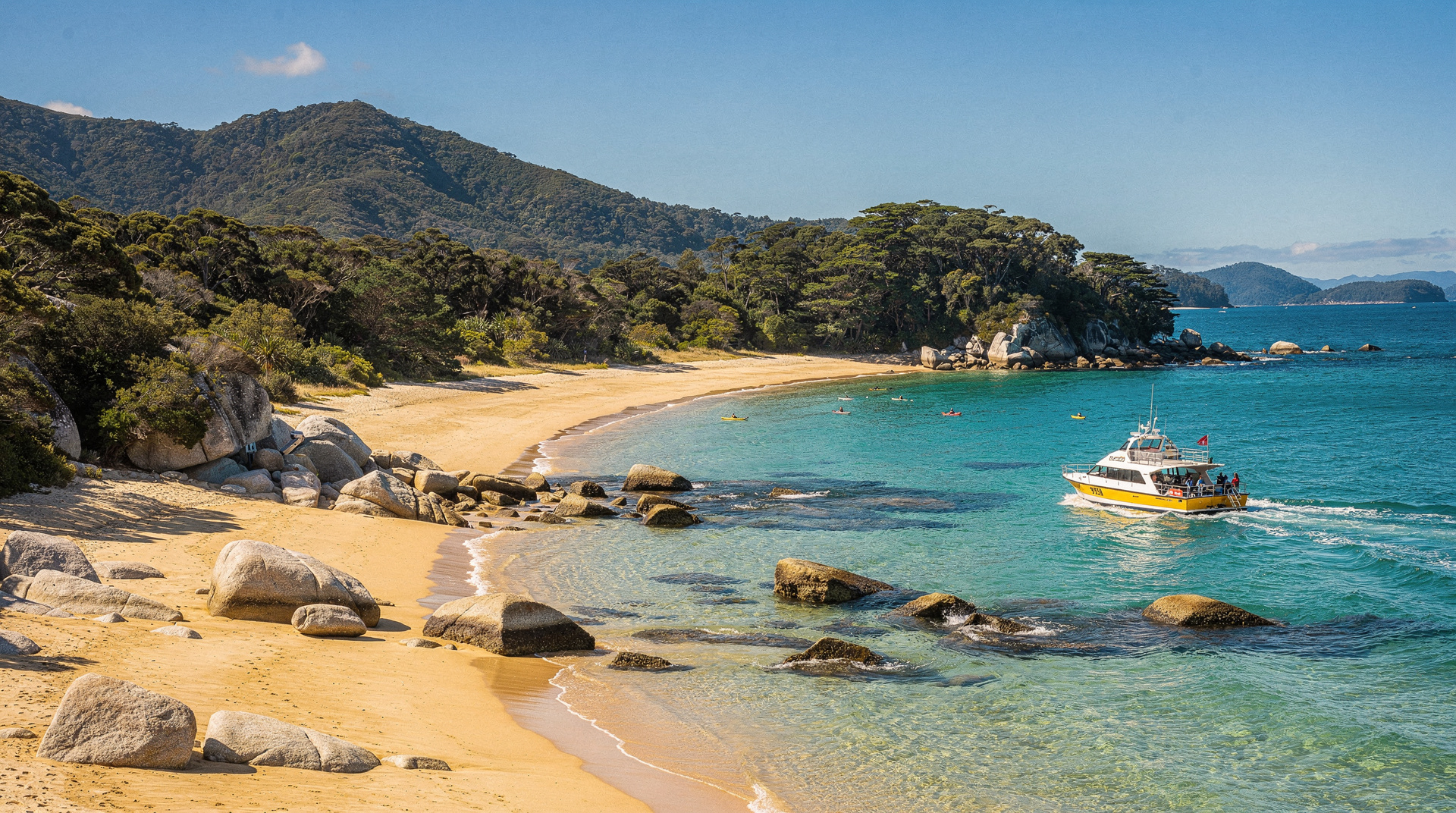
Abel Tasman National Park
Honest Abel Tasman guide: kayak vs coast track, water taxis, best bays — real NZD/USD/EUR prices and how long you actually need for this park.
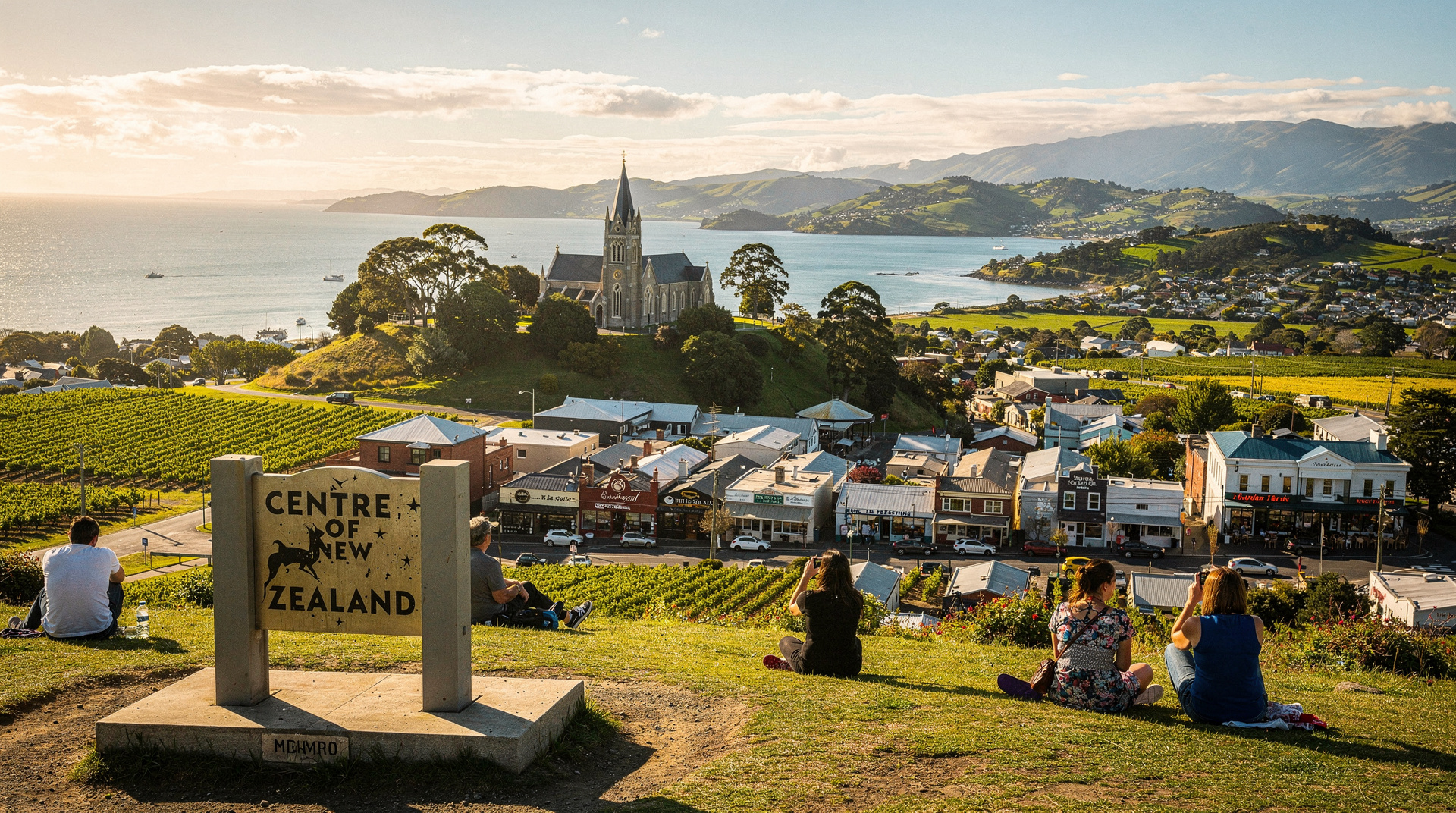
Nelson
Nelson: New Zealand's sunniest city, gateway to Abel Tasman, with a strong arts scene, wine and craft beer, and real costs NZD/USD/EUR.
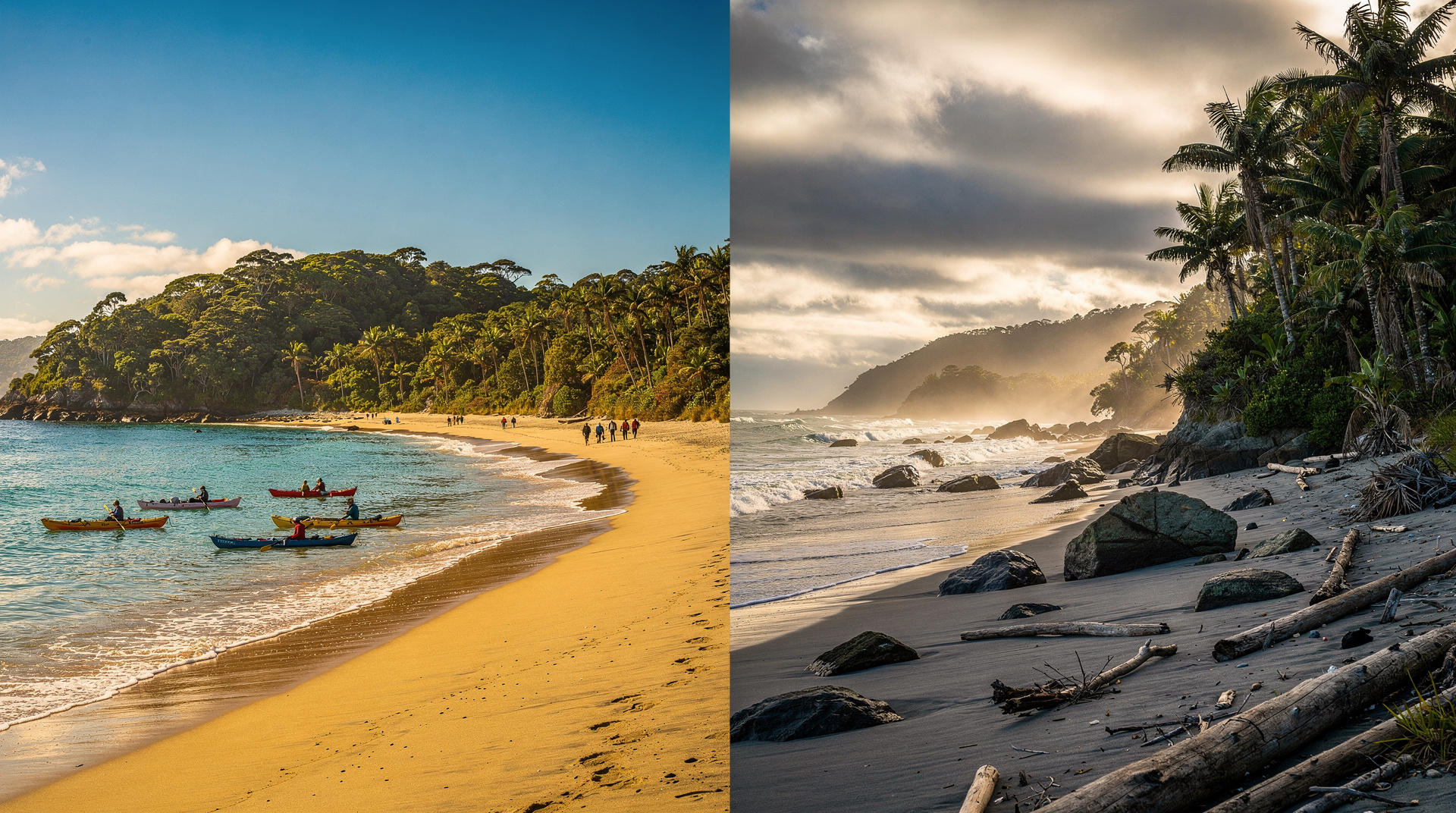
Abel Tasman vs Kahurangi National Park
Abel Tasman vs Kahurangi honest comparison: beaches, tracks, caves, access and cost. Clear verdict for walkers, kayakers and Great Walk planners. NZD/USD/EUR.
Heaphy Track — Great Walk through Kahurangi National Park
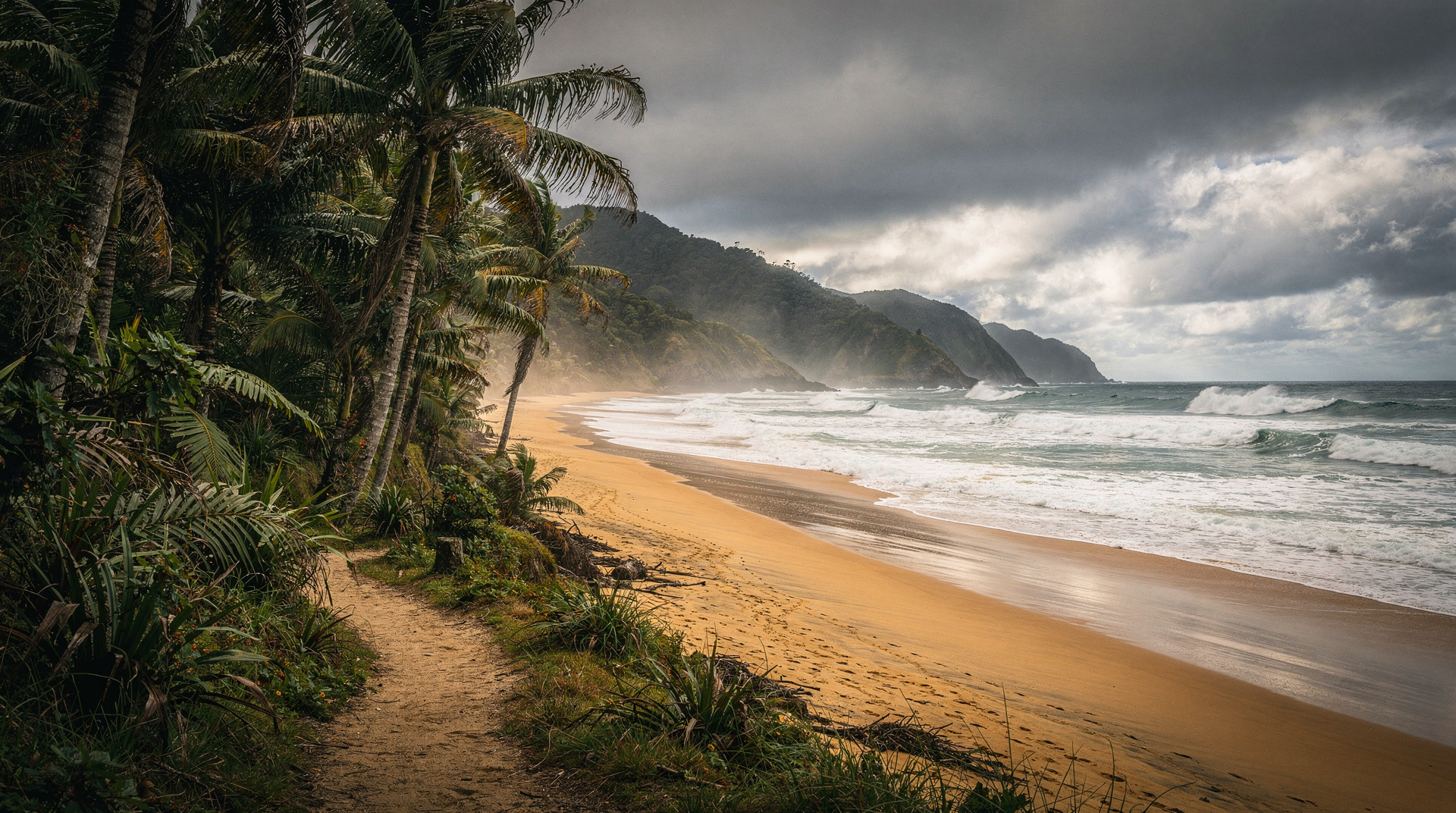
Heaphy Track: 78km, 4-6 days, most remote Great Walk. No MTB in summer. Kahurangi NP coastal wilderness. Book DOC huts from June. Full guide.
Nelson vs Marlborough
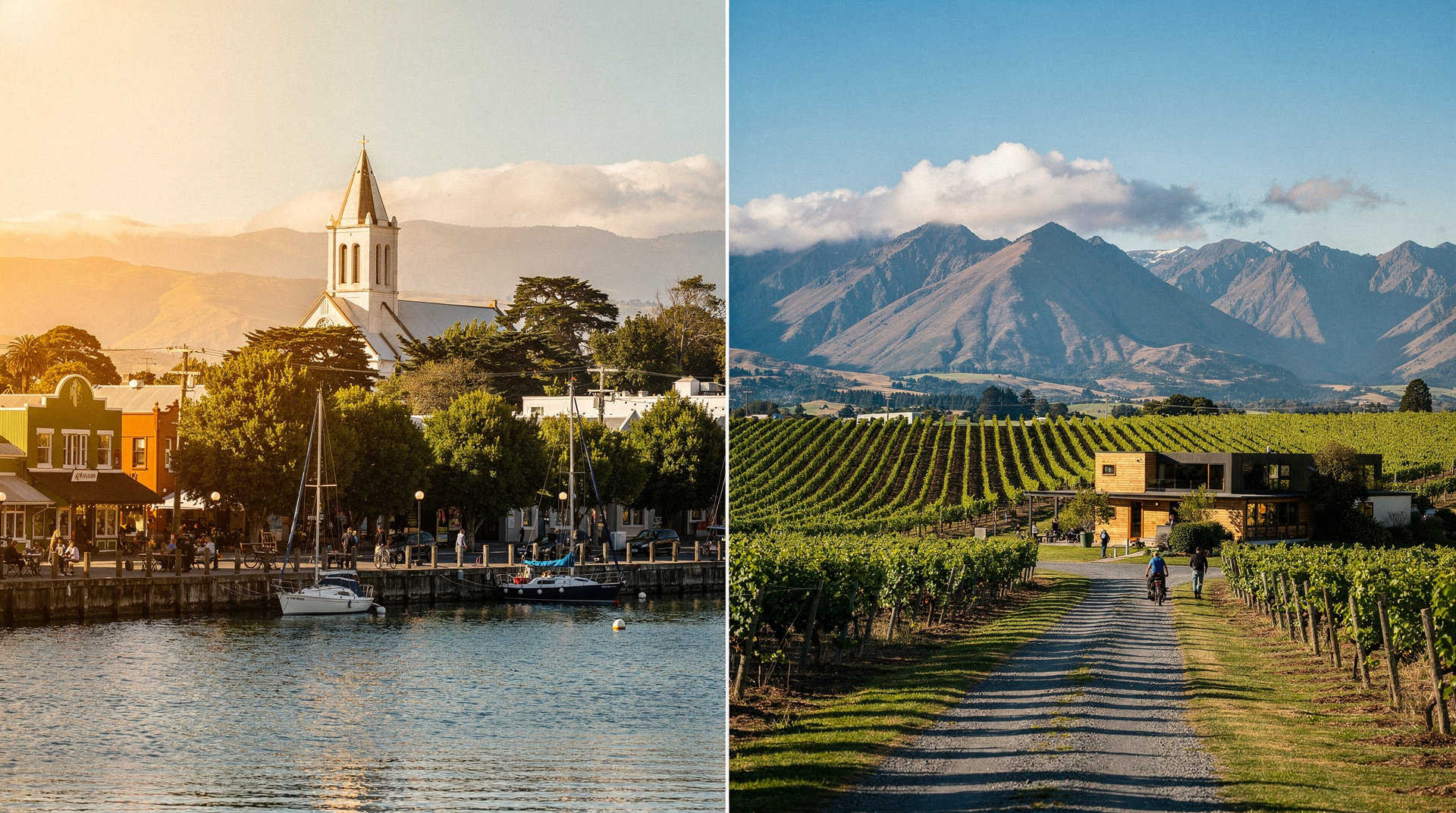
Nelson vs Marlborough honest comparison: wine, national parks, beaches, access and which region to prioritise. Clear verdict with prices in NZD/USD/EUR.
Last reviewed: