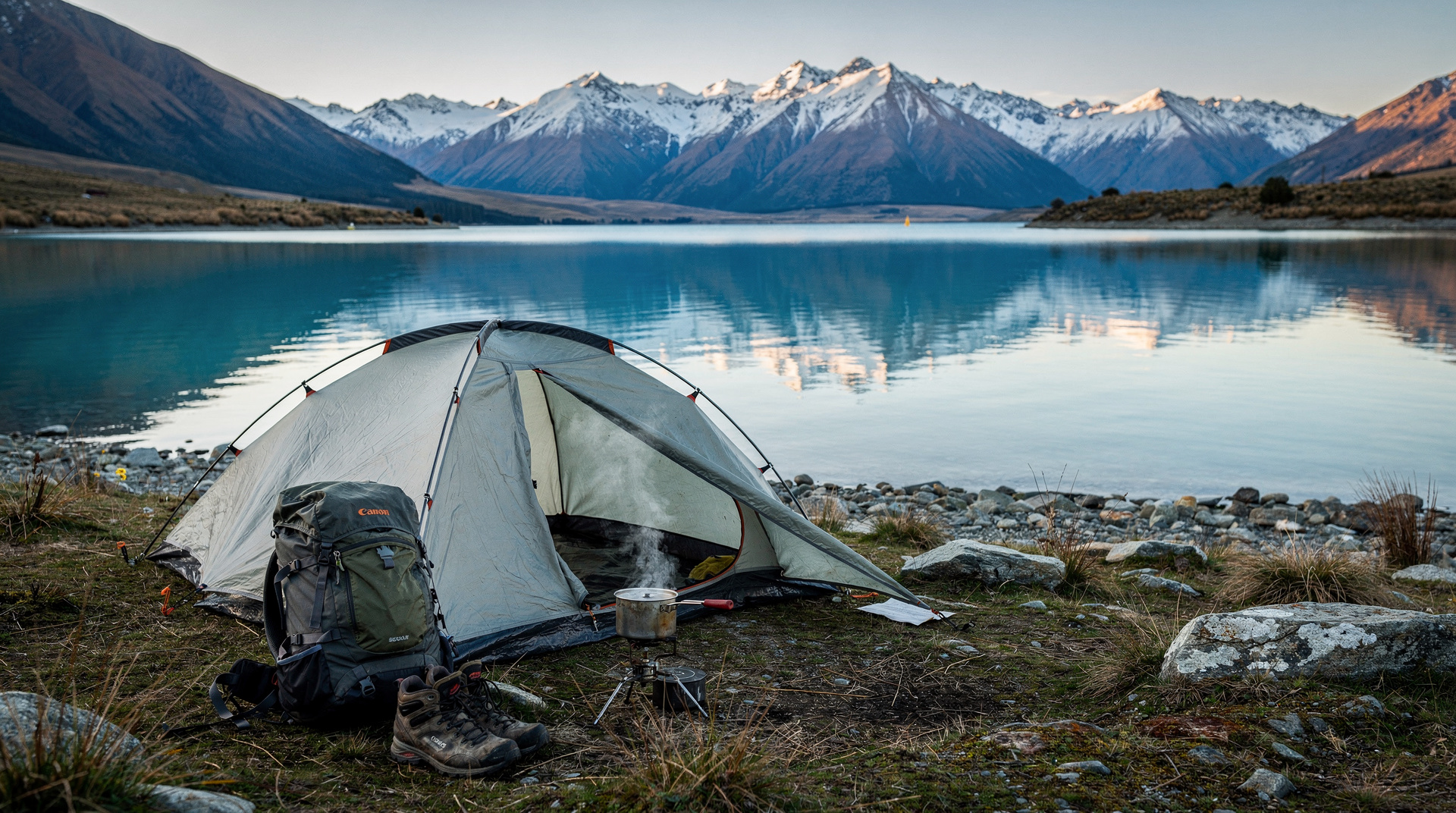
Backpacker hostel vs holiday park in New Zealand — which suits you?
Should I stay in a hostel or a holiday park in New Zealand?
Hostels if you're solo, want to meet people, and are on a tight budget — dorms from NZD 35/night. Holiday parks if you have a campervan, travel with a partner or family, or want privacy and a kitchen to yourself. For a 2-week trip you'll probably use both.
The honest two-line answer
| Dimension | Backpacker hostel | Holiday park |
|---|---|---|
| Cheapest bed option | Dorm from NZD 32–45/night | Tent/campervan site from NZD 20–40/night |
| Privacy | Low in dorms; private rooms available for more | Higher — your own space regardless of option |
| Social scene | High — common rooms, kitchens, board games | Low to moderate — campers stay in their units |
| Facilities | Shared kitchen, bathrooms, often a TV lounge | Camp kitchen, laundry, BBQs, often a pool or spa |
| Best for | Solo travelers, budget backpackers 18–35 | Campervans, couples wanting privacy, families |
| Quiet hours | Variable — enforced but often ignored | Better enforced — families with children present |
| Key chains | YHA, Base, BBH, Bug Hostel Network | Top 10 Holiday Parks, Kiwi Holiday Parks, Tasman |
| Found everywhere? | Major towns and tourist hubs only | Virtually every town including small stops |
| Booking required? | Essential in peak season for popular spots | Campervans: less urgent; cabins: book ahead |
| Family-friendly? | Some, but loud common areas not ideal for kids | Yes — most have playgrounds, BBQ areas, pools |
Verdict: Neither is universally better — they serve different travelers. Most NZ road-trippers use both over a 2-week trip depending on location.
New Zealand has one of the best-developed budget accommodation networks in the world, shaped by decades of backpacker culture and the campervan industry. The hostel and holiday park systems operate in parallel but serve mostly different travelers — and understanding what each actually delivers avoids a lot of disappointment.
I spent the better part of three seasons living in and around this sector when I was doing DOC work out of Wanaka in my early twenties. I’ve slept in YHA dorms that smelled of wet boots and regret, and I’ve also had genuinely good nights in holiday park cabins in places where there was no hostel for 60 kilometres. Both have their place. The choice depends almost entirely on how you’re traveling, with whom, and what you need from your evening.
Backpacker hostels in New Zealand
The networks
New Zealand has three main backpacker networks plus independents:
YHA (Youth Hostel Association NZ) — The gold standard for quality control. YHA properties in Queenstown, Auckland, Wellington, Christchurch, and the main South Island stops are consistently well-maintained, with proper kitchens, reliable hot water, secure lockers, and a level of cleanliness that justifies the slightly higher price. YHA cards (NZD 49/year or NZD 4/night surcharge) give discounts on stays and on some tour operators. The name is misleading — there’s no age limit; solo travelers in their 30s and 40s are common in YHA common rooms.
BBH (Budget Backpacker Hostels) — A larger network with more variability. At its best, BBH properties are indistinguishable from YHA in quality. At its worst, a BBH sticker on a door means a slightly rundown building with a leaking shower and a kitchen where someone has stolen your milk. The BBH Club Card (NZD 50/year) gives NZD 3 off per night at member properties — worth buying if you’re spending 3+ weeks in hostels.
Base Backpackers — The party hostel chain. Auckland, Rotorua, Queenstown, Christchurch. Purpose-built for the 18–25 demographic that wants organized social events, rooftop bars, and a bar on-site. If that’s you, Base is genuinely excellent at what it does. If you want to sleep before 1am, book elsewhere.
Bug Hostel Network — A smaller collective of independent properties. Variable quality; some are exceptional (the Wanaka hostel is good), some are basic. Worth checking reviews per property rather than relying on the brand.
Independent hostels — Some of the best-value stays in New Zealand are independently run. In smaller towns (Kaikōura, Hanmer Springs, Nelson, Picton) a family-run hostel with 20 beds will often outperform a chain property on breakfast quality, local knowledge, and atmosphere.
What a hostel dorm is actually like
A standard 4–8 bed dorm has bunk beds with a reading light and power socket per bunk (in newer properties), a shared bathroom either in the room or down the hall, and varying degrees of locker security. Bring your own padlock — some properties supply them, most don’t. Earplugs are not optional. Someone will come in at 2am, turn on the overhead light, and search noisily through a bag the size of a small car.
The kitchen situation varies dramatically. YHA kitchens are usually well-equipped with pots, pans, utensils, chopping boards, and a commercial dishwasher. The supermarket across the road becomes your restaurant. Cooking your own meals in hostels is one of the genuine strategies for keeping a New Zealand budget under control — a pasta dinner for two costs NZD 8–12 in a hostel kitchen versus NZD 50–70 in a mid-range restaurant.
Social dynamics
The hostel common room is where the social magic either happens or doesn’t. In busy backpacker hostels in Queenstown or Auckland in January, you’ll meet travelers from 20 countries within an afternoon. The hostel notice board covers tour companies with group rates, ride shares heading south, and the occasional work opportunity. This social infrastructure is genuinely valuable for solo travelers — it’s the fastest way to go from knowing nobody to having a hiking partner for tomorrow.
The flip side: if you’re a couple, or 35+, or value quiet mornings, the hostel common room can feel like someone else’s party that you didn’t know you were attending. Private rooms in hostels (usually NZD 95–145/night for a double) offer a middle ground — your own space, access to the communal kitchen, and you can opt into the social scene as much or as little as you like.
The chains worth knowing
Haka Lodge (Queenstown, Auckland, Christchurch, Bay of Islands) — Premium-ish hostels at mid-range prices. Modern, clean, well-designed. Good for travelers who want hostel social culture without hostel squalor. Dorms NZD 42–68/night.
Nomads (Auckland, Queenstown, Wellington) — Similar positioning to Haka. Auckland Nomads is well-located in the CBD. Consistently decent.
Jucy Snooze — The bright purple pods. Capsule-hotel format in converted spaces. Auckland, Queenstown, Christchurch. Private sleep pods stack vertically with curtains for privacy. Not for the claustrophobic, excellent for light sleepers who want the price point without the snoring dorm.
Holiday parks in New Zealand
The format
A New Zealand holiday park is a campsite + cabin complex, typically with the following zones:
- Unpowered tent sites — Grass or gravel, outdoor shower block. For tents and some campervans.
- Powered sites — Electric hookup for campervans and caravans. Often the most booked option.
- Camp kitchen — Shared cooking facility, usually with stoves, kettles, microwaves, and a communal dining area. Less social than a hostel kitchen, more functional.
- Cabins — Usually studio rooms with a double or twin bed, often without an en suite (shared bathroom block). NZD 80–160/night.
- Units/motel rooms — En suite, small kitchen or kitchenette. Effectively a budget motel within the park. NZD 130–220/night.
- Extras — BBQ areas, playgrounds, children’s swimming pools or spa pools, laundry, dump stations for campervans, sometimes a small shop.
The chains
Top 10 Holiday Parks — The premium network. Around 50 properties across New Zealand, consistently maintained, reliably bookable online. The 10% membership discount (free to join) is worth using if you’re staying at more than one. Top 10 properties in popular spots (Queenstown, Rotorua, Kaikōura) have full facilities and fill up in January and February — book 4–8 weeks ahead for peak season.
Kiwi Holiday Parks — Mid-range network, wider geographic coverage than Top 10, quality more variable. Good for finding a powered site in a small town where there’s no Top 10.
Tasman Holiday Parks — The chain that came from Tourism Holdings Limited. Usually positioned between Kiwi and Top 10 in price and quality. Good network in North Island.
DOC campsites — Department of Conservation-managed sites, usually on conservation land. Three tiers: serviced (NZD 16–22/night, toilets and basic water), standard (NZD 8–14, toilet only), and basic (NZD 6 or free). No powered sites. Often spectacularly located — a DOC campsite at the edge of a national park, 15 minutes’ drive from the nearest town, is frequently the best-value accommodation in New Zealand. Most require a Kiwi conservation card (NZD 26/year) for booking, or pay at honesty boxes on-site.
Campervans and holiday parks
Holiday parks are essentially built around the campervan. A powered site gives you electricity for your van’s internal systems, access to the dump station (emptying grey and black water tanks), and the camp kitchen if your van kitchen runs out of gas. The powered site is the backbone of the campervan economy in New Zealand.
If you’re driving a campervan, holiday parks should be your default accommodation unless you’re self-contained and choosing DOC sites or freedom camping. Not all areas permit freedom camping — councils in popular areas (Queenstown, Wanaka, Coromandel, Abel Tasman approaches) have restricted or eliminated it due to overuse. A powered site at NZD 30–55/night for two people is significantly cheaper than any hostel private room and gives you complete independence.
Verdicts — Skip / Worth it / Splurge
- ✓ Worth it YHA dorm for solo travelers — NZD 35–52, the best social infrastructure in NZ budget accommodation. Kitchen access makes the price look very different once you’re cooking your own food.
- ✓ Worth it Holiday park powered site for campervans — NZD 30–55 per site for two people. Access to dump station, electricity, camp kitchen. The math works strongly in favor of campervans on longer trips.
- ✓ Worth it Holiday park cabin for couples — NZD 95–150 for a private room with shared bathroom. Better than a hostel private room in many respects: quieter, your own space, family-park atmosphere.
- ◆ Hidden gem DOC campsites — NZD 8–22/night for locations that would cost 10× in private accommodation if they existed. Often in national parks or conservation areas with no commercial development. The best budget option in New Zealand if you’re tenting or self-contained.
- ✕ Skip Holiday park motel units in peak season — At NZD 195–240 in Queenstown or Rotorua in January, you’re paying motel prices with camp facilities. At that point a mid-range hotel with private bathroom and proper linens is better value.
- ✕ Skip Base Backpackers if you’re over 28 — Excellent if the rooftop bar and organized pub crawls are what you’re after. Exhausting if they’re not.
What it actually costs (NZD + USD + EUR)
Cost breakdown
Prices approximate 2026. Popular destinations (Queenstown, Rotorua, Kaikōura) run 20–35% higher than national averages.
| Item | NZD | USD | EUR | Verdict |
|---|---|---|---|---|
| Hostel dorm — budget BBH/independent Per person per night | NZD 32–45 | USD 19–27 | EUR 18–25 | ✓ Worth it |
| Hostel dorm — YHA/Haka/Nomads Better quality, more reliable | NZD 42–68 | USD 25–41 | EUR 23–37 | ✓ Worth it |
| Hostel private room (no en suite) Per room, 1–2 people | NZD 95–145 | USD 57–87 | EUR 52–80 | ✓ Worth it |
| Holiday park tent site (unpowered) Per site for 2 people | NZD 20–38 | USD 12–23 | EUR 11–21 | ✓ Worth it |
| Holiday park powered site (campervan) Per site for 2 people | NZD 35–58 | USD 21–35 | EUR 19–32 | ✓ Worth it |
| Holiday park cabin (no en suite) Per room, 2 people | NZD 85–155 | USD 51–93 | EUR 47–85 | ✓ Worth it |
| Holiday park unit (en suite + kitchenette) Effectively budget motel | NZD 135–220 | USD 81–132 | EUR 74–121 | ✓ Worth it |
| DOC campsite (serviced) Best value in NZ. Tent or self-contained van | NZD 16–22 | USD 10–13 | EUR 9–12 | ◆ Hidden gem |
| Annual YHA membership Pays off after 12 nights | NZD 49 | USD 29 | EUR 27 | ✓ Worth it |
| Annual BBH Club Card NZD 3 off per night — break-even at 17 nights | NZD 50 | USD 30 | EUR 28 | ✓ Worth it |
FAQ
Which is cheaper — hostels or holiday parks?
For a solo traveler with a tent: holiday parks (DOC sites especially). For a solo traveler without a tent: hostel dorms. For two people with a campervan: holiday park powered sites, comfortably. For two people without a vehicle: hostel private room or holiday park cabin are broadly similar in price, with holiday parks often slightly cheaper outside major cities.
Are New Zealand hostels safe?
Generally yes. Theft in hostels exists — mostly opportunistic — and is almost entirely preventable with a padlock on your locker and not leaving valuables in the dorm. YHA properties have security lockers; Base and Nomads properties have reasonable security. The bigger safety variable is whether the hostel has working smoke alarms and fire exits — this is regulated in New Zealand but worth checking in older buildings.
Can families use holiday parks?
Holiday parks are purpose-built for families. Top 10 properties in particular have playgrounds, children’s pools, BBQ areas, and cabin configurations that accommodate families of 4 or more. The camp kitchen handles self-catering easily. It’s the most family-friendly accommodation format available below the mid-range hotel tier in New Zealand — and at NZD 85–155 for a cabin, significantly cheaper than a mid-range hotel room.
Do I need to book ahead?
In summer (December–February): yes, significantly ahead for both hostel dorms and holiday park sites in popular locations. Queenstown YHA dorms in January can sell out a month ahead. Top 10 Queenstown powered sites fill rapidly. For January travel, book 6–8 weeks ahead. In shoulder season (March–May, September–November): 1–2 weeks for hostels, 1 week for holiday parks is usually sufficient. In winter (June–August): rarely a problem except in ski towns (Queenstown, Wanaka) during school holidays.
What’s the Wi-Fi like?
Variable across both types. Newer hostel properties in cities (YHA Auckland, YHA Wellington) have reliable urban broadband. Regional hostels and holiday parks often have Wi-Fi that throttles heavily after basic use — not suitable for streaming or video calls. Mobile data (Spark, One NZ, 2degrees SIM cards) is the reliable option for working remotely or staying connected in New Zealand. SIM cards cost NZD 25–40 for 30 days of data.
What about noise?
Hostels are noisier. This is structural — shared spaces, shared bathrooms, a culture of late nights in many properties. Earplugs address 80% of it. Holiday parks are quieter in the evenings because the mix of families and campervaning couples self-regulates toward earlier nights. DOC campsites are the quietest of all — often just the sound of the river or wind in the trees, plus your neighbours’ generator if they have one.
Which should a couple choose?
If budget is the priority: holiday park cabin (NZD 85–155, private room, shared bathroom, kitchen access) beats a hostel private room on value and atmosphere for most couples. If social interaction matters and budget is very tight: hostel private room keeps you in the social ecosystem. If you have a campervan: holiday park powered site, no contest.
When to pick each
Book a hostel if:
- You’re traveling solo and want to meet other travelers
- Budget is the primary constraint and a dorm is acceptable
- You’re in a major hub (Auckland, Wellington, Queenstown, Christchurch, Rotorua) where quality hostels exist
- You value the tour-booking infrastructure and social notice boards
- You’re a working holiday visa holder between stints — hostels have job boards and notice boards that are genuinely useful
Book a holiday park if:
- You’re traveling in a campervan or caravan
- You’re traveling as a couple and want a private room with kitchen access
- You’re traveling with children
- You need a dump station for your campervan
- You’re passing through a small town where there’s no hostel
- You value quiet evenings and your own pace
Use DOC campsites if:
- You’re tenting or self-contained
- You want the most spectacular locations at the lowest price
- You’re willing to be without power, Wi-Fi, and sometimes hot water
- You’re walking any of the Great Walks (huts are DOC-managed) or doing off-track tramping
Use both on the same trip: Most New Zealand road-trippers naturally gravitate toward using both — hostels in major cities for the social infrastructure and convenience, holiday parks (or DOC sites) in the regions between for the privacy, kitchen independence, and price. A two-week South Island trip might use 4 hostel nights in Queenstown and Christchurch and 7 holiday park nights in Kaikōura, Abel Tasman, and the West Coast. There’s no reason to commit to one format for an entire trip.
Booking platforms and timing
Hostelworld and Booking.com cover most hostels and holiday parks with free cancellation on many rates — useful for the flexibility a New Zealand road trip demands, since weather and route changes are common. Top 10 and Kiwi Holiday Parks also take direct bookings through their own sites, sometimes with membership discounts not available on aggregators.
For popular locations (Queenstown, Rotorua, Kaikōura) in January and February, book the specific property directly once you’ve settled on dates — aggregator availability can lag behind what’s actually free. If your plans are genuinely fluid, favour properties and aggregators with free cancellation over the cheapest non-refundable rate; the price difference is usually small compared to the cost of a forced last-minute change.
Regional differences worth knowing
Availability and pricing vary more by region than most first-time visitors expect. In the geothermal towns (Rotorua, Taupo) holiday parks are often built around natural hot pools, adding genuine value beyond the powered site. In the far south (Te Anau, near Fiordland) hostel options thin out and holiday parks become the default even for solo travelers, simply because there isn’t enough hostel demand to support multiple properties.
Along the West Coast, DOC campsites are unusually good value relative to the region’s otherwise-expensive accommodation, since the towns are small and commercial competition is limited. Queenstown and Wanaka run 20-35% above national averages across both categories in peak summer and the ski season — booking further ahead matters more there than almost anywhere else in the country.
Related guides
Related guides
New Zealand on a budget
Honest budget guide to NZ: real daily costs, where to save, where not to cheap out, free things, and how to stretch NZD on a backpacker or mid-range budget.
Campervan vs car rental in New Zealand
Honest campervan vs car rental comparison for NZ: real costs, freedom camping rules, who should choose each, and what the brochures don't tell you.
Working Holiday Visa New Zealand
Complete guide to the NZ Working Holiday Visa: age limits by nationality, costs, how to apply, what work you can do, and realistic expectations.
The ultimate New Zealand travel guide — honest, complete, current
The complete honest planner for New Zealand: when to go, how long, both islands, costs, visas and what to skip.
7-day South Island itinerary — the essential loop
Christchurch → Tekapo → Mt Cook → Queenstown → Milford → TranzAlpine return. The honest 7-day South Island loop with real costs and pacing.
Last reviewed: