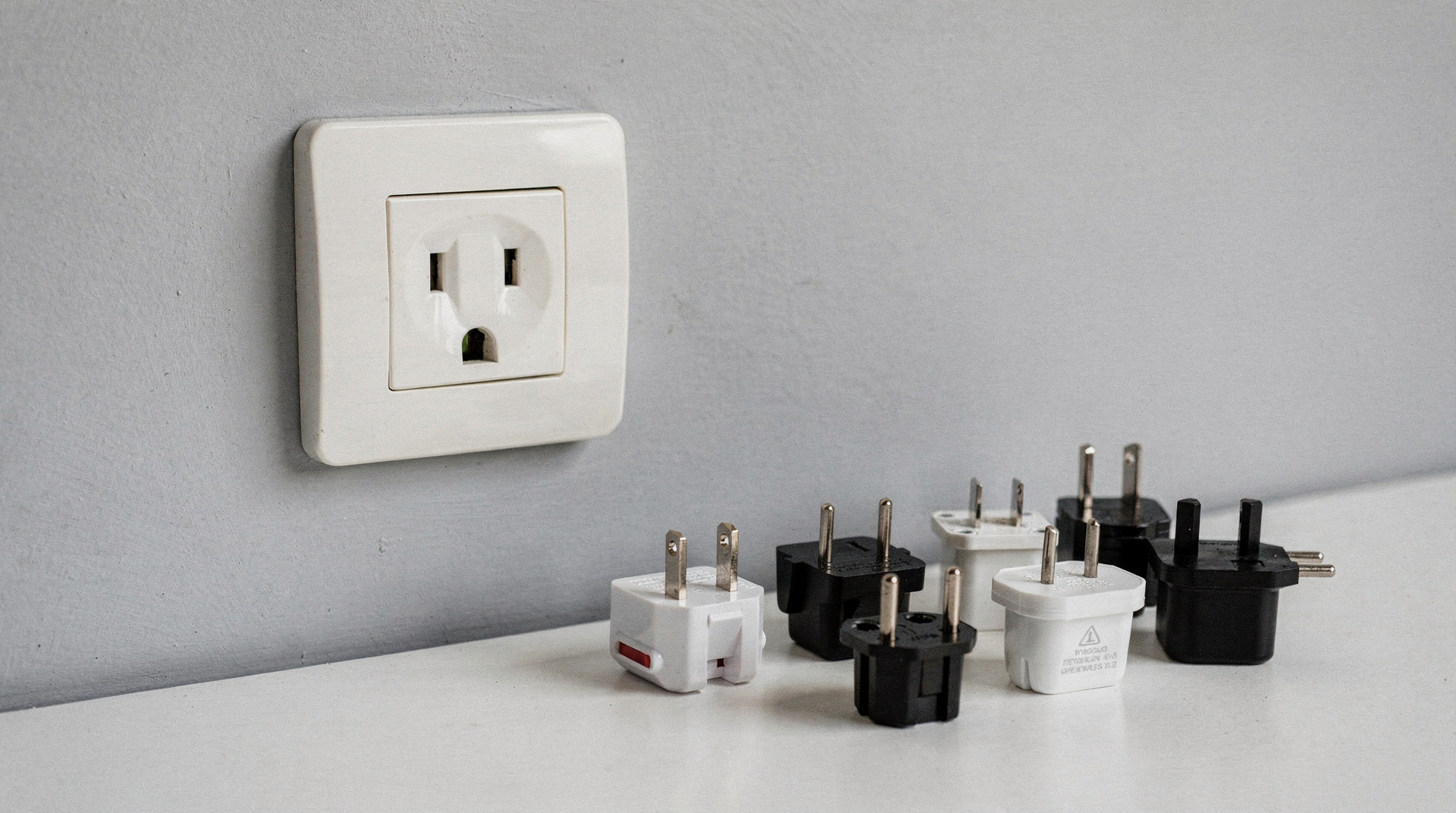
Electricity and plugs in New Zealand
What plug adapter do I need for New Zealand?
New Zealand uses the Type I plug — three angled flat pins (same as Australia). The voltage is 230V at 50Hz. Most modern electronics (phones, laptops, cameras) are dual-voltage (100-240V) and only need an adapter plug, not a voltage converter. Buy a Type I adapter before you travel — airport stores charge NZD 25-35; online it is NZD 5-12.
New Zealand electricity: the quick facts
| Specification | Detail |
|---|---|
| Plug type | Type I (AS/NZS 3112) — angled flat pins |
| Voltage | 230V |
| Frequency | 50Hz |
| Same as | Australia, Papua New Guinea, China (mostly), Argentina |
| Different from | US/Canada (Type A/B, 120V), UK/Ireland (Type G, 230V), EU (Type C/E/F, 230V) |
The Type I plug has two flat angled pins (live and neutral) in a V-shape, plus a grounding (earth) pin below. It is not interchangeable with any European or North American plug without an adapter.
Do you need a voltage converter?
Almost certainly not, if you are bringing modern consumer electronics.
Dual-voltage devices (need adapter only):
- Smartphones (all modern models)
- Laptops and tablets
- Camera battery chargers (check: most say 100-240V on the plug)
- Portable battery banks
- Electric shavers and hair trimmers (check the device label)
- Most modern hair dryers (premium brands: usually dual-voltage)
How to check: Look at the power brick (the box part of the cable) or the device’s power port panel. If it reads “Input: 100-240V ~ 50/60Hz” or similar, it is dual-voltage. You need only the adapter plug.
Single-voltage devices (need converter + adapter):
- Older American or European hair dryers rated “120V only”
- Some cheap travel appliances without dual-voltage circuitry
- Some US-spec power tools
Practical reality: Almost every device that modern travellers bring is dual-voltage. Hair dryers are the main exception, and even most travel hair dryers sold in the last decade are dual-voltage. Check before assuming you need a heavy converter.
The Type I adapter: what to buy
Any adapter labelled “Australia/New Zealand” or showing three angled flat pins will work.
Formats available:
- Simple plug adapter (NZD 5-15): converts the physical shape of your plug, no power transformation
- Multi-country adapter packs: include Type I, Type C/E, Type G, Type A/B in one kit (NZD 15-30)
- Dual USB-A + USB-C adapter that plugs into the wall (useful if you want to charge multiple devices without a multi-plug)
- Surge-protected power strip with Type I plug and USB ports (the most versatile option for travellers with multiple devices)
Where to buy:
- Online before departure: cheapest option (USD 5-15 / EUR 5-12)
- Auckland/Christchurch airports: available at travel accessories stores, typically NZD 25-35
- JB Hi-Fi, Harvey Norman (NZ electronics chains): NZD 15-25
- Daiso (Japanese 2-dollar store with branches in NZ): sometimes stocks basic adapters cheaply
Do not buy at the airport if you can avoid it — the markup is significant for a product you can easily find cheaper online or in any NZ town centre electronics store.
How many outlets does accommodation provide?
New Zealand accommodation varies considerably:
Hotels (4-5 star): International bedrooms typically have 2-4 Type I outlets plus USB charging ports at the bedside. International-standard hotels in Auckland, Queenstown, and Christchurch often include universal adapter outlets in the desk area.
Mid-range motels: Usually 2-4 Type I outlets in the room. USB ports less common. Bring a multi-port USB charger that fits your adapter.
Hostels and budget accommodation: Often 2 shared outlets per dormitory bunk. Power boards/strips are common but not universal. Bring a compact multi-outlet adapter.
Holiday parks and campervans: Powered sites at holiday parks provide a 15-amp Type I outlet per site. Campervans have 12V sockets and/or a 230V shoreline inlet — confirm with your rental company what’s included and whether you need a power board.
Airbnb: Entirely variable. Contact the host if you have specific requirements (e.g., you need to charge camera batteries and a laptop simultaneously and have only one adapter).
Charging strategy for multi-device travellers
Most travellers carry: smartphone, camera, smartwatch, possibly a tablet or laptop, and portable battery bank. That is 4-5 devices potentially needing simultaneous charging overnight.
Solution: A multi-port USB-C/USB-A wall charger with a single Type I plug — Anker, Baseus, and similar brands make compact 65W GaN chargers with 3-4 ports that replace multiple chargers and adapters. Pair this with one Type I adapter and you have a compact charging station.
The alternative — one adapter per device — creates a pile of adapters and competes for the limited outlets in most accommodation rooms.
What about USB-C charging?
USB-C (PD) charging is universal regardless of country — if you have a USB-C to USB-C cable, your cable works everywhere; the adapter/charger is what requires country-specific adjustment. A USB-C GaN charger with a Type I adapter plug is all you need.
Campervans and power
12V socket (cigarette lighter): All campervans have one or more. Useful for USB charging via car adapters. Does not power 230V appliances.
230V shoreline power: Most holiday park-connected campervans have a 15-amp cable that plugs into the holiday park power post. This gives you access to full 230V mains power in the campervan for appliances. Check that your campervan’s shoreline cable is Type I compatible (it should be, as NZ campervans are built for NZ outlets).
Freedom camping (no shore power): Running exclusively on battery/solar. Portable battery banks for phones and cameras. Laptop charging is possible from the campervan’s battery via an inverter — check if your rental campervan has an inverter and its wattage capacity.
New Zealand’s 24-hour convenience for forgotten adapters
If you arrive without an adapter:
Auckland Airport: International terminal has a travel accessories store (near arrivals). Expensive but available at any hour.
Convenience stores (Countdown, Z petrol stations): Some stock basic adapters, though not reliably.
Electronics stores (JB Hi-Fi, Harvey Norman, PB Technologies): In all major cities; open 9am-5:30pm or later. Cheapest and most reliable for quality adapters.
Daiso stores in Auckland, Wellington, and Christchurch sometimes have basic adapters at discount prices.
Power on the Great Walks and multi-day hikes
New Zealand’s Great Walks huts (Milford, Routeburn, Kepler, Abel Tasman, and the rest) have no mains power for guests — solar lighting in the common areas, but nothing to charge a phone or camera. If your itinerary includes a Great Walk or a multi-day tramp, plan your power separately from the rest of the trip:
- Portable battery bank: A 10,000-20,000mAh bank easily covers 3-4 nights of phone and headtorch charging for one person. Charge it fully at your last powered accommodation before the walk.
- Solar chargers: Only useful on longer, sunnier tramps — the weight and unreliable output rarely justify carrying one for a 3-4 night Great Walk.
- Camera batteries: Cold reduces battery life noticeably in alpine huts. Carry spares rather than relying on recharging mid-walk, and keep spare batteries in an inner pocket overnight rather than a cold pack.
- Phone use: Most huts have no signal at all — treat the phone as a camera and torch, not a communication device, once you’re on the track.
This applies equally to freedom camping and remote South Island road-trip nights away from powered sites — see the campervan section above for the equivalent logistics on wheels.
Frequently asked questions about NZ electricity
Can I use my North American hair dryer in New Zealand?
Only if it is dual-voltage (rated 100-240V). Most travel hair dryers are; most standard North American household hair dryers (120V only) are not. Plugging a 120V appliance into 230V without a voltage converter will damage it immediately. Check the label before packing.
What happens if I use the wrong voltage without a converter?
For a 120V device plugged into 230V: the device will likely burn out immediately, possibly with smoke, sparks, or a small fire. The circuit breaker in the room will trip. The appliance will be destroyed. This is not recoverable.
Do New Zealand hotels provide adapters?
Some upscale hotels in Auckland and Queenstown offer complimentary adapters at the front desk. Do not count on it — bring your own to avoid arriving late at night without power for your phone.
Are there USB ports in New Zealand rental cars?
Yes — virtually all modern rental cars in New Zealand have USB-A and increasingly USB-C ports. Older vehicles may have only the cigarette lighter socket. Confirm when booking if this matters to you. See the driving in New Zealand guide for other practical rental car questions.
How do I charge devices on a Great Walk with no power?
Carry a fully charged portable battery bank (10,000-20,000mAh covers most people for 3-4 nights) and treat your phone as a torch and camera only, since huts have no power outlets and no signal. Charge everything fully the night before you start, ideally at accommodation with reliable power.
Do family travellers need extra adapters for children’s devices?
Generally yes, if children bring tablets or handheld games — plan on one adapter per device needing simultaneous charging, or bring a multi-port USB charger to share a single Type I plug across several devices. See the family itinerary tips for New Zealand guide for other practical family planning.
Can I bring a power strip from home?
Yes, with your Type I adapter at the end of the strip. Useful for rooms with limited outlets. Do not bring an unlabelled or unbranded power strip from a very cheap source — New Zealand electrical safety standards apply, and poorly made power strips can fail dangerously.
Related guides and itineraries
- Packing list for New Zealand — full packing checklist
- Best eSIM for New Zealand — connectivity for road trips
- Campervan vs car rental — power in campervans
- First time in New Zealand — complete pre-departure guide
- Currency and money in New Zealand — other practical planning
- Auckland guide — where to buy electronics on arrival if needed
Related guides

Packing list for New Zealand
Practical NZ packing list: layers for 4-season weather, hiking essentials, biosecurity musts, and what NOT to bring through customs. Season-by-season breakdown.

First time in New Zealand
Complete first-timer's guide to NZ: costs, logistics, Maori culture, what to book early, and how to structure 7–21 days.

Best eSIM for New Zealand
Honest eSIM guide for NZ: which providers actually work, coverage gaps in rural NZ, how much data you need, and what to do when signal disappears.
Currency and money in New Zealand
Everything about NZ money: NZD exchange rates, where to get cash, card usage, ATMs, GST, tipping rules, and how to avoid bad exchange deals.
NZeTA visa guide (by nationality)
Complete NZeTA guide: who needs it, costs (NZD 23 + IVL 100), validity, and a per-nationality table for FR, DE, IT, ES, PT, US, CA, UK.
Last reviewed: