Currency and money in New Zealand
What currency does New Zealand use, and should I bring cash?
New Zealand uses the New Zealand dollar (NZD / NZ$). As of April 2026: 1 NZD = approximately USD 0.60 / EUR 0.55. Cards are accepted nearly everywhere — many businesses are card-only post-COVID. Bring some cash (NZD 100-200) for rural areas, markets, and small operators, but you can get by mostly on card.
| Currency | New Zealand dollar (NZD), 1 NZD ≈ USD 0.60 / EUR 0.55 |
| Payment | Card-dominant; contactless accepted almost everywhere |
| Cash needed | Around NZD 100-200 for rural areas and markets |
| Best exchange | Bank card at ATMs; avoid airport exchange counters |
| Tax | GST 15%, always included in the displayed price |
Understanding the New Zealand dollar
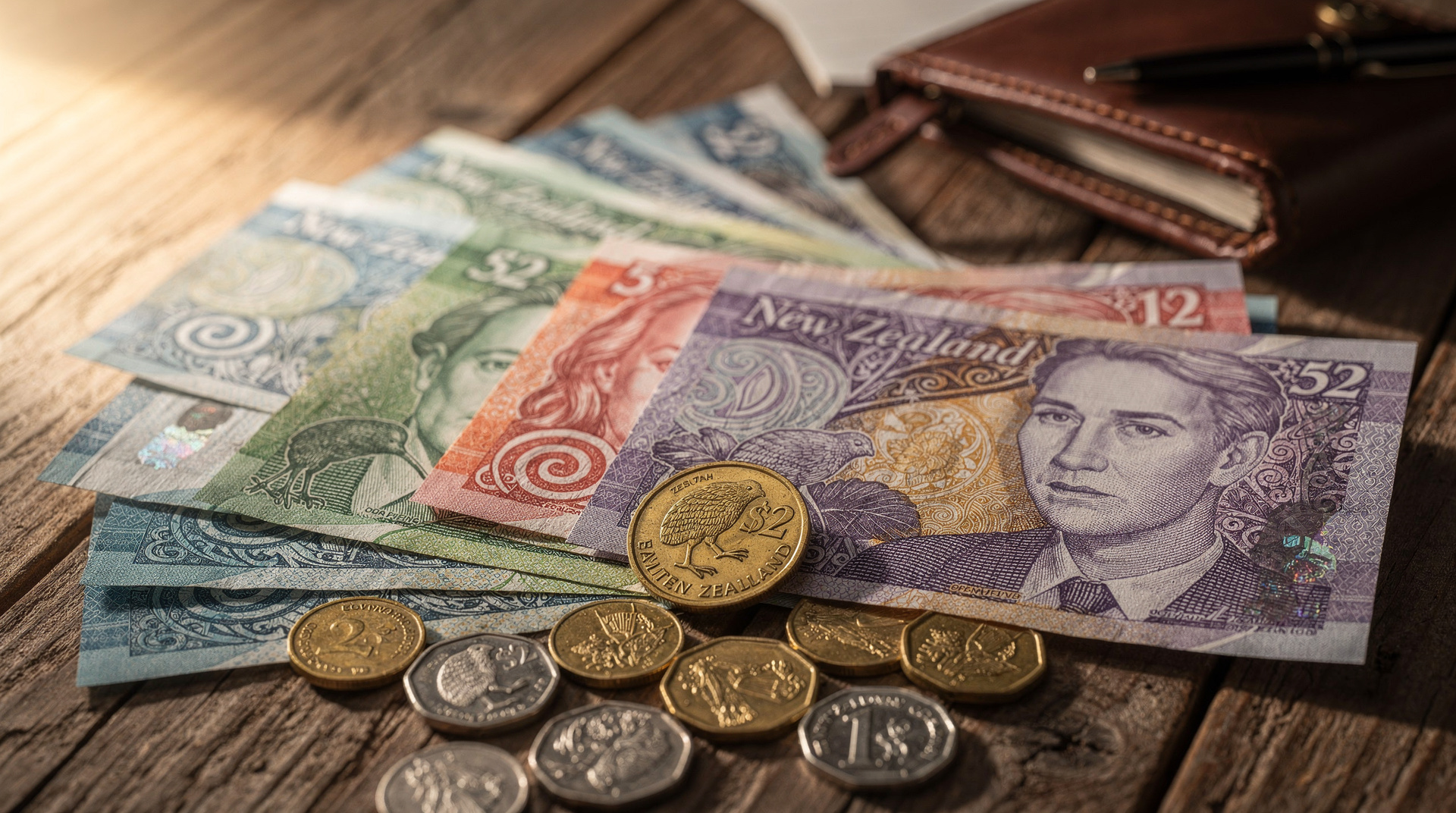
New Zealand uses the New Zealand dollar (NZD, symbol NZ$ or sometimes just $). Notes come in NZD 5, 10, 20, 50, and 100 denominations, all printed on polymer (plastic) — they are waterproof, difficult to tear, and feature native wildlife (the kiwi bird appears on the NZD 1 and 2 coins, tuatara on NZD 5 coin). Coins: 10c, 20c, 50c, NZD 1, NZD 2.
Exchange rate snapshot (April 2026):
- 1 NZD = approximately USD 0.60
- 1 NZD = approximately EUR 0.55
- 1 NZD = approximately GBP 0.47
- 1 NZD = approximately CAD 0.82
The NZD fluctuates — for budget planning, use 0.58-0.62 USD and 0.53-0.57 EUR as a realistic range. New Zealand’s economy is commodity-linked (dairy, meat, tourism), and the dollar weakens during global downturns. If you are budgeting a trip 6+ months ahead, assume NZD slightly higher than current mid-rate for conservative planning.
Cards: the dominant payment method
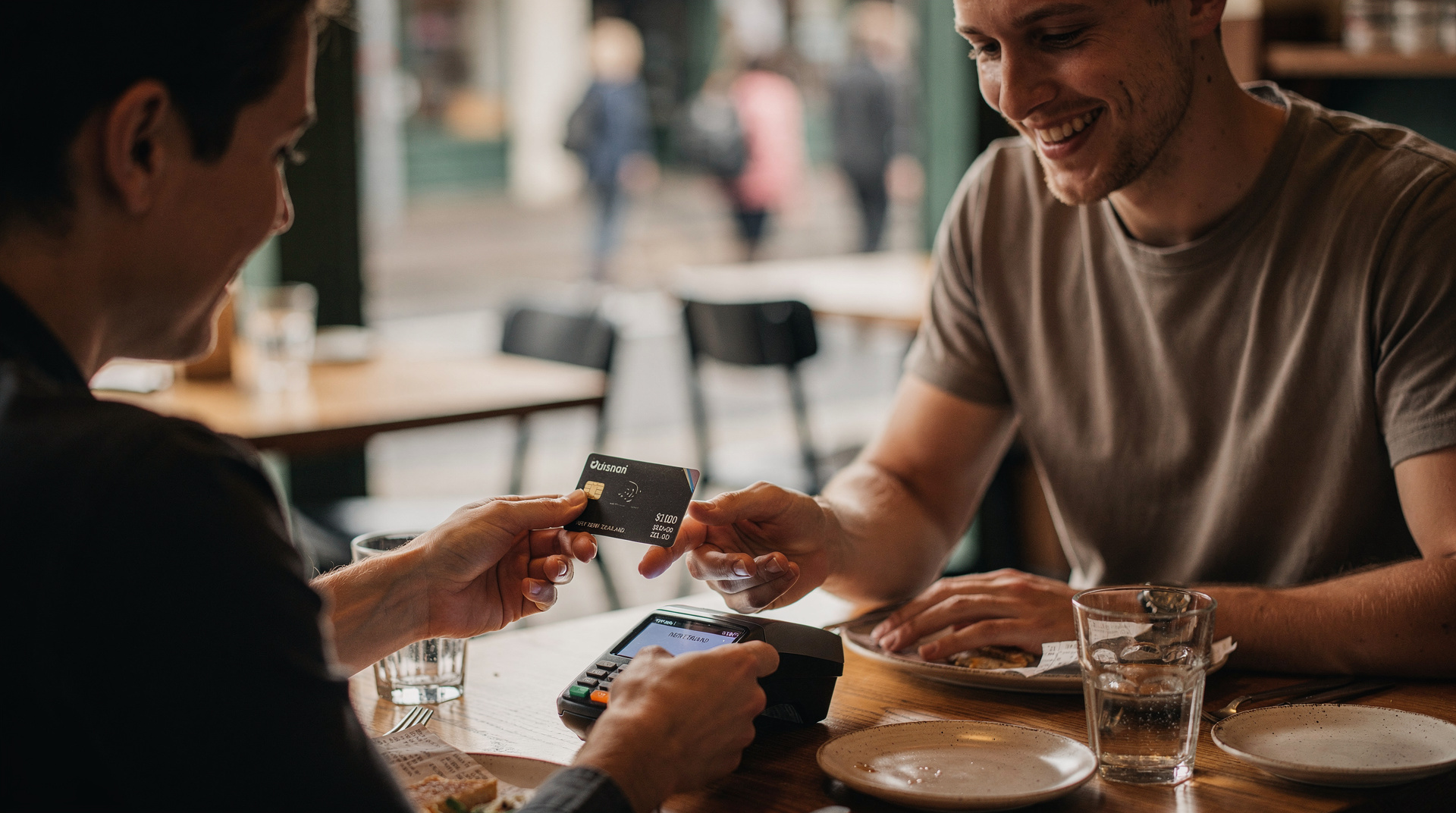
New Zealand is one of the most card-friendly countries in the world. Contactless payments (tap-to-pay) are universal. Many businesses — particularly cafes, bakeries, food trucks, and smaller operators — are now card-only or strongly prefer card.
Visa and Mastercard are accepted everywhere. Amex is accepted at larger restaurants, hotels, and tourist businesses but often rejected at petrol stations, rural shops, and smaller operators.
Chip-and-PIN works perfectly. Tap/contactless works for all transactions up to NZD 200 (no PIN needed); above that, PIN is required.
Surcharges: Some operators (particularly small businesses and those using certain payment terminals) add a 1-2.5% surcharge for card payments. This is legal and must be disclosed at point of sale. It is not common but exists — notably for Amex (sometimes 2-3% surcharge).
Overseas transaction fees: If your card charges foreign transaction fees (typically 1.5-3.5%), consider bringing a travel card (Wise, Revolut, Starling Bank for UK travellers) that converts at the mid-market rate without fees. Over a 2-3 week trip, this can save NZD 50-150 depending on spend.
ATMs
ATMs are available in all cities and most larger towns. Networks: ANZ (Bank of New Zealand), BNZ, Westpac, and Kiwibank are the main bank ATMs. International ATM networks (Cirrus, Plus, Maestro) work at most bank ATMs.
Fee structure: Your home bank may charge a flat fee per withdrawal (commonly USD 3-5 / EUR 3-5). The NZ ATM may also charge a fee (typically NZD 3-5). To minimise costs, withdraw larger amounts less frequently rather than small amounts regularly.
Where ATMs can be sparse:
- West Coast of the South Island (Hokitika to Haast — there is an ATM in Franz Josef town, but it runs out during peak season)
- Milford Sound road (no ATM; use card or bring cash)
- Northland north of Kaitaia (Cape Reinga — card operators at the tip, no ATM)
- Chatham Islands (ATM in Waitangi, the main settlement — unreliable supply)
Rural rule: any time you are heading into backcountry or remote regions, withdraw NZD 200-300 in cash beforehand.
Where to exchange currency
Best rates: Use your bank card at ATMs, which get the interbank mid-rate minus a fee. This consistently beats exchange bureaus.
Airport exchange counters: Worst rates in the country. The spread (difference between buy and sell) can be 5-10%. If you need cash on arrival, exchange only a small amount at the airport (NZD 100-150 for the taxi/shuttle), then use ATMs or your card for everything else.
City exchange bureaus: Travelex and independent exchange offices in Auckland and Christchurch CBD are slightly better than airports but still inferior to ATMs. Some independent operators (particularly in Queenstown) offer more competitive rates.
Best approach for most travellers:
- Bring a no-foreign-fee travel card (Wise, Revolut) for day-to-day spending
- Have a local ATM withdraw for markets/rural cash needs
- Keep NZD 100-200 in small notes on hand for emergencies
GST: what you see is what you pay
New Zealand’s Goods and Services Tax (GST) is 15% and is always included in the displayed price. This is unlike the US, where sales tax is added at point of sale. When you see a price in New Zealand — on a menu, shelf, or tour booking page — that is the total price you pay.
No mental arithmetic required. No “plus tax.” What is displayed is what leaves your wallet.
This simplicity extends to tipping (see below) and to tourist attraction pricing — there are no add-ons.
GST refunds for tourists: New Zealand does not operate a tourist VAT/GST refund scheme. Unlike EU countries or Australia, you cannot claim back GST on purchases made in New Zealand when departing. What you spend in NZ stays in NZ tax terms.
Tipping: the honest answer
New Zealand has a weak tipping culture — much weaker than the US or Canada. For full detail, see the dedicated tipping in New Zealand guide, but the short version:
- Restaurants: Not expected. Rounding up or leaving a few dollars for exceptional service is appreciated but genuinely optional — servers are paid living wage and do not depend on tips.
- Taxis/Ubers: Not expected. Rounding up is the limit of convention.
- Tours/guides: For a half or full day tour with excellent service, NZD 5-20 per person is appreciated and more common than in restaurants.
- Hotels: No expectation for housekeeping or porter tipping.
Service charges: Some Auckland and Queenstown restaurants add a 10-15% service charge on weekends or public holidays. This is legal and usually disclosed on the menu. It goes to staff wages, not at the discretion of your server.
Budget levels in NZD + USD + EUR
For detailed cost analysis, see New Zealand on a budget. Summary:
| Budget level | Per person per day (NZD) | USD | EUR |
|---|---|---|---|
| Backpacker | NZD 90-130 | USD 54-78 | EUR 50-72 |
| Mid-range | NZD 200-350 | USD 120-210 | EUR 110-193 |
| Comfortable | NZD 350-550 | USD 210-330 | EUR 193-303 |
| Luxury | NZD 600+ | USD 360+ | EUR 330+ |
These are per-person estimates including accommodation, food, local transport, and one paid activity per day. They exclude international flights and the IVL levy.
Split bills and group payments
New Zealand restaurants and cafes handle split bills without issues — simply ask before ordering if you want separate bills. Most card terminals allow splitting at point of sale. This is less fuss than in France or Germany, where split billing is sometimes resisted.
Cash for specific situations
Even in card-dominated New Zealand, cash remains necessary for:
- Rural petrol stations (some don’t have working card terminals)
- Farmers’ markets and craft fairs (many stalls cash-only)
- Small shuttle operators in remote areas
- DOC hut fees for some backcountry huts (though many now have EFTPOS or online booking)
- Tipping if you choose to
NZD 100-200 in cash is a sensible emergency float for any visitor.
Digital wallets and NZ-specific payment apps
Apple Pay and Google Pay work at any terminal that accepts contactless cards — which in New Zealand means almost everywhere, including taxis, supermarkets, and most cafes. This is often the easiest way to pay without pulling out a physical card, and it carries the same overseas transaction fee structure as your underlying card, so a fee-free travel card linked to your phone wallet gets you the best of both. Some smaller operators — food trucks, market stalls, casual weekend pop-ups — use EFTPOS-only terminals that occasionally reject certain international cards; carrying a small cash float covers this gap.
New Zealand does not have a widely used homegrown payment app equivalent to Venmo or Alipay for tourist-facing transactions, so there’s nothing extra to set up beyond your usual card or digital wallet.
Budgeting for the New Zealand International Visitor Levy
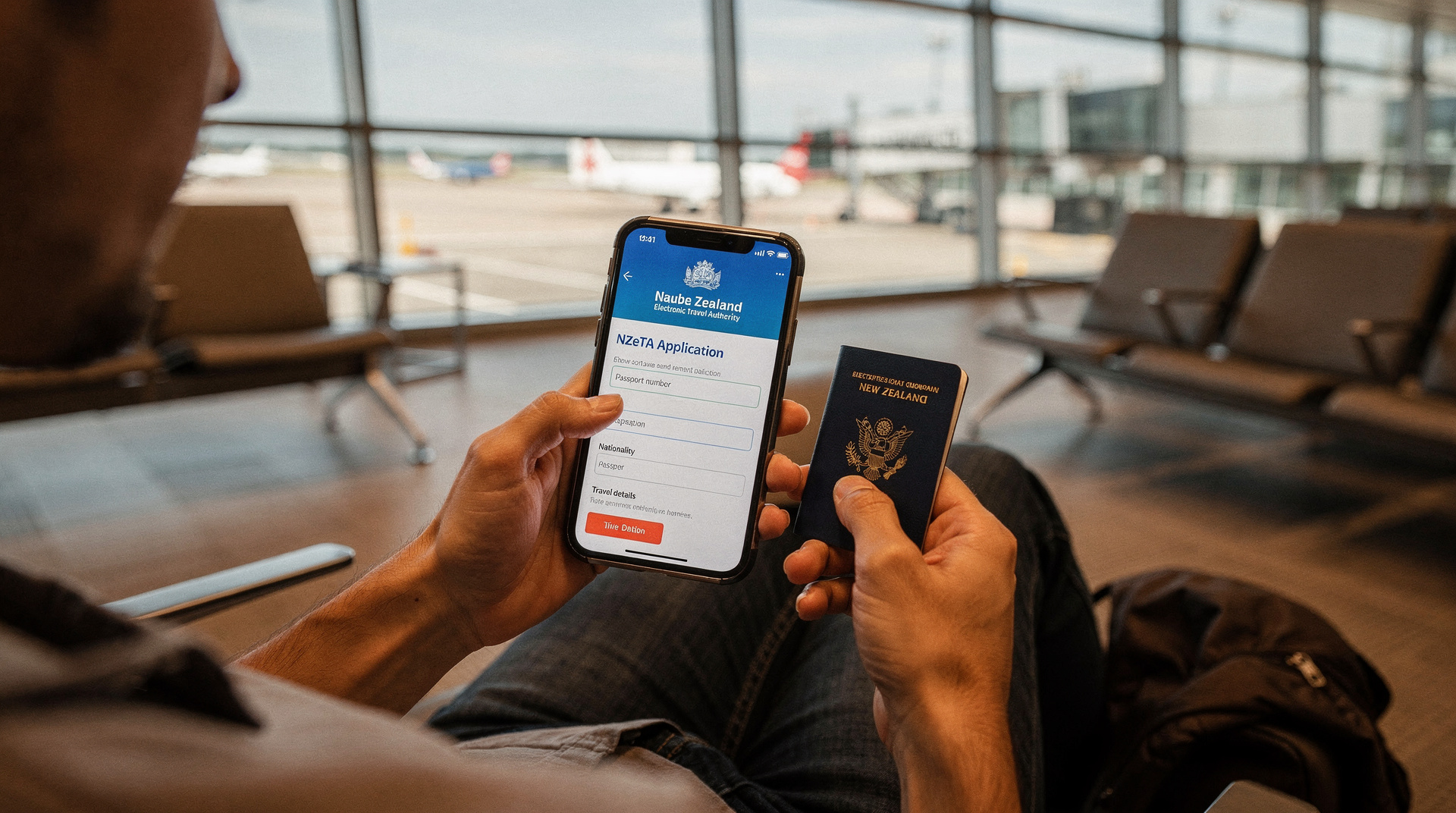
Separate from everyday spending, most visitors pay the International Visitor Conservation and Tourism Levy (IVL) as part of their NZeTA application before arrival — this is a one-off government charge, not something you’ll encounter at point of sale during the trip. See the NZeTA visa guide for the current amount and how it’s collected, since it changes periodically and is easy to overlook when budgeting a trip.
Frequently asked questions about money in New Zealand
Can I use USD or EUR directly in New Zealand?
No. All transactions in New Zealand are in NZD. No business accepts foreign currencies. Exchange before arrival, use ATMs, or pay by card.
Are credit cards safe to use in New Zealand?
Yes. Chip-and-PIN and contactless are the standard. Fraud rates are low. Skimming is rare. Notify your bank before travel to prevent automatic fraud blocks on overseas transactions.
Is it worth getting NZD before I leave home?
It depends. If your bank offers good rates, converting a small amount (NZD 200-300) before departure removes the pressure of finding an ATM on arrival. However, rates at home banks are often no better than NZ ATMs. The priority is avoiding airport exchange bureaus, not having NZD cash at the gate.
Should I use Wise or Revolut?
For travellers spending NZD 3,000+ over a trip, a zero-fee card like Wise (real exchange rate, small transaction fee) or Revolut (mid-market rate with a monthly free conversion allowance) saves meaningfully vs. a standard credit card charging 2-3% foreign transaction fees. Setup takes 3-5 minutes online; cards arrive within a week.
What are the NZD notes like?
New Zealand polymer banknotes are some of the most beautifully designed in the world. Each features a notable New Zealand figure (Sir Edmund Hillary on the NZD 5) and native flora/fauna. The NZD 100 note is purple and relatively uncommon in day-to-day use — petrol stations and small shops sometimes decline it. Use NZD 20 and 50 notes for most transactions.
Is New Zealand expensive compared to Europe or the US?
Generally yes, for accommodation and activities. Groceries are comparable to UK/European prices. Eating out at cafes is slightly more expensive than continental Europe but cheaper than London, Zurich, or Scandinavian capitals. Petrol/gas is typically NZD 2.40-2.80 per litre (USD 5.8-6.7 / EUR 5.3-6.2 per gallon equivalent) — significantly higher than the US but comparable to UK/Europe.
Do Apple Pay and Google Pay work in New Zealand?
Yes, at any terminal that accepts contactless cards, which covers the large majority of shops, cafes, and transport. It’s a convenient way to pay without carrying a physical card, though a small minority of cash-only market stalls and rural operators still require notes or coins.
Related guides and itineraries
- Tipping in New Zealand — full tipping etiquette
- New Zealand on a budget — making every dollar go further
- Packing list for New Zealand
- Best eSIM for New Zealand — another pre-departure purchase
- NZeTA visa guide — visa costs including IVL levy
- First time in New Zealand — full orientation
- Driving in New Zealand — petrol costs and road budgeting
Related guides
Tipping in New Zealand
Honest guide to tipping in New Zealand: restaurants, taxis, tours, hotels. Short answer: it is optional, not expected, and servers earn a living wage.
New Zealand on a budget
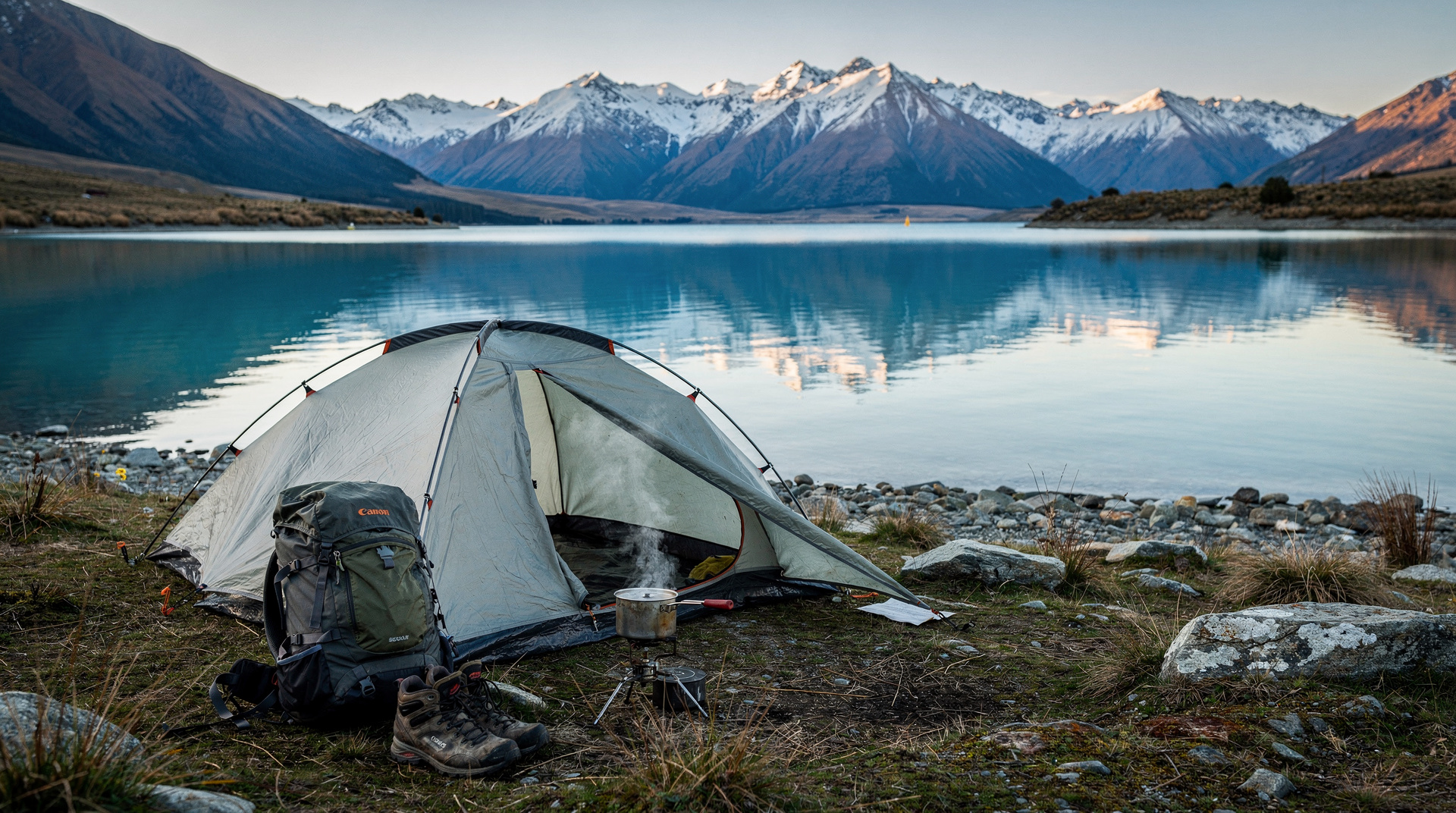
Honest budget guide to NZ: real daily costs, where to save, where not to cheap out, free things, and how to stretch NZD on a backpacker or mid-range budget.

First time in New Zealand
Complete first-timer's guide to NZ: costs, logistics, Maori culture, what to book early, and how to structure 7–21 days.
NZeTA visa guide (by nationality)
Complete NZeTA guide: who needs it, costs (NZD 23 + IVL 100), validity, and a per-nationality table for FR, DE, IT, ES, PT, US, CA, UK.

Packing list for New Zealand
Practical NZ packing list: layers for 4-season weather, hiking essentials, biosecurity musts, and what NOT to bring through customs. Season-by-season breakdown.
Last reviewed: