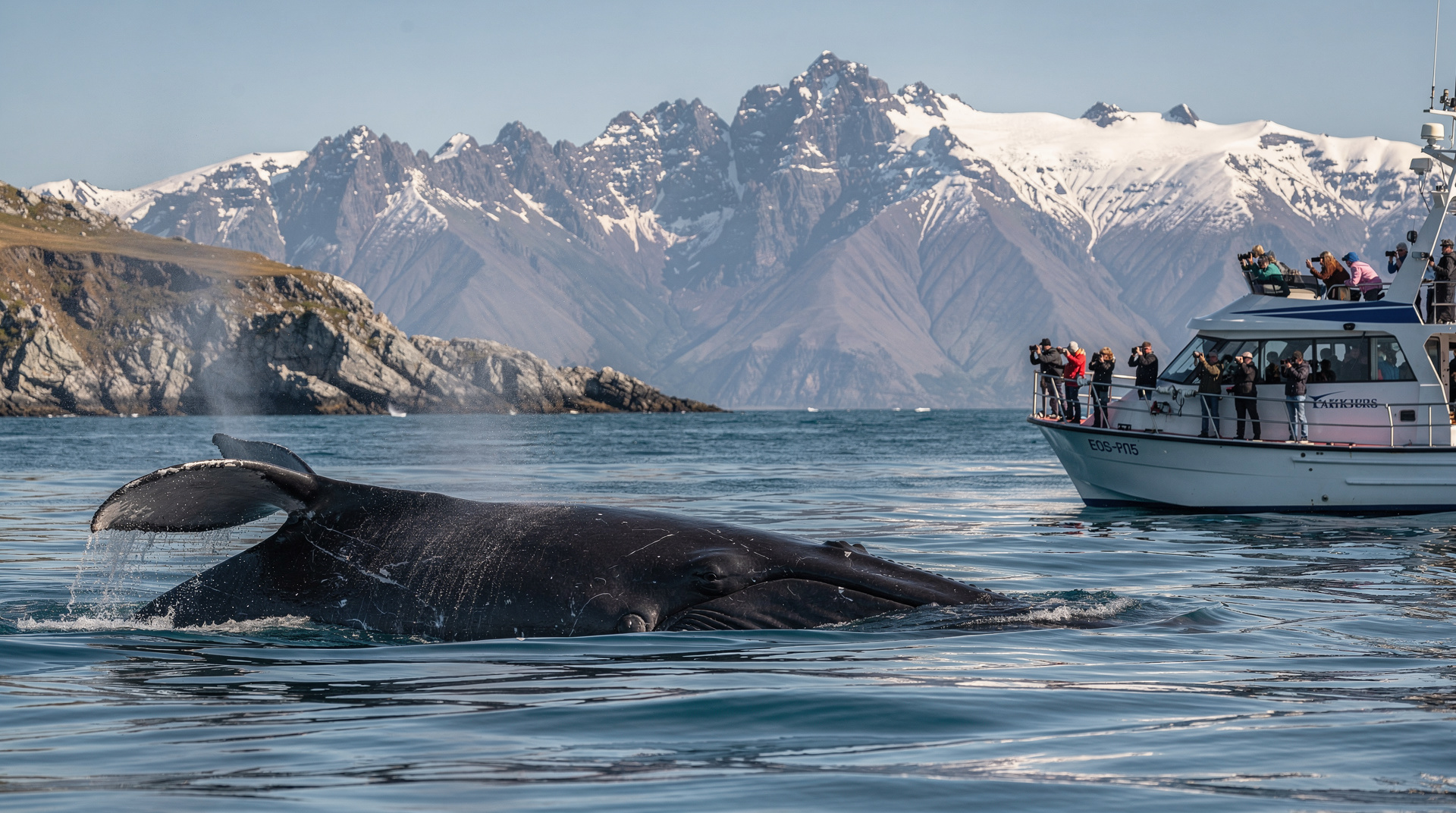
Whale Watch Kaikoura catamaran review — sperm whales, honest verdict 2026
Is the Whale Watch Kaikoura boat tour worth NZD 165?
Yes — this is one of the most reliable large whale encounters on earth. Sperm whales are present year-round in the Kaikoura Canyon, and sighting rates exceed 95%. At NZD 165 for 2.5 hours with hydrophone tracking, a Maori-owned operator, and a near-guarantee of seeing an 18-metre whale breach-dive, it's exceptional value.
The most reliable large whale encounter in the Southern Hemisphere — ✓ Worth it
Most whale watching is seasonal, probabilistic, and fundamentally unreliable. Humpbacks migrate. Blues appear briefly. Orcas follow prey. Kaikoura is different: the Kaikoura Canyon — a submarine trench that drops to over 1,000 metres within 5 km of the coastline — concentrates deep-water squid at depth year-round, and the sperm whales (tohora in te reo Maori) that feed on them stay in residence all twelve months.
What you’re booking is access to adult male sperm whales — the largest toothed predators on earth. The males that feed in the Kaikoura Canyon reach 14–18 metres and 45,000–57,000 kg. They dive to 600–1,000 metres, hold their breath for 45–60 minutes, and then surface within 300 metres of where they went down — their characteristic blow (angled forward at 45 degrees, the diagnostic marker of the species) announcing their return before you see the body. They rest at the surface for 8–10 minutes, then, on the final dive, lift their massive flukes clear of the water before descending again.
The fluke photograph is the centrepiece of every Kaikoura whale watching trip. You spend the 2.5 hours positioning for it.
| Where | Kaikoura marina, South Island — 181 km north of Christchurch |
| Cost | around NZD 165/adult, NZD 60/child (2.5-hour trip) |
| Time needed | 2.5-3 hours on the water |
| Getting there | self-drive, Coastal Pacific train, or guided day tour |
| Booking | well ahead in summer (Dec-Feb); a day or two ahead off-season |
Kaikoura: Whale Watching Cruise (2-Hour)
Whale Watch Kaikoura catamaran — 2.5-hour sperm whale encounter with hydrophone tracking.
From NZD 165 / USD 99 / EUR 91
What you actually get
The operator context
Whale Watch Kaikoura is unique among NZ wildlife operators: it is entirely owned by Ngati Kuri, the iwi (tribal group) of Kaikoura. The company was founded in 1987 when Ngati Kuri negotiated the sole concession for commercial whale watching in the canyon. It’s the only boat-based whale watching operator in Kaikoura — there is no competitor to compare, because the DOC concession is exclusive.
This matters practically: the money you spend stays in the local Maori community. Whale Watch is one of the most direct examples of Maori economic sovereignty in the tourism sector, and the company has been outspoken about conservation — they actively monitor the whale population, contribute data to international sperm whale research, and have a documented history of supporting conservation policy.
The catamaran
Whale Watch runs a purpose-built catamaran fleet — twin-hulled for stability on the open sea, with a covered lower deck, an upper open observation deck, and hydrophone equipment that the crew uses to track whales by sound before they surface. The catamaran holds approximately 80 passengers; departures are staggered so no more than one or two vessels are in the whale’s vicinity at any time.
The lower deck has seats, windows, and seasickness bags (placed without irony). The upper deck is open, cold, and where you want to be for the fluke photography. Bring a windproof jacket regardless of season — the sea wind at 15 knots is cold even in January.
How the whale finding works
Before departure, the crew checks the hydrophone data and recent surface sightings to estimate where the whales are. The catamaran travels to the general area (typically 6–12 km offshore) and deploys the on-board hydrophone — a directional microphone lowered into the water. Sperm whales are among the loudest biological sound producers on earth; their echolocation clicks (codas) are detectable at kilometres range. The crew triangulates the position of any whale vocalising in the area.
When a whale is located, the catamaran moves to a position 100–300 metres ahead of where the whale is likely to surface, based on the dive direction. Then you wait. The whale will blow — the misty, forward-angled blow that distinguishes sperm whales from baleen whales — and begin its breathing rest period. The boat repositions to observe from the permitted distance (minimum 50 metres by DOC regulation; in practice 100–200 metres).
The fluke dive
After 8–10 minutes at the surface, the whale signals the terminal dive: it arches its back, raises its body, and in a deliberate sequence of motion, lifts its flukes — the tail lobes — clear of the water as it drives downward. The flukes reach several metres above the surface before the animal descends vertically into the canyon.
This is the shot. Everyone on the observation deck has their cameras ready. The guide will tell you approximately when to expect it (based on the whale’s breathing rhythm at the surface). There is typically 5–10 seconds of visible fluke above the water — enough for multiple frames if you’re prepared.
What the photograph captures: two enormous tail lobes, slightly scalloped on the trailing edge, each whale individually identifiable by the pattern. The crew photographs the fluke from the stern on every trip — Whale Watch has an archive of hundreds of individually named and tracked whales, each recognisable by their specific fluke marking. Ask the crew to look up the whale you saw in the database.
On a typical 2.5-hour departure
- 0:00 — Departure from Kaikoura wharf, brief safety briefing
- 0:15–0:20 — Transit to whale area while crew works the hydrophone
- 0:25 — Whale located; vessel moves to intercept position
- 0:30–0:45 — Whale surfaces; crew announces blow, observation period begins
- 0:45–0:50 — Fluke dive; frantic photography
- 0:50–1:00 — Crew searches for second whale; hydrophone repositioned
- 1:00–1:45 — Second (sometimes third) whale located and observed; fluke dive
- 1:45–2:00 — Possible additional sighting if time allows
- 2:00–2:20 — Return transit to Kaikoura
- 2:30 — Dock; crew share ID database photos of the whales seen
This is not a rigid schedule — whale behaviour dictates the actual sequence. Some trips see one whale for 45 minutes; others encounter three or four in quick succession. The crew is transparent about what’s happening and provide running commentary.
Beyond sperm whales
Kaikoura’s productive waters mean bonus wildlife is common:
Dusky dolphins: Large pods — sometimes hundreds — are frequently encountered. The boat crew does not chase dolphins but dolphins often approach and ride the bow wake. Dusky dolphins are among the most acrobatic cetaceans — aerial leaps, spinning jumps, and sustained bow-riding are all possible.
New Zealand fur seals (kekeno): A large colony hauls out on the rocks near the peninsula. You’ll see them on the water regularly — curious, unbothered by boats, occasionally surface-diving alongside.
Humpback whales: Migration route June–August. Not a primary draw for the tour but increasingly common bonus sightings in winter.
Seabirds: Wandering albatross, royal albatross, giant petrels, and multiple shearwater species are common around the boat throughout the tour. Bring binoculars — the albatross identification game is excellent if you have a field guide.
What it costs and what’s not included
Cost breakdown
Prices approximate 2026. Exchange: 1 NZD ≈ 0.60 USD ≈ 0.55 EUR.
| Item | NZD | USD | EUR | Verdict |
|---|---|---|---|---|
| Whale Watch Kaikoura catamaran (adult) 2.5-hour trip; money-back guarantee if no sighting | NZD 165 | USD 99 | EUR 91 | ✓ Worth it |
| Whale Watch Kaikoura catamaran (child 3–15) | NZD 60 | USD 36 | EUR 33 | ✓ Worth it |
| Whale watching scenic flight (30 min) Alternative for motion sickness sufferers | NZD 195–220 | USD 117–132 | EUR 108–121 | |
| 1-hour helicopter whale tour | NZD 280–320 | USD 168–192 | EUR 154–176 | ★ Splurge |
| Wildlife kayaking half-day (add-on) Seal colony kayaking — excellent second activity | NZD 85–110 | USD 51–66 | EUR 47–61 | ✓ Worth it |
| Day trip from Christchurch (transport + boat) | NZD 295–340 | USD 177–204 | EUR 162–187 |
What’s not included: Motion sickness medication (bring your own if susceptible — Stugeron works well; take 1 hour before departure), meals, transport to Kaikoura (181 km north of Christchurch — 2.5 hours, or 127 km south of Blenheim — 1.5 hours), accommodation.
The money-back guarantee: If the tour departs and no sperm whale is sighted, you receive a full refund or a free future booking. This has happened rarely since 1987. Trips are occasionally cancelled before departure due to sea conditions (full refund given). It is not a conditional guarantee with fine print — Whale Watch Kaikoura has operated it for nearly 40 years.
Who should book ✓ Worth it
- You want to see a sperm whale — Kaikoura is the most reliable place on earth for this outside of Norway (winter only) and the Azores
- You’re self-driving the South Island and passing through the north Canterbury coast — Kaikoura is directly on SH-1 between Christchurch and Blenheim; it requires zero detour
- You’re interested in marine conservation and want to support an iwi-owned operator
- You have children old enough to understand scale — a 15-metre whale lifting its flukes 5 metres above the water is one of NZ’s most impactful wildlife moments
- You’re combining with a Kaikoura overnight stay — the town has excellent crayfish, and the seal colony peninsula walk is free
Who should skip ✕ Skip
- Significant motion sickness is a genuine problem — the catamaran is stable on calm days but the open ocean is unpredictable; take medication and consider the whale watching flight as an alternative ( Kaikoura whale watching flight with guided commentary )
- You’re on a rigid tight itinerary between Christchurch and Picton with no buffer — weather cancellations before departure are possible, and if you can’t rebook, you’ve lost travel time
- You’ve already seen the kiwi and the Milford Sound cruise and are rationing wildlife experiences — whales from a catamaran are different from both, but if the budget is finite, Milford Sound and kiwi are harder to replicate elsewhere
When to splurge ★ Splurge
If you want to see both the boat perspective (low, intimate, hydrophone) and the aerial view (full body outline, comparative scale from above), the helicopter tour is the combination answer. The helicopter can fly lower than fixed-wing aircraft and can hover at a respectful distance while a whale surfaces — the view of a sperm whale from 50 metres directly above is one that no boat ever replicates.
Kaikoura: 1-Hour Whale Watching Helicopter Tour
Kaikoura 1-hour whale watching helicopter — aerial view of sperm whales in the Kaikoura Canyon.
From NZD 310 / USD 186 / EUR 171
The combination booking — catamaran in the morning, helicopter in the afternoon — is the complete Kaikoura whale experience. It costs NZD 475 total per person and takes most of a day. For dedicated whale-watchers, this is the correct answer.
How to actually get there
Kaikoura is one of the easiest major attractions in NZ to access because it sits directly on SH-1 — the main road between Christchurch and Picton (Marlborough/South Island top). There is no detour required if you’re driving north from Christchurch or south from Blenheim.
From Christchurch: 181 km, approximately 2.5 hours. Google Maps is accurate on this route — it’s mostly coastal SH-1 with good road quality.
From Blenheim (Marlborough): 127 km, approximately 1.5 hours south on SH-1.
TranzCoastal scenic train: Christchurch–Picton stops at Kaikoura. The coastal approach by train — with ocean views on the eastern (right-hand) side heading north — is genuinely beautiful. Journey time approximately 2.5 hours from Christchurch. The train schedule is limited (typically 3-4 departures per week) — plan ahead if using this option.
Day trip from Christchurch: Feasible but tight. The whale watch boat runs 2.5 hours; add check-in time (arrive 30 minutes before departure) and the 3-hour drive each way and you’re looking at a 10-hour day minimum. A 6am Christchurch departure makes it work. Overnight in Kaikoura is significantly more relaxed and adds the wildlife kayaking, seal colony walk, and crayfish lunch to the itinerary.
The from Christchurch: Kaikoura day tour with whale watching is the guided alternative that handles all logistics if you prefer not to self-drive.
If you would rather let the train do the work, the Coastal Pacific train guide explains the route, and the Christchurch destination page covers where to base yourself before heading north. Travellers continuing towards Marlborough can read the Picton destination page to plan the next leg, and anyone building a longer loop will find the 7-day South Island itinerary a useful frame for slotting Kaikoura in.
Booking lead time by season
How far ahead you need to book depends heavily on when you’re visiting:
| Season | Booking lead time | Sea conditions | Notes |
|---|---|---|---|
| Summer (Dec-Feb) | 2-4 weeks | Calmest, most reliable | Peak demand — book earliest here |
| Shoulder (Mar-May, Oct-Nov) | 1-2 weeks | Good, occasional rough days | Reasonable balance of availability and conditions |
| Winter (Jun-Aug) | A few days to a week | Rougher, more cancellations | Whale numbers unchanged; possible bonus humpback sightings |
| School holidays (any season) | 4-6 weeks | Varies by season | NZ and Australian holiday periods spike demand sharply |
If your travel dates are fixed and fall in summer or a school holiday period, book as early as your itinerary allows — this is consistently one of the first activities to sell out on a South Island trip.
Honest red flags
Motion sickness is real. The catamaran’s twin-hull design reduces roll considerably compared to single-hull vessels, but the open ocean is the open ocean. Departures in 2–3-metre swells are uncomfortable for people prone to motion sickness. In peak summer (January–March), seas are typically calmer; in winter and spring they can be rough. Take medication prophylactically — don’t wait to feel sick.
The whale is not performing for you. Between the blow and the fluke dive, the sperm whale is breathing. It’s not swimming alongside the boat, it’s not breaching, it’s not doing anything particularly dramatic from a wildlife spectacle standpoint. The 8–10 minutes at the surface involves the whale slowly moving away from you as it breathes and rests. The fluke dive is brief. People expecting continuous whale action for 2.5 hours will be underwhelmed; people who understand the encounter structure will find it absorbing.
Photography is harder than you expect. The whale’s blow announces its position but the animal itself may be 200 metres away. A 200–400mm telephoto lens is the minimum for meaningful fluke photographs on a smartphone’s optical zoom. Anything shorter and you’re photographing a dark shape in grey ocean. The crew’s GoPro footage (purchased separately at the wharf) gives close-up views that most cameras from the observation deck cannot replicate.
The mist. Kaikoura sits at a latitude where cloud and sea spray are common. Overcast days are the majority, not the exception. The sperm whales do not care. But your photographs will lack the drama of blue-sky-and-white-flukes that dominates the promotional material.
One operator only. Because Whale Watch Kaikoura holds the sole DOC concession, there is no price competition, no alternative if you find the company unsatisfactory, and no comparison to be made. The operator is generally excellent — experienced, professional, conservation-oriented. But the monopoly is worth knowing about.
Alternatives if you don’t book
Whale watching scenic flight: For motion sickness sufferers who need an alternative. The 30-minute fixed-wing flight over the canyon gives the aerial perspective — you see the full body outline of surfacing whales clearly, which boats at water level cannot replicate. The trade-off is shorter duration and distance. Book via Kaikoura whale watch flight with commentary .
Wildlife kayaking: Not whale watching but a legitimate alternative half-day activity for people who don’t want the boat. Paddling through the seal colony on the peninsula, seeing the fur seals from water level, exploring the kelp forest. Book via Kaikoura half-day wildlife kayaking .
Kaikoura Peninsula seal colony walk (free): A self-guided walkway around the Kaikoura Peninsula passes close to the New Zealand fur seal colony. The seals are completely habituated to human presence. The walk takes 2–3 hours return and costs nothing. It is not whale watching — but the seal encounter at close range, combined with the dramatic coastal scenery of the Seaward Kaikōura Range meeting the sea, makes this one of NZ’s finest free walks.
Akaroa cetacean encounters (South Island alternative): Banks Peninsula, 75 km east of Christchurch, offers Hector’s dolphins — the world’s smallest dolphin species — in swimming tours that no other location in NZ provides in the same proximity. Different species and experience, but relevant for dolphin-focused travellers. See the Hector’s dolphins in Akaroa guide and the fuller Kaikoura vs Akaroa wildlife comparison if you’re deciding between the two.
How Kaikoura compares to whale watching elsewhere
Most travellers arriving at this review have seen — or considered — whale watching in other parts of the world, so it’s worth being specific about what makes Kaikoura different rather than just better or worse. In most global whale-watching destinations (Iceland, the Azores, New England), you’re watching seasonal migrants: humpbacks passing through on a defined window, sometimes only for a few weeks a year.
Kaikoura’s sperm whales are residents, feeding in the canyon year-round, which is why the sighting rate here (95%+) is structurally higher than almost anywhere else — it isn’t about better boats or luckier timing, it’s about geography. The only broadly comparable year-round sperm whale locations are Norway’s Andenes (winter-only) and parts of the Azores. For a broader sense of how Kaikoura fits into New Zealand’s wider wildlife-watching landscape — penguins, dolphins, seals, albatross — see the wildlife New Zealand overview.
Where Kaikoura fits in a wider trip
Kaikoura works best as a one-night stop rather than a pass-through. The Kaikoura destination page covers the town itself, while the Kaikoura after the 2016 earthquake article gives useful context on how the coast and the road have changed. If you are weighing other marine wildlife stops, the whale watching in Kaikoura vs Bay of Islands comparison is worth a read, and for a different kind of animal encounter on the same island, the blue penguins in Oamaru guide pairs well with a whale day. Those planning the driving side of a South Island trip can also consult the driving in New Zealand guide.
Families and first-time whale watchers
The 2.5-hour format and the minimum age of 3 make this a genuinely family-viable activity, but a few practical notes based on how families actually experience the trip: younger children (3–7) often find the waiting periods between sightings the hardest part — bring snacks and something to occupy the transit time, and sit on the lower deck initially since it’s warmer and more stable.
Older children and teenagers tend to engage well with the scale of the animal once it’s explained (an 18-metre whale is a genuinely hard thing to picture until you see the fluke). If seasickness is a concern for a family member, medicate proactively before departure rather than waiting to see how they cope — turning back mid-trip isn’t an option once you’re positioned on a whale.
If you’re combining the boat tour with a full Kaikoura day trip from Christchurch, the Kaikoura day trip from Christchurch guide lays out a realistic hour-by-hour schedule that fits the whale watch, lunch, and the free Ohau Point seal colony into a single well-paced day. For the wider planning picture — sighting rates, pricing across boat vs flight vs kayak, and when to go — see the companion Kaikoura whale watching guide.
Frequently asked questions about Whale Watch Kaikoura catamaran review — sperm whales, honest verdict 2026
What is the sighting rate for sperm whales at Kaikoura?
Over 95% of departures result in at least one sperm whale sighting. The combination of the Kaikoura Canyon’s deep-water squid habitat, the hydrophone tracking, and the resident bachelor males means that finding a whale is the norm rather than the exception. The money-back guarantee (full refund or free return if no whale is seen) has been honoured a handful of times in nearly 40 years of operation.
How many whales will I see?
Typically 1–3 individuals per trip. The crew identifies the specific whale after each sighting using the fluke photograph against their database — ask them at the end which whales you encountered. Named individuals include some that have been tracked for over 30 years.
Can I get seasick on the Kaikoura whale watch?
Yes. Seasickness medications work well if taken prophylactically (1–2 hours before departure, not after symptoms begin). The catamarans are more stable than single-hulled vessels, but conditions vary. The lower deck provides a more stable environment than the upper observation deck — motion sickness sufferers are better off on the lower deck initially and only moving up for the fluke dive.
Is the whale watching suitable for children?
Yes, from age 3. Children pay reduced rates (NZD 60 for 3–15). The crew is experienced with children and the encounter — a 15-metre whale surfacing 100 metres from the boat — is genuinely impressive for all ages. Motion sickness is worth considering for young children; bring medication and snacks.
When is the best time of year to go?
Year-round, but summer (December–February) has the calmest seas, the warmest weather for the observation deck, and the most reliable departure schedules. Winter (June–August) is rougher but perfectly viable — the whales are present in identical numbers. Winter also offers the chance of bonus humpback sightings during their migration, though this is not guaranteed.
Is the whale watching at Kaikoura ethical?
Whale Watch Kaikoura is considered one of the more ethically managed cetacean tourism operations globally. The DOC permit specifies minimum approach distances, maximum time in any whale’s vicinity, and engine behaviour near animals. The company funds and supports sperm whale research, contributes to population monitoring, and has been a voice for canyon conservation policy. The whale population shows no signs of disturbance; the canyon feeding habitat is intact.
Should I also do the wildlife kayaking on the same day?
If time allows, yes. The whale watch is typically a morning or midday departure (2.5 hours), leaving the afternoon available. The wildlife kayaking runs 2.5–3 hours and gives close-up seal colony access from water level — a completely different perspective from the whale watch’s open-ocean format. Combining both activities is the most complete Kaikoura wildlife day. Book separately; the kayaking operator is independent of Whale Watch Kaikoura.
How does this compare to whale watching in other countries?
Structurally different because Kaikoura’s sperm whales are year-round residents rather than seasonal migrants — the Kaikoura Canyon’s deep-water squid means the whales never need to leave. Few other whale-watching destinations globally offer that reliability. See the section above for a fuller comparison, and the wildlife New Zealand overview for how it stacks up against the country’s other marine wildlife encounters.
Is it better to day-trip this from Christchurch or stay overnight in Kaikoura?
An overnight is preferable if your schedule allows it — it removes the time pressure of a 10-12 hour round trip and typically lands you a calmer morning departure. The day trip is entirely workable, though; see the Kaikoura day trip from Christchurch guide for a realistic hour-by-hour plan either way.
Related guides
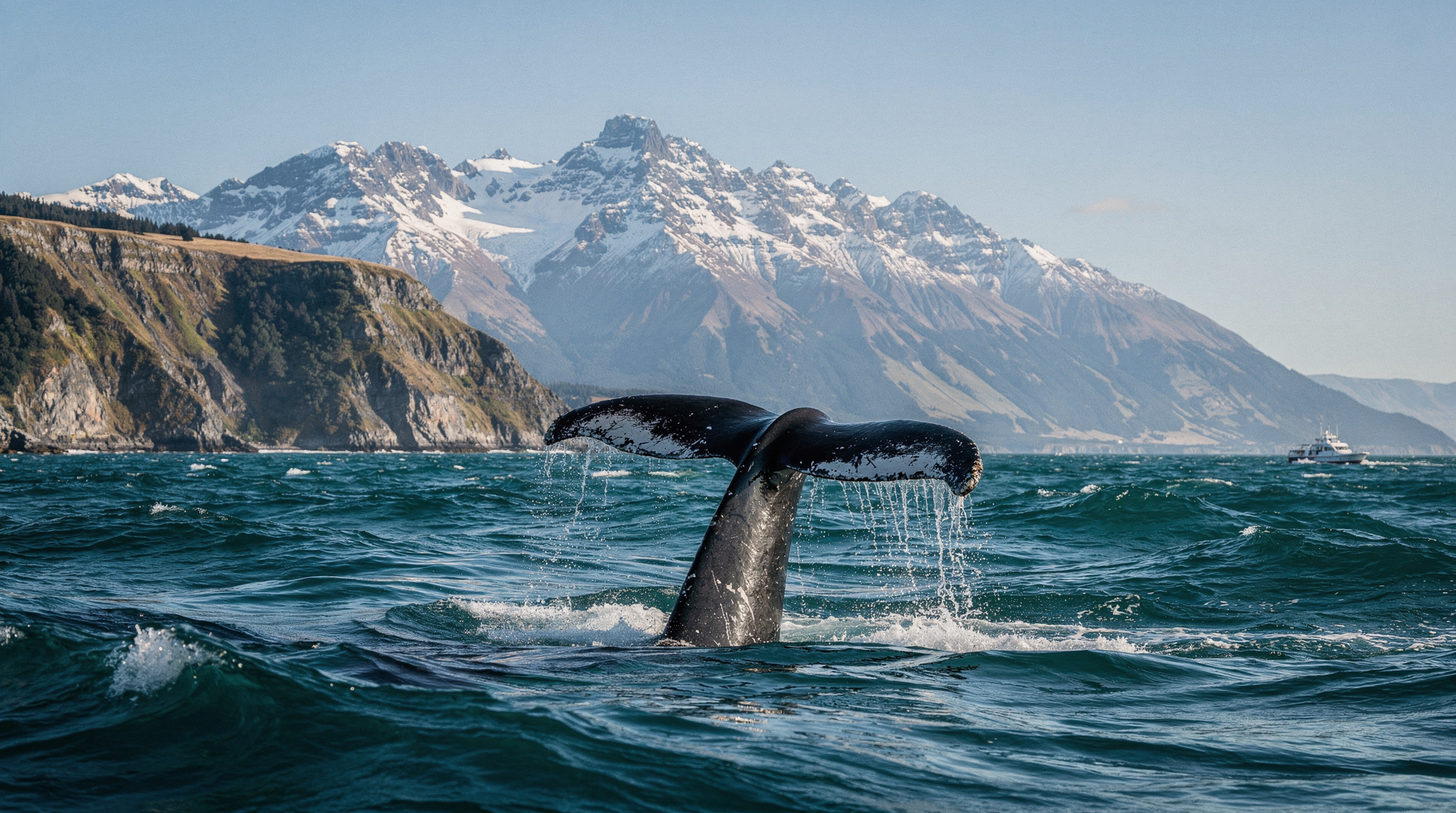
Kaikoura
Honest Kaikoura guide: sperm whale tours, wildlife kayaking, crayfish — real prices and the best time to visit after the 2016 earthquake rebuild.
Kaikoura whale watching
Sperm whales off Kaikoura year-round: boat, flight, or kayak? Real prices (NZD/USD/EUR), sighting rates, and which operator to book.
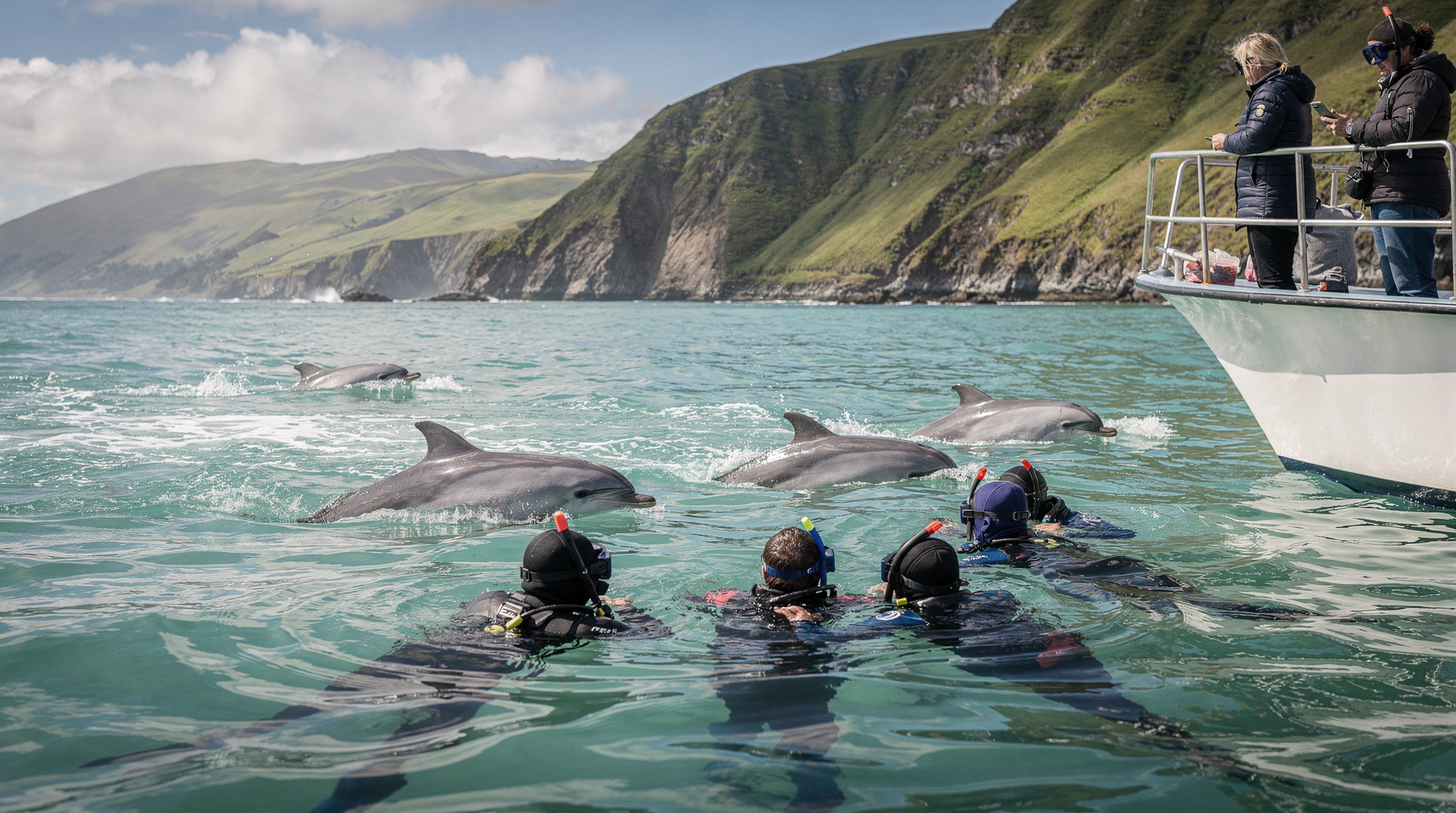
Hector's dolphins in Akaroa
Akaroa is the best place on earth to see Hector's dolphins, the world's smallest. Swim tours, cruise prices, ethical guidelines, and booking tips.
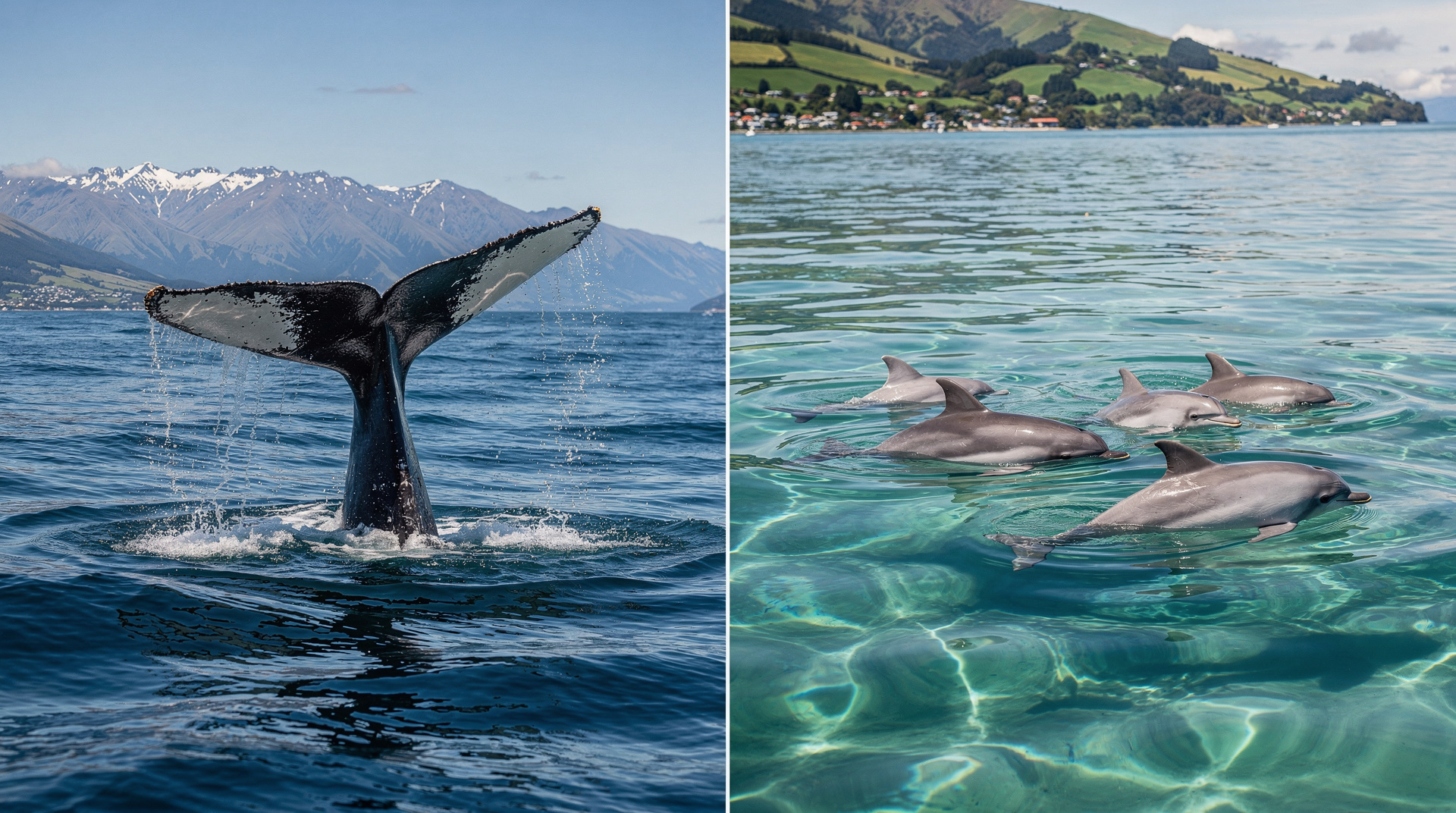
Kaikoura vs Akaroa for wildlife
Kaikoura vs Akaroa wildlife comparison: whales vs Hector's dolphins, sea kayaking, and which is better for a wildlife day from Christchurch. NZD/USD/EUR.
Canterbury
Honest Canterbury guide: Christchurch, Akaroa, Lake Tekapo stargazing, Aoraki/Mt Cook.