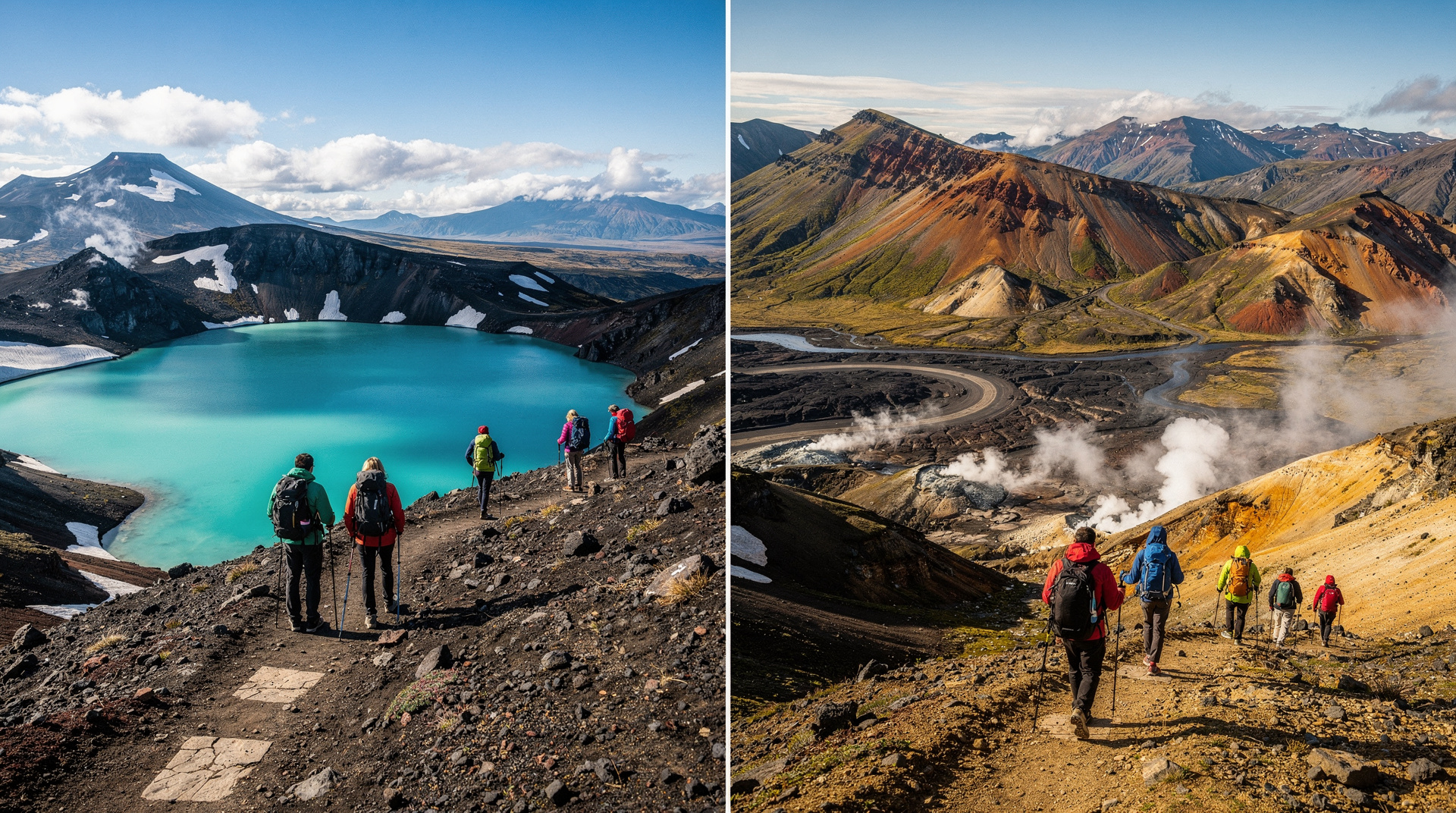
New Zealand vs Iceland — which to visit first
Should I visit New Zealand or Iceland first?
New Zealand for warm-season outdoor adventures, Maori culture, 14+ days of concentrated landscape variety, and no extreme cold. Iceland for northern lights, volcanic eruptions, midnight sun, and a raw geological energy that New Zealand doesn't quite match. Both offer world-class landscapes — the choice is hemisphere, season, and whether you want warmth or ice.
The honest verdict
New Zealand and Iceland are the two most-compared “dramatic landscape destinations” among international travellers who prioritise natural spectacle over urban tourism. Both are remote island nations with active volcanoes, glaciers, geothermal activity, and distinctive indigenous cultures. Both are accessible by international flight from Europe and North America. Both are expensive by global standards.
The comparison breaks down on season, scale, and cultural depth:
New Zealand’s advantages: Warmer climate (summer temperatures 20–27°C), far more geographic diversity crammed into accessible distance, rich Maori cultural experience, excellent hiking infrastructure (Great Walks), and an adventure sports scene (Queenstown) that Iceland cannot match. New Zealand also works better as a 14-day comprehensive trip — Iceland’s highlights are concentrated enough to feel repetitive by Day 10 for some visitors.
Iceland’s advantages: Northern lights (September–March), midnight sun (June–July), genuine volcanic eruption accessibility (the Reykjanes Peninsula has had regular lava flows since 2021), black sand beaches, and a stark geological rawness — black lava fields, steam vents emerging from the earth, waterfalls falling into ice — that has a particular visual intensity. Iceland is also much closer to Europe (3–4 hours from London, Dublin, Copenhagen) and can be done in a week in a way New Zealand cannot.
The verdict depends on where you’re based and when you’re travelling. For European visitors: Iceland first (cheaper, closer, shorter trip possible). For North American visitors: similar proximity but New Zealand’s summer falls in Northern Hemisphere winter — excellent if you want to escape cold. For Australian and Southeast Asian visitors: New Zealand is the obvious first choice.
| Pick New Zealand if | Warm-season adventure, Māori culture, 14+ days, no extreme cold |
| Pick Iceland if | Northern lights, midnight sun, 7-10 day trip, based in Europe |
| Cheaper to reach from Europe | Iceland (3-4h vs 23-26h) |
| Cheaper to reach from Australia/Pacific | New Zealand |
| Both can be done for | USD 4,000-8,000 per couple, 14 days, mid-range, excluding int’l flights |
Side-by-side comparison
| Dimension | New Zealand | Iceland |
|---|---|---|
| Area | 268,000 km² | 103,000 km² |
| Population | 5.1 million | 380,000 |
| Distance from London | 18,500 km (23–26h) | 2,600 km (3h) |
| Distance from New York | 14,000 km (17–20h) | 4,500 km (6h) |
| Summer temperature | 20–27°C | 12–18°C |
| Winter temperature | 5–15°C | -5 to +3°C |
| Northern lights | No | Yes (Sep–Mar) |
| Midnight sun | No | Yes (Jun–Jul) |
| Active volcano access | Yes — Tongariro, Whakaari | Yes — Reykjanes, active lava fields |
| Glaciers | Yes — Fox, Franz Josef | Yes — Vatnajökull (Europe’s largest) |
| Geothermal pools | Rotorua, Hanmer Springs, Tekapo area | Blue Lagoon, Myvatn, natural pools |
| Fiords | Fiordland (Milford, Doubtful) | Westfjords |
| Indigenous culture | Maori — living, integrated | Norse / Viking heritage |
| Dangerous wildlife | None | No dangerous land animals |
| Best season | Dec–Feb (NZ summer) | Jun–Aug (midnight sun) or Sep–Nov (lights) |
| Time needed | 10–14 days minimum | 7–10 days for a ring road circuit |
| Driving | Left-hand | Right-hand |
| Currency | NZD | ISK (Icelandic Króna) |
The landscape comparison
Both countries offer extreme landscape diversity in small areas. The geological comparison is striking:
New Zealand’s geological toolkit: Active volcanoes (Tongariro, Ruapehu, Whakaari), geothermal fields (Rotorua, Taupo), fiords cut by glacial action (Fiordland), alpine peaks (Aoraki/Mount Cook at 3,724m), active glaciers (Fox, Franz Josef — the most accessible temperate glaciers in the world), sub-tropical beaches (Northland, Bay of Plenty), ancient kauri forests, and tectonic fault systems.
Iceland’s geological toolkit: Active volcanic fissure zones, lava fields stretching to the horizon (Eldhraun is the world’s largest lava field), ice caps (Vatnajökull covers 8% of Iceland’s land area), glacial lagoons (Jökulsárlón, where icebergs float into the sea), waterfalls of extraordinary volume (Dettifoss is Europe’s most powerful), black sand beaches (Reynisfjara), and geothermal hotspots everywhere.
Both are on divergent tectonic plate boundaries — New Zealand on the Pacific-Australian boundary, Iceland on the Eurasian-North American boundary — and this drives much of their geological activity.
The tonal difference: New Zealand’s landscape has more colour variation and ecological diversity (green forests alongside white glaciers, turquoise fiords, ochre volcanic rock). Iceland’s landscape is starker — black, white, and grey dominate, with occasional vivid moss green on lava fields. This is not a quality difference but an aesthetic one. Travellers respond strongly to one or the other.
Activity comparison
New Zealand’s activity advantages:
The Great Walks — New Zealand’s managed multi-day hiking tracks — have no Icelandic equivalent in terms of infrastructure quality. The Routeburn Track, Milford Track, and Kepler Track all traverse world-class landscapes with DOC huts providing overnight shelter in remote terrain. See the Routeburn vs Milford Track guide for detail.
Glacier heli-hiking at Franz Josef is one of New Zealand’s signature experiences: a helicopter landing on an active temperate glacier, then guided hiking across the blue ice with glacier formation context. Franz Josef 2.5-hour glacier heli-hike — NZD 405–465 / USD 243–279 / EUR 223–256. Iceland has glacier hikes (Sólheimajökull is the main accessible glacier) but helicopter landings are not standard practice.
The Tongariro Alpine Crossing — a 19.4 km one-day walk across the volcanic Tongariro massif, passing the Emerald Lakes, Red Crater, and the flanks of Ngauruhoe — is one of the world’s great day hikes. Tongariro Alpine Crossing premium guided experience — NZD 189–250 / USD 113–150 / EUR 104–138 — adds geological and cultural context to the crossing.
Aoraki/Mt Cook (3,724m) offers helicopter experiences with alpine snow landings that have no Icelandic equivalent. Mt Cook helicopter flight with alpine landing — NZD 380–465 / USD 228–279 / EUR 209–256.
Hot air ballooning over the Wanaka basin in summer gives views across the Southern Alps that are spectacular from the air. Wanaka hot air balloon flight — NZD 395–450 / USD 237–270 / EUR 217–248.
Milford Sound kayaking provides intimate access to the fiord’s vertical walls, waterfalls, and fur seals from water level. Milford Sound kayak tour — NZD 120–165 / USD 72–99 / EUR 66–91.
Iceland’s activity advantages:
Northern lights (aurora borealis) watching is Iceland’s most sought experience from September through March. The phenomenon is unpredictable — a clear sky and solar activity index above 3 on the KP scale are required — but Iceland’s darkness and minimal light pollution between October and February make it one of the most reliable Northern European aurora destinations.
Midnight sun (June–July) allows hiking at 11pm in daylight — a psychologically extraordinary experience that no Southern Hemisphere destination can replicate.
Lava tube cave touring (Þríhnúkagígur, the only accessible magma chamber in the world, allows descent into a drained volcano) — there is no New Zealand equivalent.
Ice cave touring inside Vatnajökull glacier (October–March, when the caves are stable) is visually stunning — blue ice walls internally lit by refracted light. Franz Josef’s ice is accessible from above; Iceland’s Vatnajökull is accessible from inside.
Snorkelling in the Silfra fissure (Þingvellir National Park) between the Eurasian and North American tectonic plates — glacial-melt water with 100m+ visibility — is unique on earth.
The glacier comparison, specifically
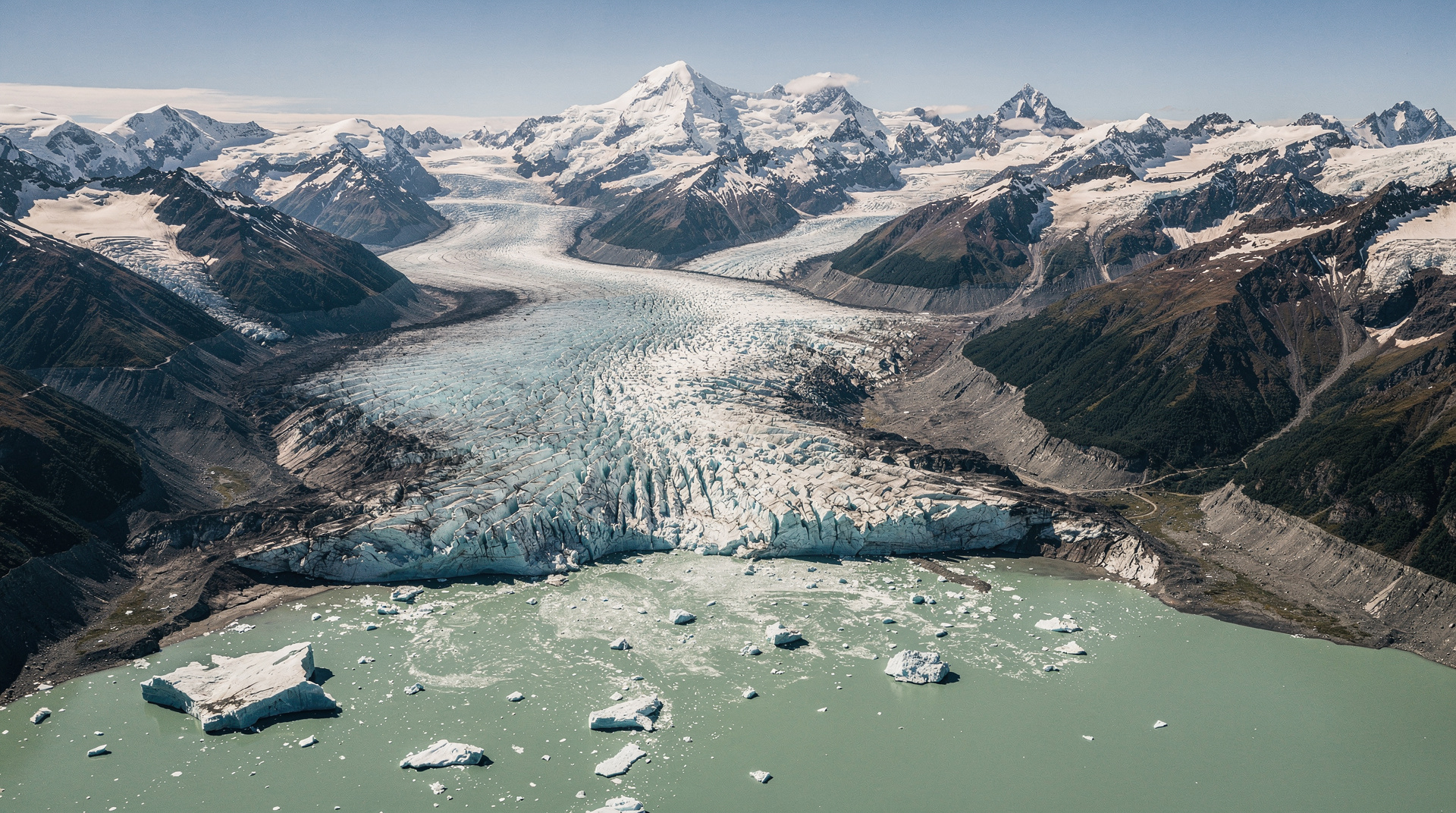
Because glaciers show up on both shortlists so often, they deserve a direct comparison rather than a footnote. New Zealand’s Fox and Franz Josef glaciers descend to roughly 300m altitude, meaning they sit unusually close to temperate rainforest — a striking juxtaposition Iceland can’t replicate. But both glaciers have retreated significantly since 2008, and the terminal-face walk is no longer viable; heli-hiking is now the only way to get on the ice.
Iceland’s Vatnajökull, by contrast, is Europe’s largest ice cap and offers walk-up glacier hikes (no helicopter required) plus the unique option of touring inside the ice via stable winter ice caves. The full detail on New Zealand’s side of this comparison — including which glacier to pick between Fox and Franz Josef — is in the glaciers of New Zealand guide and the Franz Josef vs Fox Glacier guide.
Cultural comparison
Maori culture in New Zealand: An indigenous culture with deep pre-European roots still actively lived and practised — te reo Maori language is co-official with English, Maori art, carving, and tattooing (tā moko) are widespread, and the Treaty of Waitangi relationship between the Crown and Maori continues to evolve. Cultural tourism experiences are sophisticated and genuine rather than performative. The Waitangi Treaty Grounds, Te Papa Tongarewa museum (Wellington), and Maori village experiences in Rotorua provide genuine insight into a culture with 700+ years of New Zealand presence.
Norse/Viking heritage in Iceland: Iceland was settled by Norse Vikings from approximately 874 AD — making it one of the youngest inhabited countries on earth (1,150 years versus Maori’s 700+ in New Zealand). The sagas (Icelandic medieval literature — family epics, battle narratives, adventure stories) are Iceland’s primary cultural heritage. The National Museum in Reykjavík and the Settlement Exhibition provide context. Iceland has no indigenous non-European population.
Neither cultural offering is superior — they’re simply different. New Zealand’s Maori culture has been continuously developed in situ for 700+ years; Iceland’s Viking heritage is archaeologically and literarily rich but European in origin.
Cost comparison (both countries are expensive)
| Category | New Zealand (NZD) | Iceland (ISK → USD equivalent) |
|---|---|---|
| Budget hostel | NZD 35–55 / USD 21–33 | USD 35–65 |
| Mid-range hotel | NZD 180–300 / USD 108–180 | USD 150–300 |
| Rental car/day | NZD 55–90 / USD 33–54 | USD 55–120 (4WD highland premium) |
| Restaurant meal | NZD 25–45 / USD 15–27 | USD 25–55 |
| Signature activity | NZD 85–465 / USD 51–279 | USD 50–300 |
| Petrol/100km | NZD 12–18 / USD 7–11 | USD 14–20 |
Both countries cost more than most European or North American destinations. Iceland’s food costs are slightly higher; New Zealand’s long-distance activity costs (Milford Sound, glacier heli-hike) push the activity budget higher. Both can be managed with campervan or camping; both can be done expensively. Mid-range traveller budgets of USD 150–250/day per person are realistic for both.
Who should visit which
Visit New Zealand if:
- You want warm-season outdoor adventure in summer (Dec–Feb)
- Maori culture and New Zealand’s indigenous heritage interests you
- You want 14 days of varied landscape without repetition
- Adventure sports (bungy, Shotover jet, skydiving, heli-hiking) are a priority
- You’re based in Australia, Southeast Asia, or the Pacific
Visit Iceland first if:
- You’re based in Europe (3-hour flight from major European cities)
- Northern lights are on your bucket list
- You prefer stark, raw volcanic landscapes over green and blue
- You can travel in shoulder season (September–November, when lights are visible and crowds smaller than summer)
- You want a shorter, 7–10 day trip
Frequently asked questions
Is Iceland or New Zealand more expensive?
Broadly comparable. Iceland’s restaurant prices are slightly higher and 4WD vehicle rental for highland access costs more. New Zealand’s premium activities (glacier heli-hike, Milford Sound day trip) push the activity budget higher. A mid-range 14-day trip costs USD 4,000–8,000 in either country for two adults excluding international flights.
Can you see the northern lights in New Zealand?
Aurora australis (the southern lights) are occasionally visible from New Zealand’s South Island, particularly from southern locations like the Catlins or Stewart Island on clear nights with high KP-index solar activity. They’re far less reliable and spectacular than Iceland’s aurora borealis. If northern lights are your primary goal, Iceland is the correct choice.
Is New Zealand worth the long flight?
Yes, for most travellers who make the journey. The distance (18–26 hours from Europe or North America) is the primary barrier, and most visitors who overcome it rate New Zealand among the best travel experiences of their lives. The key is allowing adequate time — 14 days minimum — to justify the travel investment.
Can I do New Zealand and Iceland on the same trip?
Not practically. They sit on almost opposite sides of the globe with no efficient routing between them — combining both usually means routing through Europe, the US, or Asia twice rather than a single continuous leg. Most travellers treat them as separate bucket-list trips rather than a combined itinerary, unlike New Zealand and Australia, which share a short, cheap regional flight.
Related comparisons and guides
Related guides

First time in New Zealand
Complete first-timer's guide to NZ: costs, logistics, Maori culture, what to book early, and how to structure 7–21 days.
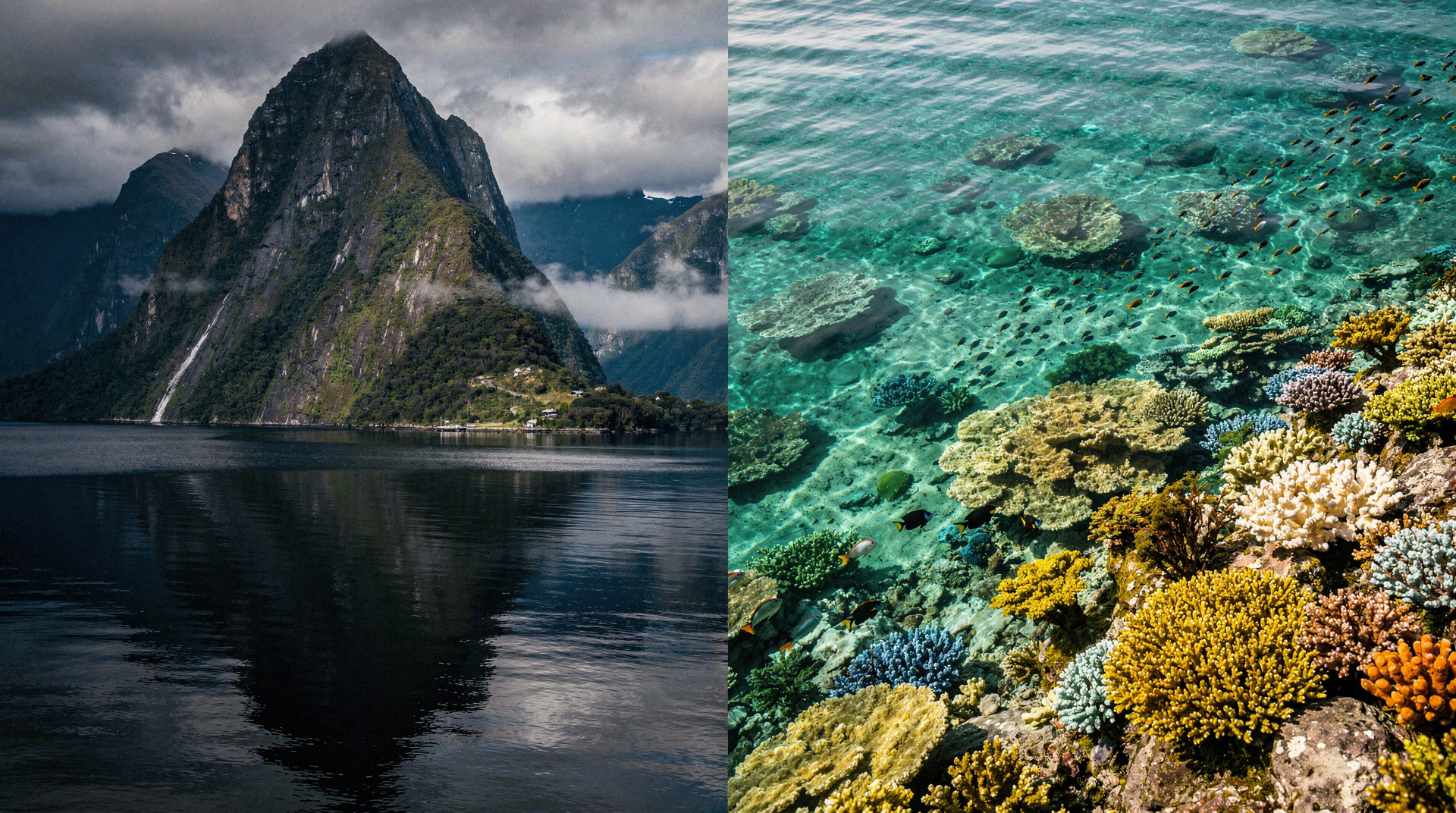
New Zealand vs Australia — which to visit first
New Zealand vs Australia compared honestly: landscapes, wildlife, costs, travel time, and which to visit if you can only choose one. NZD/USD/EUR prices.
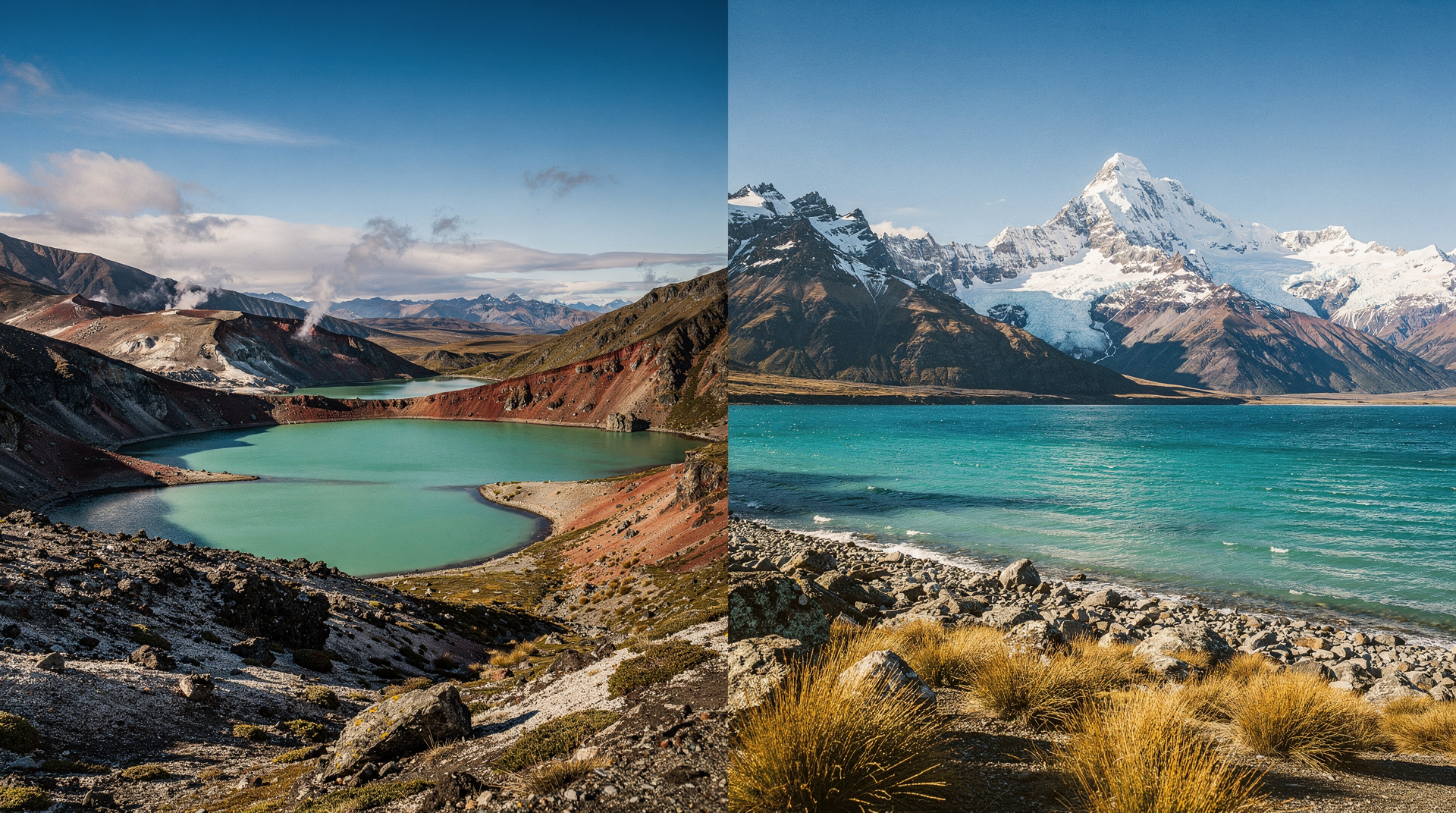
North vs South Island — which is right for you
Honest North vs South Island comparison: culture, landscapes, costs and a clear verdict for first-timers, families and short trips.
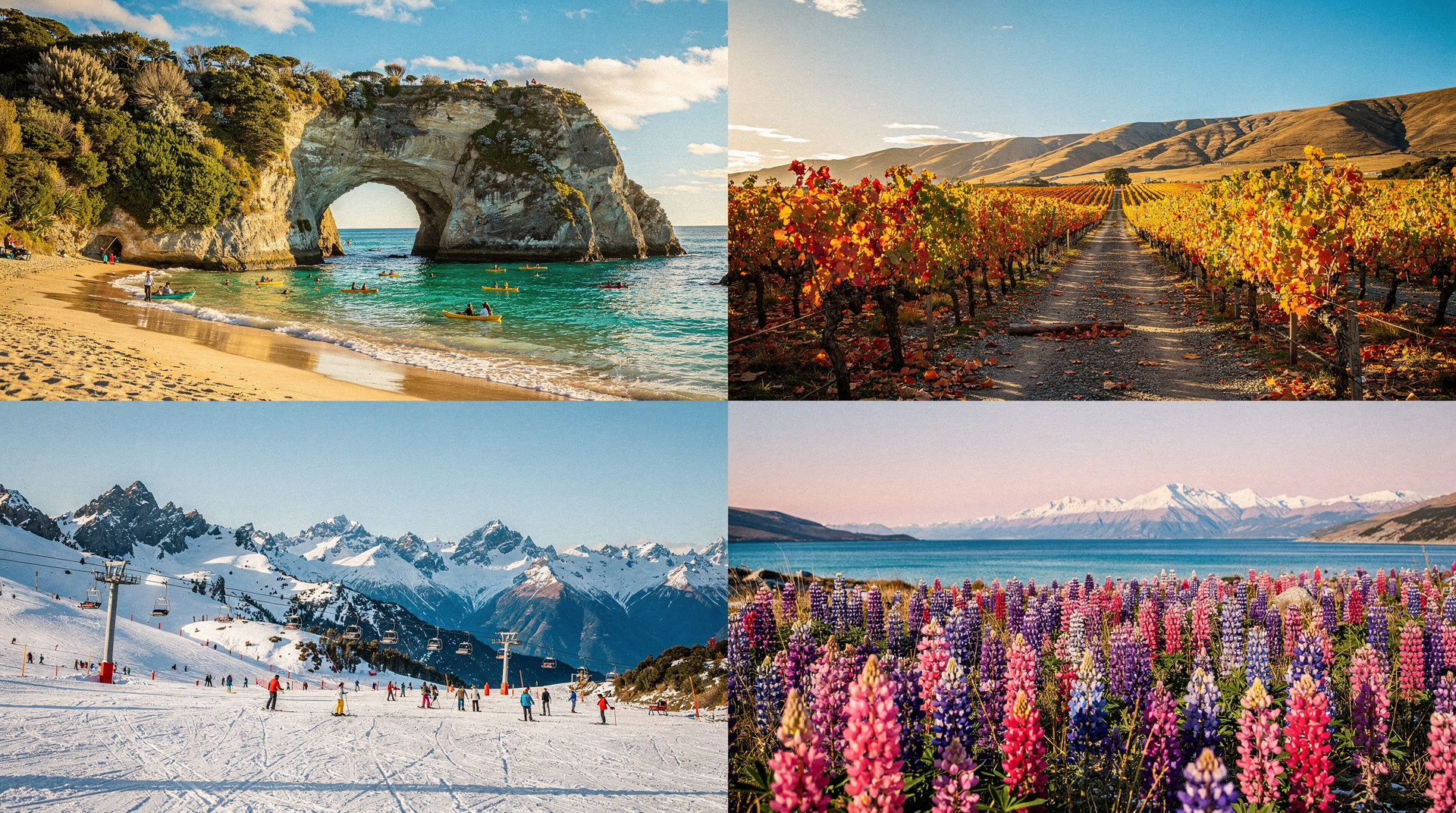
Best time to visit New Zealand
When to visit New Zealand: honest breakdown by season, region, and activity type. Summer is not always best. Spring and autumn often outperform the peak season.
New Zealand glaciers guide — Franz Josef, Fox, and the Tasman
Honest NZ glacier guide: Franz Josef vs Fox vs Tasman Glacier comparison, heli-hike options, glacier retreat reality, what's still accessible in 2026.
Last reviewed: