The Catlins self-drive guide — 2 to 3 days along New Zealand's forgotten coast
How long do you need to drive The Catlins?
Two full days is the minimum to see the highlights without rushing — Nugget Point, Cathedral Caves (tide-dependent), Curio Bay petrified forest, and yellow-eyed penguin viewing. Three days lets you linger at Slope Point, explore Jack's Bay Blowhole, and catch both dawn and dusk penguin sessions. The road is entirely paved but winding; allow 30% more time than Google Maps predicts.
The honest case for The Catlins
Southern New Zealand’s most underrated drive sits between Dunedin and Invercargill — a stretch of coast so remote that most visitors miss it entirely by taking State Highway 1. That’s their loss. The Catlins delivers waterfalls crashing into native bush, a petrified 180-million-year-old forest exposed at low tide, yellow-eyed penguins waddling ashore at dusk, fur seals sleeping on photogenic rock stacks, and a lighthouse so isolated it’s almost theatrical. All of it on a sealed two-lane road with minimal traffic.
The catch: several highlights are tide-dependent and penguin viewing requires you to stay very still in a cold hide for up to an hour. This guide tells you exactly when to be where, and whether the detours are worth the extra kilometres.
| Where | Between Dunedin and Invercargill, South Otago/Southland |
| Time needed | 2 days minimum, 3 days comfortable |
| Cost | Around NZD 250-380/person for 2 nights, self-catering |
| Getting there | Self-drive (2WD fine); guided day tour if without a car |
| Best time | October to March for penguin chick activity and long daylight |
Why most itineraries skip it — and why that’s a mistake
The Catlins adds roughly 120 km and at least a night’s accommodation to the Dunedin-to-Invercargill leg. Most coach tours don’t stop here; the backpacker bus passes through Owaka but rarely lingers. That’s precisely why it rewards self-drivers: you can time your Cathedral Caves visit to the tide table, position yourself at the Nugget Point hide before sunset, and have Curio Bay’s petrified forest almost to yourself at 7 a.m.
The route: Dunedin to Invercargill
The standard direction is north-to-south (Dunedin start, Invercargill end), which lets you arrive at Nugget Point in the morning light and Curio Bay late in the day — broadly matching the better wildlife-viewing windows. The reverse works too, and some argue the morning light suits Curio Bay better; it’s genuinely close either way.
Total distance: approximately 250 km Dunedin to Invercargill via The Catlins (vs 186 km direct on SH1).
Real driving time: allow 5-6 hours of actual driving spread across 2-3 days, plus stops.
Day 1 — Dunedin to Owaka via Nugget Point
Leave Dunedin by 8:30 a.m. and head south on SH1 before branching onto SH92 near Balclutha. The first significant stop is Nugget Point/Tokata, about 2 hours from Dunedin (90 km, but count 1 hour 45 minutes on the winding approach road).
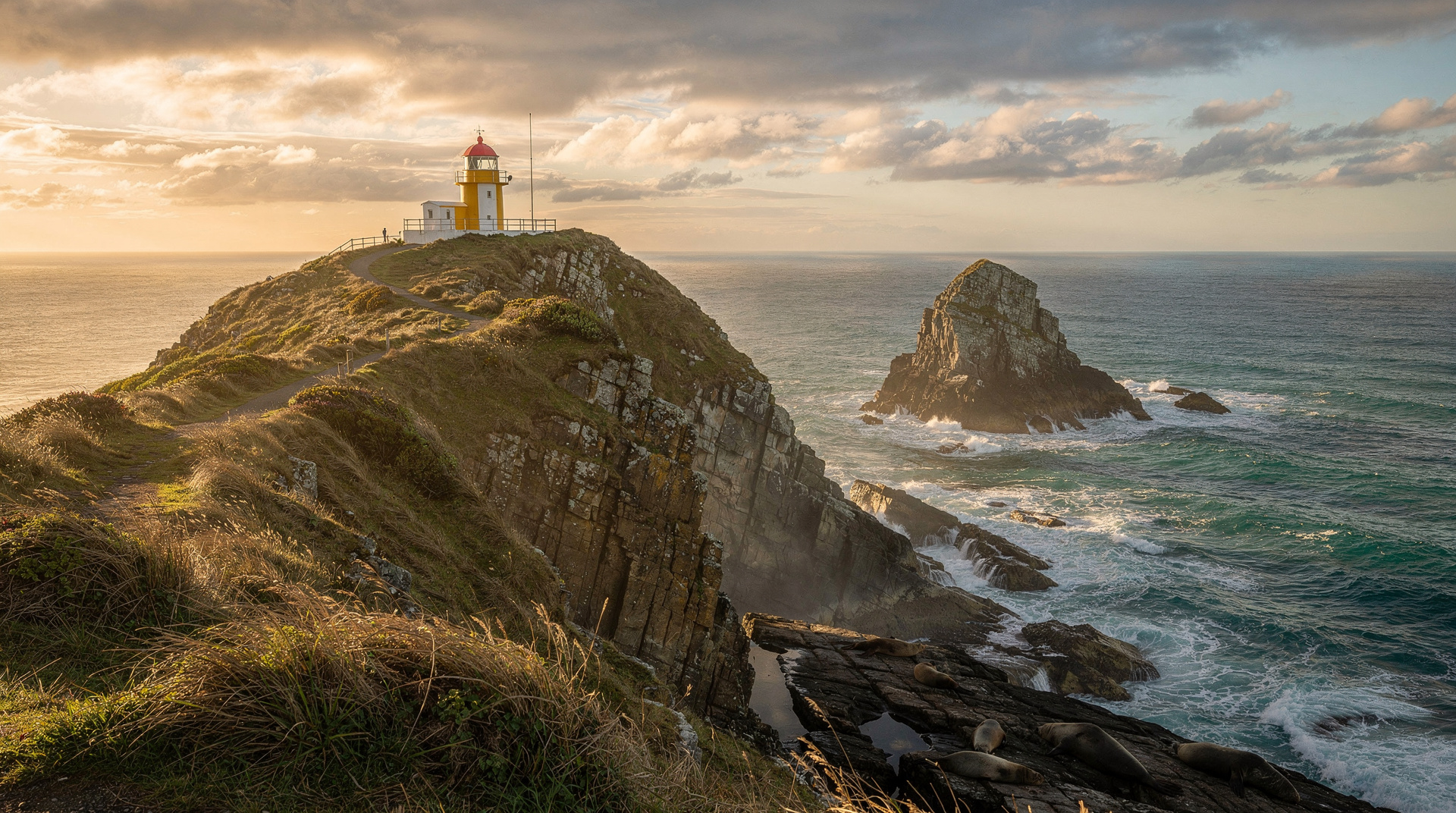
Nugget Point is worth at least 90 minutes. A 20-minute walk on a clifftop boardwalk leads to a lighthouse perched above a scattering of sea stacks — the “nuggets” — occupied by Hooker’s sea lions, fur seals, spotted shags, and royal spoonbills. The lighthouse itself is not open, but the views are exceptional. This is also one of the most reliable spots to see yellow-eyed penguins (hoiho) arriving ashore late afternoon; if you plan to stay for the evening session, book a spot at the nearby hide through DOC.
Continue 30 minutes to Owaka, the region’s largest settlement (population roughly 350). This is your best base for night one. There’s a DOC information centre here with current tide tables and track conditions — stop in even if briefly.
Where to stay in Owaka:
- Jack’s Bay Backpackers: the cheapest option (NZD 30-35 / USD 18-21 / EUR 17-19 per dorm bed), run by a local family who know the tide schedules
- Catlins Farmstay (various operators outside town): expect NZD 120-160 / USD 72-96 / EUR 66-88 for a B&B double
- There is no luxury accommodation in Owaka; mid-range means a self-contained cottage
Day 2 — Cathedral Caves and Curio Bay (tide-critical day)
This is the most logistics-dependent day. Cathedral Caves is only accessible 1 hour either side of low tide — at high tide, the cave entrance is completely submerged. Check the Catlins Cathedral Caves website for the daily tide schedule before you leave. Admission is NZD 8 / USD 5 / EUR 4.40 per adult, paid at the entrance gate. The 20-minute walk through native forest to the beach is itself pleasant, but if the tide is wrong, the cave is simply closed.
Cathedral Caves is a 10-minute drive from Papatowai (itself 30 minutes south of Owaka). The caves themselves are extraordinary: 30 metres high at the vaulted ceiling, carved by thousands of years of swell action into the limestone headland. Allow 45 minutes inside once you’re there.
Papatowai is a good rest stop — there’s a basic café and a small general store. If you plan to spend a second night in the region, this is a quieter alternative to Owaka:
- Whistling Frog Café and Resort: backpacker beds from NZD 35 / USD 21 / EUR 19, motel units NZD 120-140 / USD 72-84 / EUR 66-77
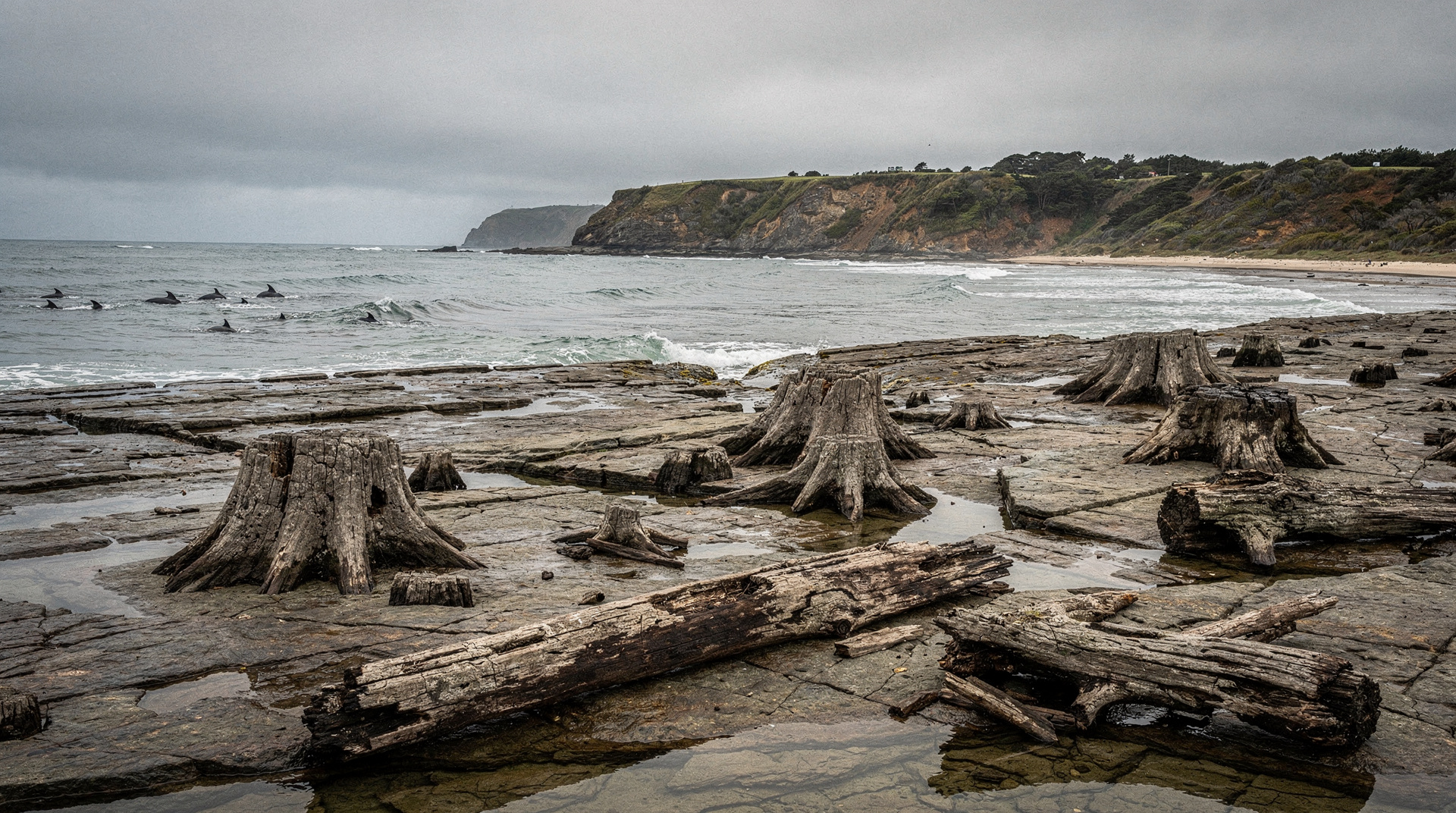
From Papatowai, head 20 minutes south to Curio Bay. This is where you’ll find the best-preserved Jurassic petrified forest in the Southern Hemisphere — 180-million-year-old tree stumps and logs fully exposed at low tide on a flat wave-cut platform. Like Cathedral Caves, this is tide-dependent: you need to be here within 2 hours of low tide for the forest to be visible. At high tide, the whole platform is underwater.
Curio Bay is also one of the most reliable spots to see Hector’s dolphins in the surf (endemic to NZ, the world’s smallest marine dolphin) and yellow-eyed penguins coming ashore at dusk. The penguin viewing area has a roped-off section to keep people from disturbing the birds — stay behind the rope, stay quiet, and be patient.
Important: Do not use a flash or phone torch near the penguins. Keep at least 10 metres distance. Rangers patrol in season (October to March) and will ask you to leave if you’re too close.
Where to stay at Curio Bay:
- Curio Bay Accommodation: holiday park with powered sites (NZD 45 / USD 27 / EUR 25), basic cabins (NZD 90 / USD 54 / EUR 50)
- Southern Comfort Backpackers (nearby): budget option, popular with independent travellers
Day 3 — Slope Point, Waipapa Lighthouse, Jack’s Bay Blowhole, Invercargill
Day 3 is shorter but finishes two iconic spots before dropping you in Invercargill.
Slope Point (accessible from Haldane, a 15-minute drive from Curio Bay) is the southernmost point of New Zealand’s South Island. It’s a 20-minute walk each way across a sheep paddock — yes, literally through farmland with a stile at the start — to a sign marking the latitude. No dramatic cliff, no lighthouse, but it’s oddly moving. Worth 45 minutes total if you care about geographic extremities.
Waipapa Point Lighthouse is 15 minutes west of Slope Point and sits on a broad grassy headland above a seal colony. The white-painted lighthouse (not open to visitors inside) is one of the most photographed in the South Island. This is also the site of New Zealand’s worst peacetime maritime disaster: the SS Tararua struck a reef here in 1881, killing 131 people. A memorial stone stands nearby.
Jack’s Bay Blowhole requires a 20-minute walk from the Jack’s Bay car park (about 40 minutes’ backtrack north of Waipapa — check if it fits your routing). The blowhole is dramatic when the swell is up: seawater erupts up to 20 metres through a surface opening in the cliff. In calm weather it’s just a hole in the ground with some gurgling. Check the MetService swell forecast before committing to the detour.
From Waipapa, it’s 55 minutes to Invercargill — a functional city rather than a destination in itself, but the southern gateway to Stewart Island/Rakiura.
Tide planning — the single most important preparation
Two of The Catlins’ signature attractions are accessible only within a narrow window around low tide. Getting this wrong means missing them entirely.
How to check tide times:
- NIWA Tide Forecaster (niwa.co.nz/our-science/coasts-and-oceans/tools/tides) — free, select “Papatowai” or “Fortrose” for The Catlins coast
- The Catlins Cathedral Caves website publishes daily opening times based on the tide schedule
- Owaka DOC visitor centre prints the week’s tide table on request
Rule of thumb: if low tide is before 10 a.m. or after 4 p.m., you’ll need to either adjust your schedule or accept missing the site on that day. The best scenario is a low tide between 10 a.m. and 2 p.m., which lets you visit Cathedral Caves mid-morning and the Curio Bay petrified forest early afternoon.
Because tides shift roughly 50 minutes later each day, a 3-day visit that starts with an inconvenient tide on day 2 will often resolve itself by day 3.
Yellow-eyed penguin viewing — what to expect
The hoiho (yellow-eyed penguin) is one of the world’s rarest penguins; The Catlins is among the best places to see them in the wild. Key sites: Nugget Point, Curio Bay, and Roaring Bay (near Nugget Point, DOC-managed hide).
Viewing rules:
- Penguins arrive ashore 30-60 minutes before sunset. Be in position before 5 p.m. (summer) or 3:30 p.m. (winter).
- Stay in the designated hide or behind the rope markers. Penguins that detect humans may abandon their chicks.
- No flash photography, no phone torches.
- The Nugget Point DOC hide at Roaring Bay holds about 12 people; arrive early.
Verdict: Worth it / Skip? Worth it, unambiguously — if you are patient. Budget 60-90 minutes of waiting for a 15-20 minute viewing window as the birds emerge from the surf. The experience of watching a hoiho waddle up through the kelp is genuinely unforgettable.
The yellow-eyed penguin guide has more detail on biology, seasonality, and the best sites nationally.
Real costs
| Item | NZD | USD | EUR |
|---|---|---|---|
| Cathedral Caves entry | 8 per adult | 5 | 4.40 |
| Curio Bay petrified forest | Free | — | — |
| Nugget Point lighthouse walk | Free | — | — |
| Slope Point walk (farmland fee) | Free (gold coin donation box) | — | — |
| Waipapa Lighthouse | Free | — | — |
| Jack’s Bay Blowhole | Free | — | — |
| Owaka hostel dorm | 30-35/night | 18-21 | 17-19 |
| Budget motel/B&B double | 120-160/night | 72-96 | 66-88 |
| Self-contained cottage | 140-180/night | 84-108 | 77-99 |
| Fuel (Dunedin to Invercargill via Catlins) | ~NZD 30-40 extra vs SH1 | 18-24 | 17-22 |
Budget estimate for 2 nights/3 days: NZD 250-380 / USD 150-228 / EUR 138-209 per person, assuming hostel accommodation and self-catering dinners. The Catlins is genuinely affordable — the main cost is accommodation and time.
When to go
October to March is the recommended window. Yellow-eyed penguin chicks are in the nests from October, giving you the best chance of watching adults return with food. Days are long (sunset after 9 p.m. in December), Hector’s dolphins are most active in summer surf, and the roads are dry.
April to September: The hoiho are present year-round but chick activity peaks in summer. Winter days are short (sunset around 5 p.m. in June), which can actually make penguin-viewing logistics easier since you don’t have to wait until 8 p.m. The roads are safe but occasionally muddy on side tracks. Cathedral Caves and Curio Bay are open year-round (tide permitting).
Rainfall: The Catlins receives significant rainfall year-round — pack a waterproof layer regardless of month. The bush is green precisely because of this.
Self-drive vs guided tour
Self-drive verdict: This is fundamentally a self-drive region. There are no Great Walk-style facilities, no shuttle system, and the tide logistics require you to adapt your schedule on the fly. If you don’t have a car, the only realistic option is a guided day tour from Dunedin.
Dunedin to Invercargill via The Catlins (one-way guided tour) — this operator runs a day-tour that covers the major highlights including Cathedral Caves (tide schedule permitting) and Nugget Point. It’s a long day (departs Dunedin at 7:30 a.m., arrives Invercargill around 6 p.m.) but efficient if you’re without a car. The downside: you’re locked into one day and can’t linger at penguin hides until dark.
If you’re approaching from the south (starting in Invercargill rather than Dunedin), the reverse option works equally well:
From Invercargill: explore The Catlins coast guided tourIf you need a car, Dunedin has all the major rental agencies (Hertz, Budget, Ezi Car Rental, Ace). Book ahead in summer — Dunedin rental stocks thin out quickly in December and January.
Common mistakes
1. Not checking tide times before leaving. Cathedral Caves has no “almost open” state — if the tide is in, the gate is locked. Check the night before and adjust departure time accordingly.
2. Arriving at penguin viewing sites after sunset. Penguins come ashore before dark. If you arrive at Curio Bay at 9 p.m. in December, you’ve missed them by two hours. In April, sunset is around 6:30 p.m. — be at the viewing area by 5 p.m.
3. Taking SH1 direct. It saves 90 minutes of driving time. It also means missing one of New Zealand’s most rewarding coastal routes for the sake of efficiency.
4. Underestimating road times. Google Maps will say 40 minutes. Allow 55. The roads are sealed but narrow, sheep occasionally use them, and the scenery will make you slow down.
5. Not fuelling up before you enter. Owaka has one petrol station. There is nothing between Owaka and Invercargill on the Catlins route. Fill up in Balclutha or Owaka.
6. Skipping Waipapa Lighthouse. It adds only 15 minutes to the route and is genuinely beautiful. The seal colony below the headland is an unexpected bonus.
Where to eat along the route
Dining options are sparse by design — this is a rural, low-population route, not a food destination. Owaka has the Lumberjack Café (hearty, reliable, good pies) and a small general store for supplies. Papatowai’s Whistling Frog Café and Resort serves the best sit-down meal on the route, with a menu that leans on local produce and venison. Curio Bay Camping Ground has a small kiosk with basic supplies but no restaurant — bring food if staying there. Balclutha, on SH1 before you branch into The Catlins, has the last proper supermarket (New World) and several chain fast-food options if you want to stock up before entering the region. Outside these towns, expect nothing — pack snacks and water for the drive.
Māori history along the route
The Catlins takes its European name from Captain Edward Catlin, a whaler who purchased land here in the 1840s, but the coast has a much older Ngāi Tahu history as a mahinga kai (food-gathering) area — muttonbirding, eeling, and shellfish gathering sites are dotted along this stretch, and several place names (Waikawa, Papatowai, Owaka) predate European settlement by centuries. Owaka itself means “place of the canoe.” If you’re interested in the deeper cultural context, the Waikawa Museum (small, volunteer-run, near Curio Bay) has local Ngāi Tahu history alongside its shipwreck and settler displays — worth the 15-minute stop if you’re passing through with time to spare.
What to pack for The Catlins
The Catlins is one of the wetter, cooler corners of the South Island year-round, and the wildlife-watching activities (still hides, exposed headlands) reward specific gear more than most self-drive routes:
- A genuine waterproof layer, not just water-resistant — the bush is green because it rains often, and penguin hides offer no shelter.
- Binoculars — Nugget Point and Curio Bay reward them; naked-eye wildlife spotting from the hide misses most of the detail.
- A head torch with a red-light setting (or none at all near penguins) — white light and flash disturb hoiho; if you must use a torch en route to the hide, keep it pointed at the ground.
- Warm layers even in summer — evening penguin sessions mean standing still for 60-90 minutes after sunset, and the coastal wind chills quickly regardless of season.
- Cash — several honesty-box donation points (Slope Point farmland access, some parking areas) don’t take cards, and mobile coverage to use a payment app is unreliable.
Alternatives and connections
Blue penguins at Oamaru: If you’re approaching from the north (Christchurch direction), Oamaru offers an evening viewing of little blue penguins at an established colony with grandstand seating — a more controlled experience than the wild hoiho at The Catlins. See the Oamaru blue penguins guide.
From The Catlins to Stewart Island: Invercargill is the departure point for Stewart Island/Rakiura — a 1-hour ferry to arguably the best wild kiwi spotting in New Zealand. The combination of Catlins self-drive followed by a Stewart Island night adds 2-3 days to your South Island trip but delivers extraordinary wildlife density. See the kiwi spotting at Stewart Island guide.
Day trips from Dunedin: If you don’t want to overnight in The Catlins, a long day trip from Dunedin is possible but rushed. See day trips from Dunedin for the options and time budgets.
FAQ
Do I need a 4WD for The Catlins?
No. Every road on the main Catlins route (SH92, SH1 extension, and the sealed side roads to Nugget Point, Cathedral Caves, and Curio Bay) is passable in a standard 2WD car. The only exception is if you plan to drive onto Waipapa Beach directly (unnecessary — the lighthouse is accessible by walking from the carpark). Gravel options exist for adventurous detours but the main sights don’t require them.
Can I do The Catlins as a day trip from Dunedin?
Technically yes — the full distance is about 250 km — but it means very little time at any individual site, no penguin viewing (you’d need to leave before dusk), and a 5-6 hour round-trip drive. One night in Owaka or Papatowai transforms it from a drive-through into a proper experience.
Is there mobile coverage in The Catlins?
Patchy. Owaka has coverage (Spark and Vodafone). Between Owaka and Curio Bay, coverage drops in and out. Download offline maps on Google Maps or Maps.me before you leave, and screenshot the tide table for Cathedral Caves.
What wildlife can I realistically see?
Yellow-eyed penguins (morning and dusk arrivals), fur seals (at Nugget Point year-round), Hector’s dolphins (Curio Bay, most active in summer surf), spotted shags, royal spoonbills, white herons (September to March), and occasional sea lions hauled out on beaches. Tuatara exist in the region but are not reliably visible to visitors.
Is Cathedral Caves worth it if the tide is wrong?
No — the cave itself requires low tide. However, the beach is still walkable and the native forest walk is pleasant. If the tide is poorly timed (more than 2 hours before or after low), spend the time at Curio Bay instead and revisit Cathedral Caves if your itinerary allows.
Where should I get groceries for self-catering?
Balclutha (on SH1, before you branch south into The Catlins) has a New World supermarket — the last proper supermarket until Invercargill. Owaka has a Four Square (small range, higher prices). Stock up before entering if you plan to self-cater.
Is The Catlins suitable for children?
Yes, with appropriate expectations. The penguin hides require stillness and patience — challenging for young children but rewarding when it pays off. Cathedral Caves is memorable for older kids. The walks are generally short and flat. Accommodation options are basic (hostels and farm stays rather than hotels with pools).
What’s the Māori history of the area, and are there cultural sites to visit respectfully?
Ngāi Tahu have a long mahinga kai (food-gathering) history along this coast, well predating the Catlin whaling era that gave the region its English name. There are no major marae or formal cultural sites set up for tourism along the standard route, but the Waikawa Museum near Curio Bay covers local Ngāi Tahu history alongside settler and shipwreck stories. As with anywhere in New Zealand, treat wildlife hides, urupā (burial grounds, rare but present in rural Southland) and posted private land with the same respect you’d extend anywhere — stick to marked tracks and public access points.
Related guides
The Catlins
The Catlins: yellow-eyed penguins, Hooker's sea lions, the Curio Bay petrified Jurassic forest, and Nugget Point lighthouse. Honest guide NZD/USD/EUR.
Yellow-eyed penguins on the Otago Peninsula
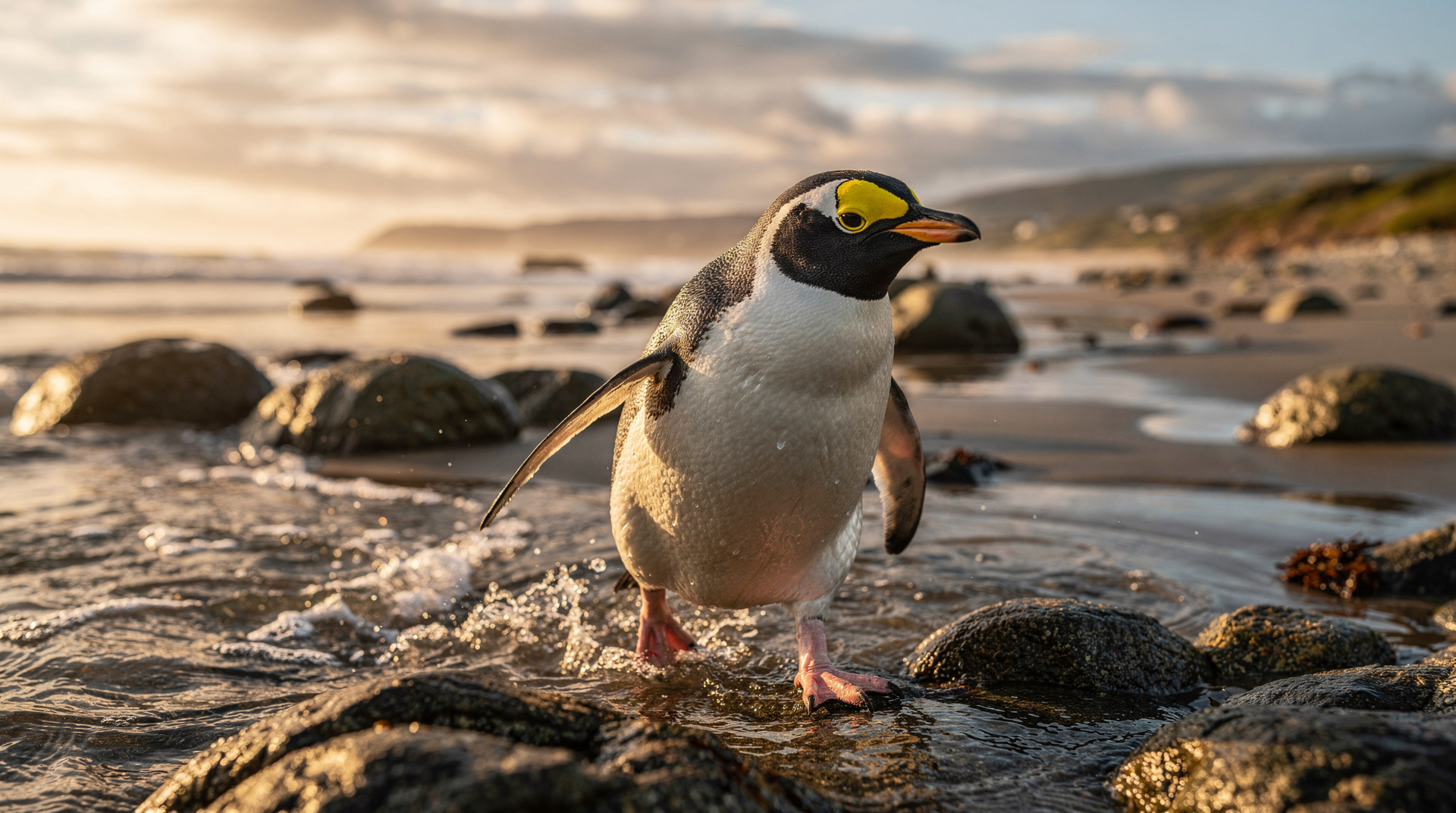
Hoiho (yellow-eyed penguin) are the world's rarest penguin. Where to see them wild on Otago Peninsula, ethical viewing hides, prices, and best timing.
Blue penguins in Oamaru
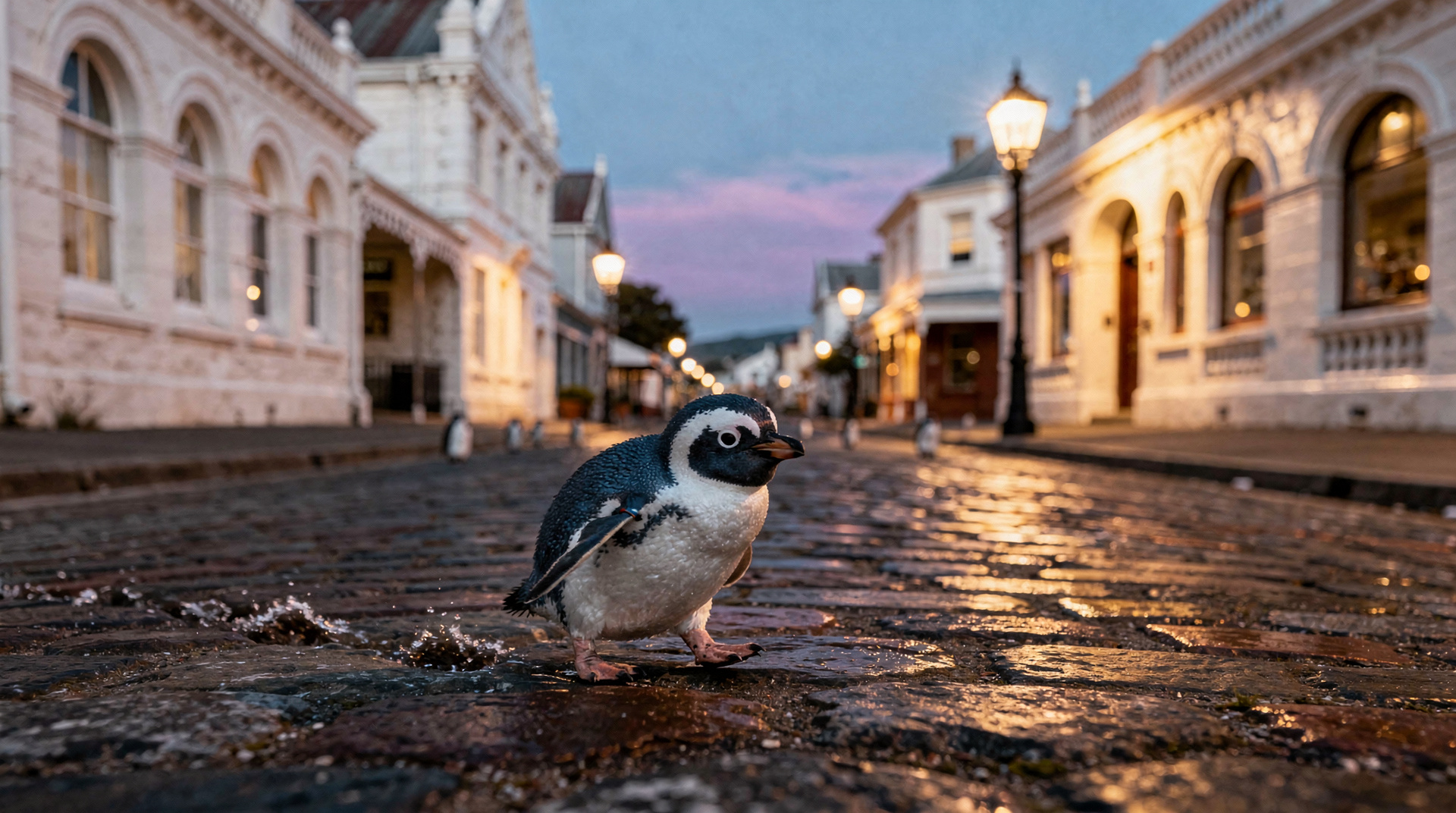
Oamaru's little blue penguin colony is the most accessible in New Zealand. Evening viewing times, prices (NZD/USD/EUR), booking tips, and ethical guidelines.
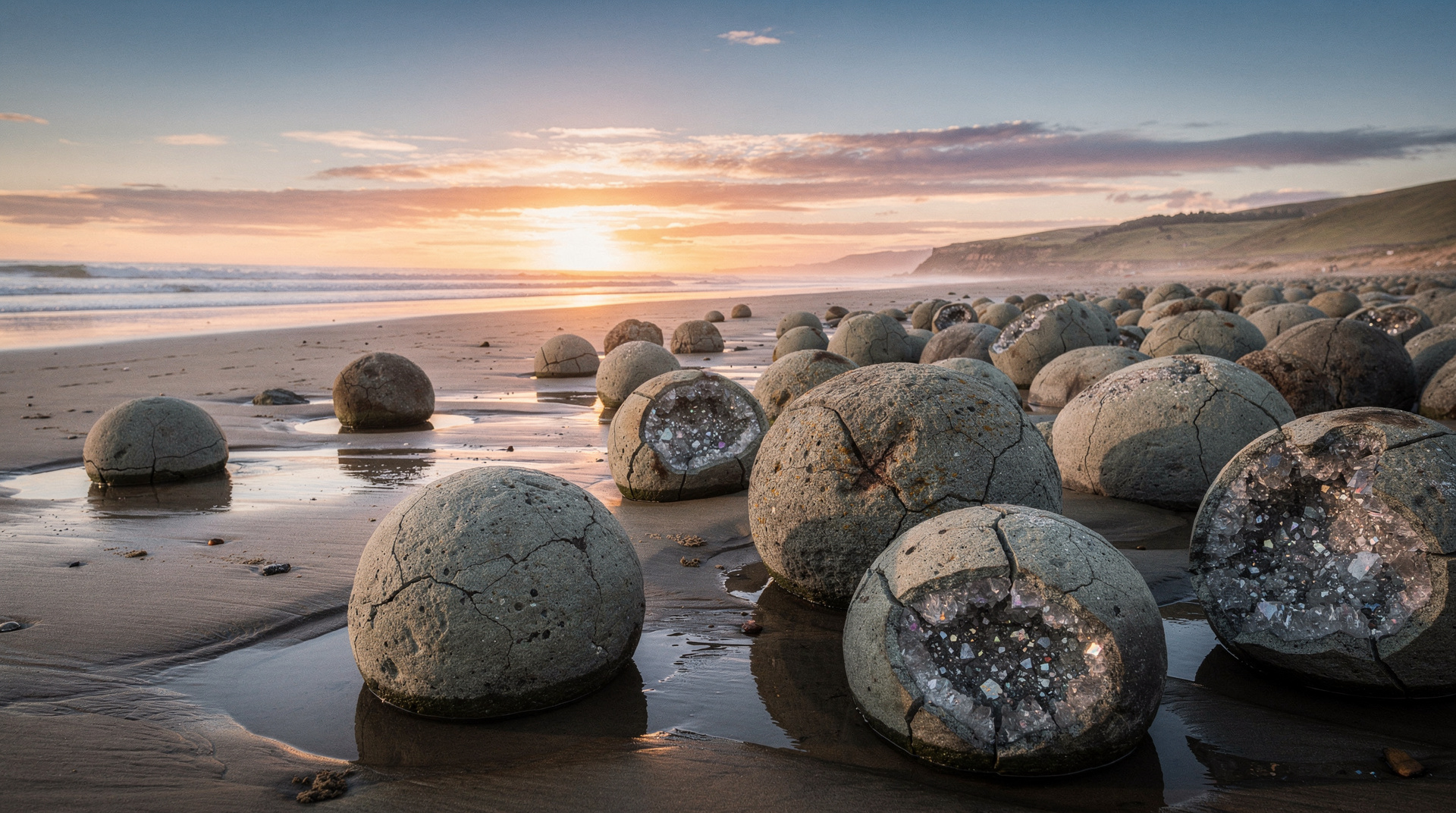
Day trips from Dunedin — the best excursions and how long each takes
Best day trips from Dunedin: Otago Peninsula, Moeraki Boulders, Oamaru steampunk and penguins, Tunnel Beach, Aramoana. Times, costs, self-drive vs guided.
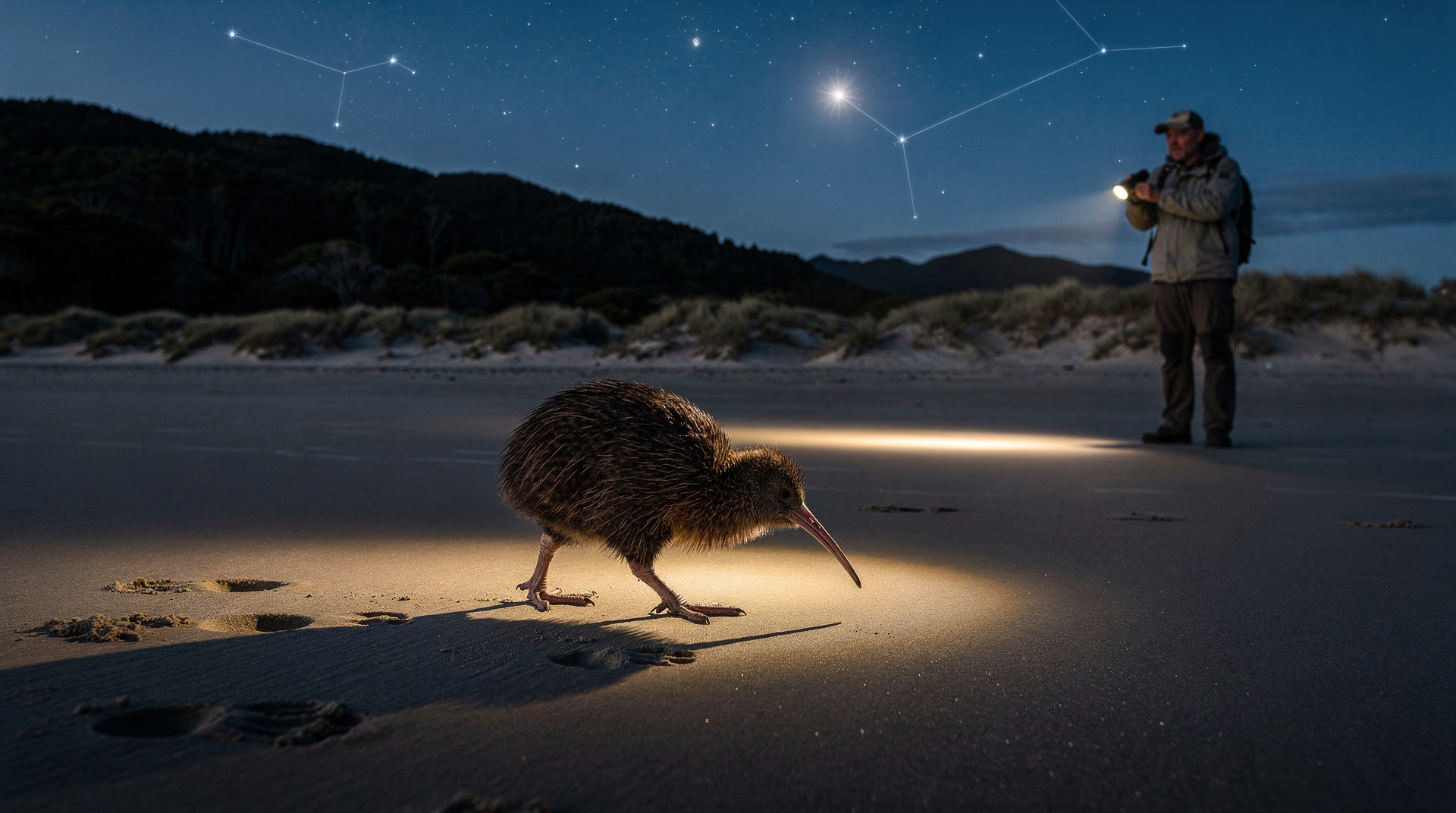
Kiwi spotting on Stewart Island/Rakiura
Stewart Island/Rakiura has New Zealand's highest kiwi density. Guided night tours, costs (NZD/USD/EUR), ferry access, and what to realistically expect.
Last reviewed: