Christchurch to Queenstown drive — the honest route guide
How long does the Christchurch to Queenstown drive take?
The direct route via Geraldine and Lindis Pass is 480 km and takes 5.5-6.5 hours of driving with no stops. Add Lake Tekapo, Lake Pukaki, and Aoraki/Mt Cook Village and you're looking at a 2-day itinerary with one overnight. Add Wanaka and you need 3 days. Roads are good but winding — Google Maps consistently underestimates time on this route by 20-30 minutes.
The classic South Island drive — what you’re actually committing to
The Christchurch to Queenstown corridor is the most-driven route in New Zealand, and for good reason: it threads through the Mackenzie Basin, past two of the country’s most photographed lakes, and within striking distance of Aoraki/Mt Cook before dropping through the Central Otago interior to the adventure capital. But most itineraries dramatically underestimate the distances involved.
This guide gives you realistic times, honest verdicts on every stop, and a practical breakdown for doing this in 1 day (rushed), 2 days (comfortable), or 3 days (worth it).
| Distance | 488 km direct (597 km with the Mt Cook detour) |
| Time needed | 1 day rushed, 2 days comfortable, 3 days worth it |
| Cost | Around NZD 90-120 fuel plus accommodation if overnighting |
| Getting there | Self-drive (2WD fine); InterCity bus as a no-car option |
| Best time | October-April; March for autumn colour and thinner crowds |
Why Google Maps will mislead you
The direct route from Christchurch to Queenstown is 488 km and Google Maps estimates 5 hours 20 minutes. In reality:
- SH8 through the Mackenzie Basin is a two-lane road with farm traffic and campervans
- The Lake Pukaki turnoff to Aoraki/Mt Cook Village adds 60 km (55 km each way) with no through-road
- Lindis Pass (SH8 south of Twizel) slows to 80 km/h max on the winding descent
- Stop any significant number of times and the cumulative time blows out fast
A reasonable 1-day “no overnight” target: 7-8 hours of actual travel time. That’s a full day of driving if you want to stop anywhere properly.
The route in detail
Christchurch — departure point
Leave Christchurch early if you’re aiming for 2 days. The drive through Canterbury Plains (SH1 south, then SH79 west at Rakaia) is fast and flat but scenically unremarkable. Most drivers are tempted to push straight to Geraldine.
Departure tip: Fuel up in Christchurch. Petrol is meaningfully cheaper in the city than in Tekapo or Twizel.
Geraldine — first real stop (1h 40min from Christchurch)
Skip or stop? Stop briefly — Worth it as a 20-minute break.
Geraldine is a pleasant small town that gets overlooked because it’s “just off the route.” In practice it’s 4 minutes from SH79 and has the best coffee between Christchurch and Tekapo. The Barkers of Geraldine food and retail complex is worth a browse (local fruit preserves, NZ wines, baked goods). There’s a petrol station here.
If you push straight through, you’ll be stopping at the far less appealing Burkes Pass township (a single café and a petrol station) before the landscape opens up.
Burkes Pass and the Mackenzie Basin — the view that changes everything
The moment you crest Burkes Pass (670 m) and the Mackenzie Basin opens up below you — flat tussock grassland, impossibly blue sky, the Southern Alps as a white wall to the west — is one of those South Island moments that stops conversations. There’s a small layby for photos. Use it.
The basin is the ancestral home of the merino sheep industry. The landscape looks like it was designed for a film set, which is partly why Aoraki/Mt Cook has attracted so much cinematic attention.
Lake Tekapo — the turquoise stop (2h 40min from Christchurch)
Skip or stop? Stop — Worth it, minimum 1-2 hours.
Lake Tekapo is famous for its unnaturally vivid turquoise-blue colour, caused by glacial flour (finely ground rock particles) suspended in the water. The town itself is small but has good facilities: several cafés, a supermarket, petrol, accommodation.
Must-do in Tekapo:
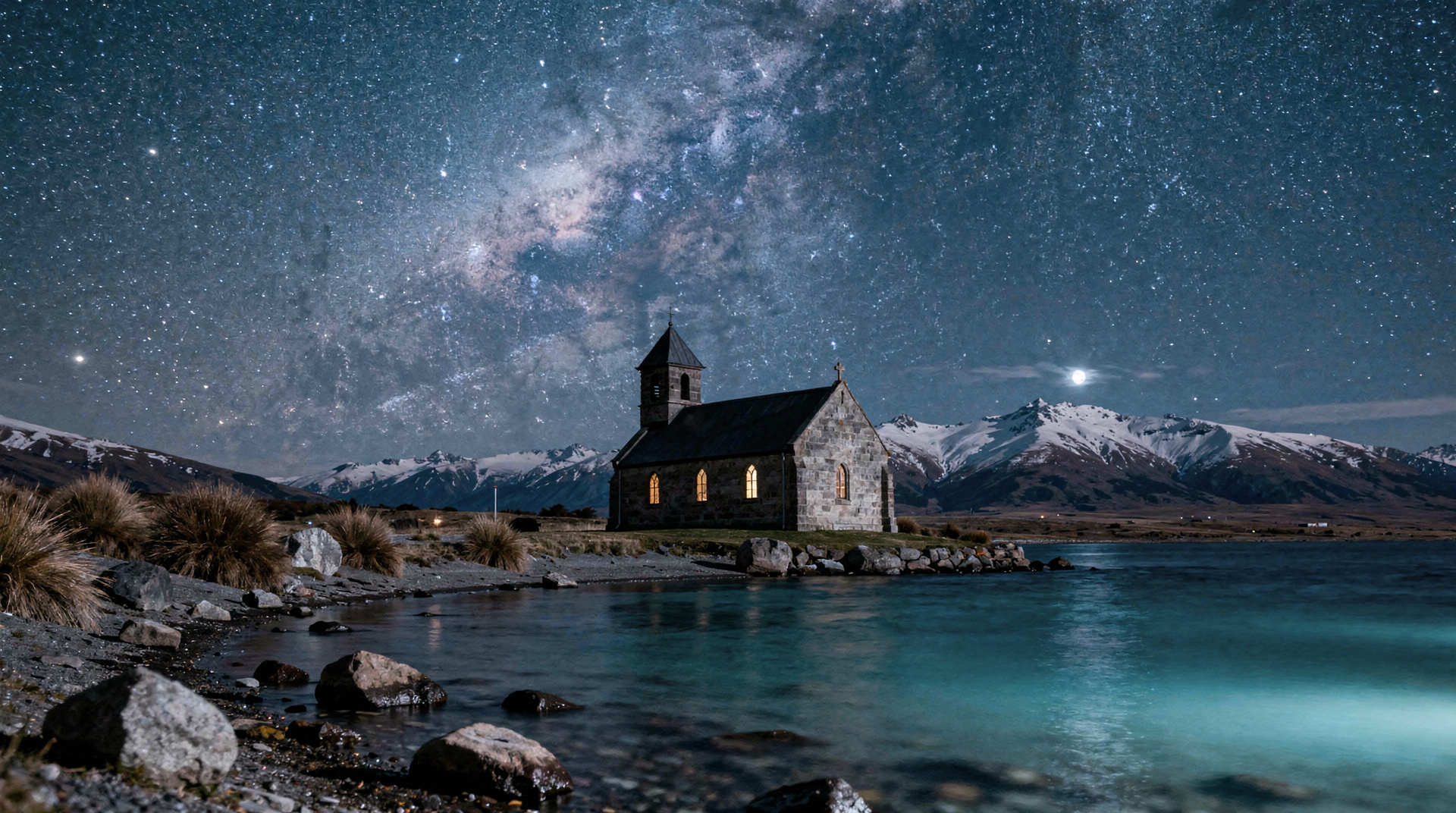
- Walk to Church of the Good Shepherd — 5 minutes from the main carpark, the stone church framed against the lake is one of NZ’s most photographed images. Arrive early morning or evening to avoid the tour-bus crowds.
- Cross the bridge to see the Collie dog statue — a working-dog memorial, oddly touching.
- Stargazing (evening only): Tekapo sits inside the Aoraki Mackenzie International Dark Sky Reserve, the largest in the Southern Hemisphere. The stargazing experience at Mount John Observatory is genuinely extraordinary.
If you overnight here: Tekapo has options at every budget tier.
- YHA Tekapo: dorms NZD 45-55 / USD 27-33 / EUR 25-30; private rooms NZD 120-140 / USD 72-84 / EUR 66-77
- Lake Tekapo Lodge: mid-range, NZD 200-280 / USD 120-168 / EUR 110-154
- Peppers Bluewater Resort: splurge, NZD 400-600 / USD 240-360 / EUR 220-330
Verdict on spending a night: Yes, if you want the dark-sky experience. No, if you’re on a tight schedule — the lake looks the same at 9 a.m. as at 9 p.m., and the Church of the Good Shepherd is better photographed in morning light than at midday anyway.
Lake Pukaki and the Mt Cook turnoff (40min south of Tekapo)
Skip or stop? Stop — the view is one of the best in New Zealand and it costs you nothing.
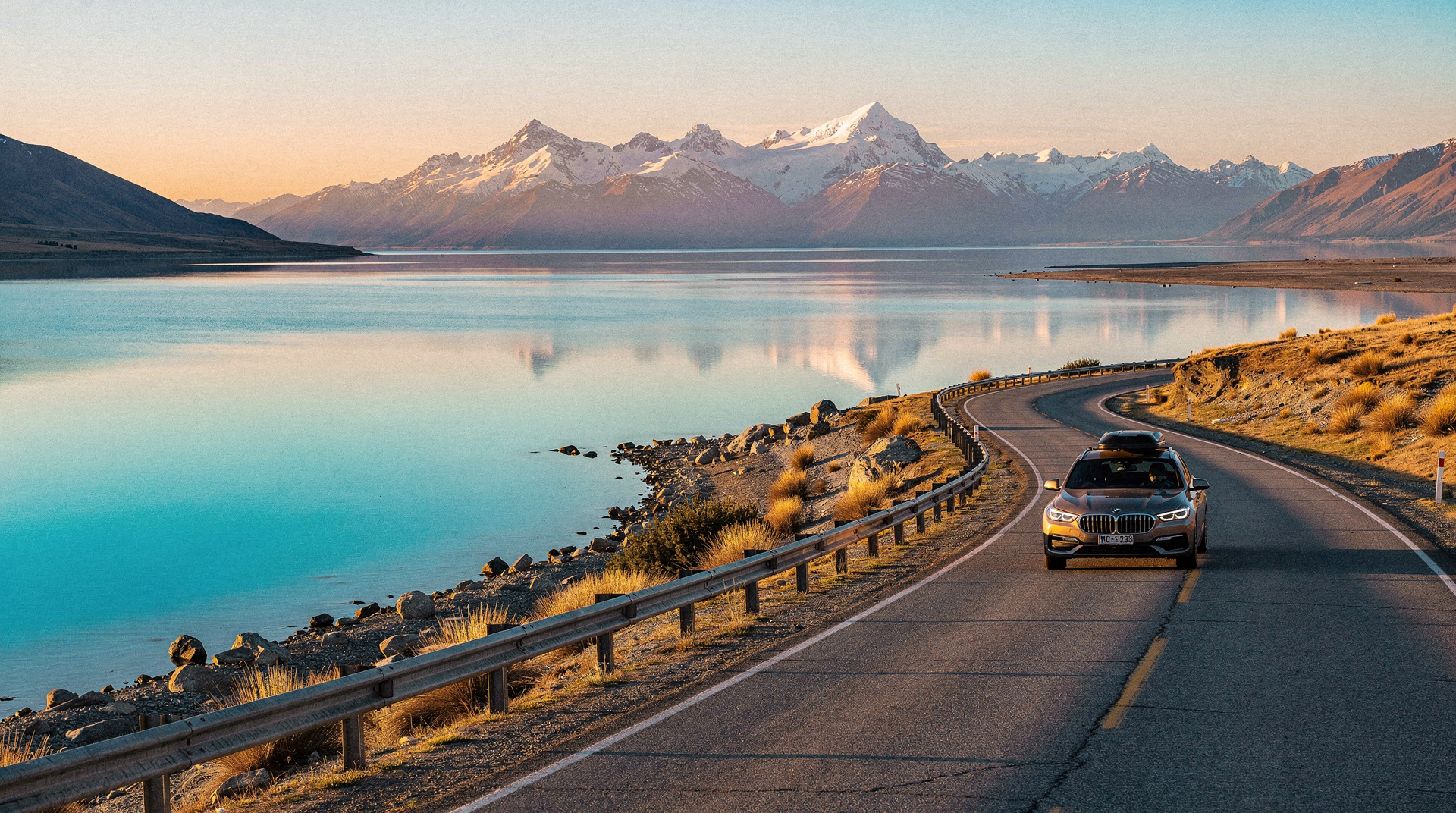
Lake Pukaki is larger than Tekapo and arguably even more vivid in colour. The famous straight road across the basin, framed by the lake on the left and the Southern Alps ahead, with Aoraki/Mt Cook visible on clear days at the end of the road, is one of those images that defines South Island travel.
There is a DOC information centre at the lake turnoff with clean toilets and an outstanding view from the carpark. No entry fee.
The Aoraki/Mt Cook detour: The sealed road from the Pukaki junction to Aoraki/Mt Cook Village is 55 km and adds 110 km (plus 1.5 hours) to your total journey. It is a dead-end road — you must backtrack to Pukaki to continue to Queenstown. Is it worth it?
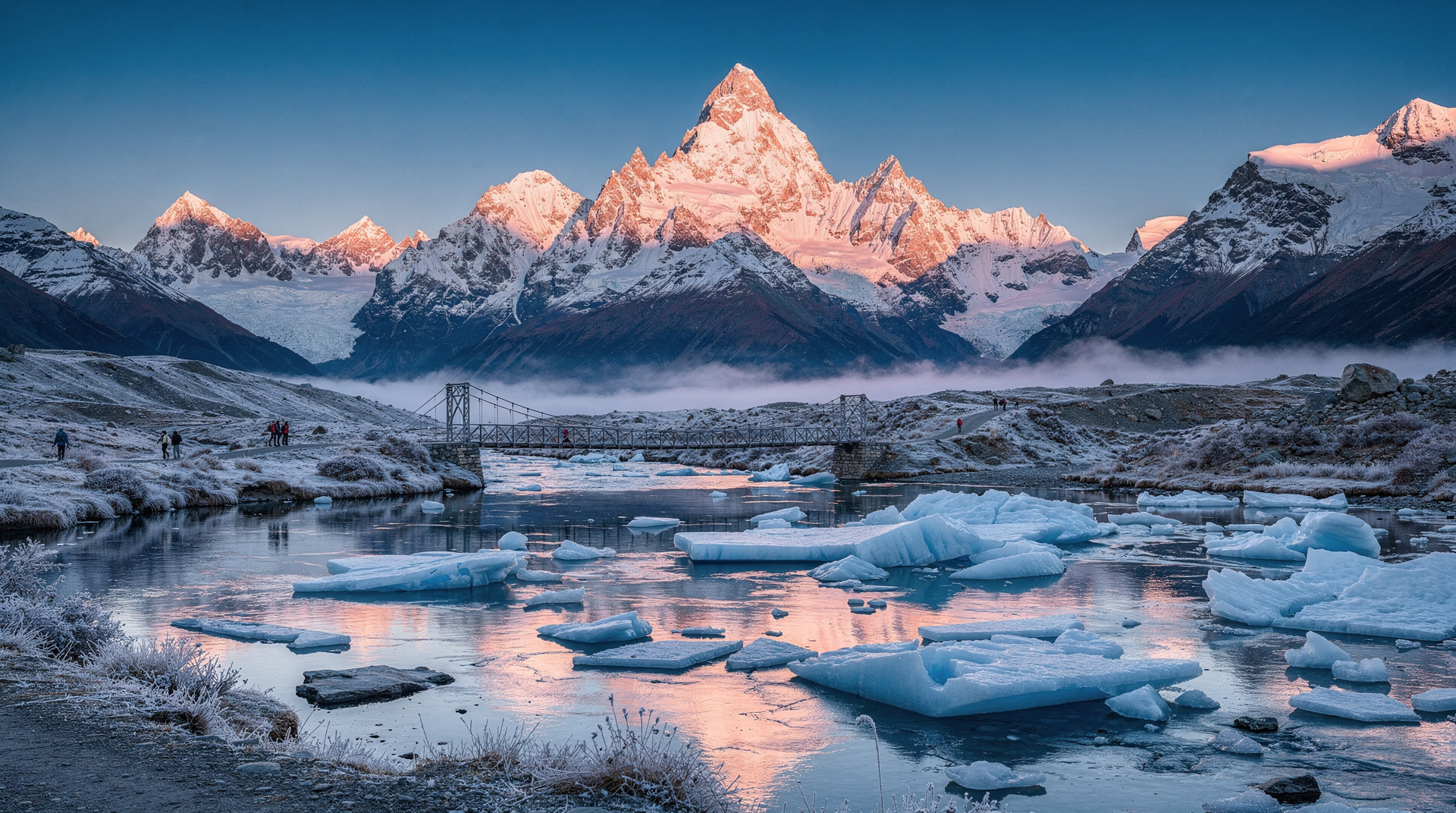
Yes if: you have a full day to spare, you want to do the Hooker Valley Track, you’re planning a helicopter flight. The Hooker Valley Track is the best accessible walk in New Zealand — 10 km return, relatively flat, culminating in a view of Aoraki across a glacial lake with icebergs. Allow 3 hours.
No if: you’re doing this in 1 day and need to be in Queenstown by evening. The detour is genuinely time-consuming.
Mt Cook and Lake Tekapo day tour from Christchurch — worth knowing about if you want to do this stretch as a day trip without a rental car. The bus tour covers Tekapo and Mt Cook in a single long day, returning to Christchurch.
Twizel — practical stop (50min south of Pukaki junction)
Skip or stop? Stop for fuel and food, not for sightseeing.
Twizel was built in the 1970s to house workers building the Upper Waitaki hydro scheme and has a functional-rather-than-charming aesthetic. What it offers: reliable petrol, a Four Square supermarket, several cafés and takeaway options, and accommodation that’s meaningfully cheaper than Tekapo (NZD 100-160 / USD 60-96 / EUR 55-88 for a motel double).
Hidden gem in Twizel: The viewing platform at Lake Ruataniwha (2 minutes from the town centre) is excellent for watching rowing regattas (international events hosted here) and is a pleasant leg-stretch. Also: this is one of the better spots in the region to see black stilts (kaki), one of NZ’s rarest wading birds — DOC runs a recovery programme here.
Lindis Pass — the dramatic middle (1h from Twizel)
The Lindis Pass (971 m) is the high point of SH8 and marks the transition from Canterbury into Otago. The landscape shifts from Mackenzie Basin tussock to the golden-brown schist hills of Central Otago. The descent into the Ahuriri Valley is spectacular — winding road, exposed hillsides, and sometimes sheep on the road.
Speed: The road through the pass is legally 100 km/h but realistically 70-80 km/h. There are no petrol stations between Twizel and Cromwell (78 km). Ensure you have enough fuel.
In winter: Lindis Pass occasionally gets snow and ice. NZTA publishes road condition alerts at nzta.govt.nz — check before departure if travelling June-September.
Cromwell — gateway to Otago wines (40min south of Lindis)
Skip or stop? Stop for fruit and fuel — Worth it for 20-30 minutes.
If you’re combining the Mt Cook area with a wine experience, note that guided tours departing from Cromwell cover both:
Queenstown: scenic Mt Cook day tour from CromwellCromwell sits at the junction of SH8 and the Clutha River and is surrounded by stone fruit orchards. In season (December-March), roadside fruit stalls sell cherries, apricots, and peaches at prices that feel criminal compared to supermarket rates. If you’re here in summer, this is mandatory.
The Cromwell Heritage Precinct — original 19th-century buildings rescued from the lake before the Clyde Dam flooded Old Cromwell — is an interesting 30-minute walk if you have the time. There’s good coffee at Mount Difficulty Restaurant (their Bannockburn winery is nearby if you want a short detour).
Cromwell also marks the start of the Central Otago wine region, extending west to Gibbston Valley and east to Bendigo. If wine touring is a priority, consider spending a night here rather than pressing to Queenstown. See the Central Otago wine tour guide for details.
For travelers already based in Queenstown who want a private day covering Arrowtown, the Cromwell area, and Wanaka without the logistics of a rental car, the private Arrowtown and Wanaka return day trip from Cromwell offers a fully customised day by private vehicle — the Central Otago circuit in a single day with the flexibility to extend or modify stops based on your interests.
Queenstown — arrival (35min from Cromwell)
The final stretch from Cromwell to Queenstown via the Kawarau Gorge is dramatic — the road clings to the rock wall above the river for several kilometres. There’s a lookout just before the Gibbston/Kawarau Bridge Junction that’s worth a 5-minute stop for the gorge view. The Kawarau Bridge (site of AJ Hackett’s original commercial bungy) is 5 minutes further and visible from the road.
You’ll arrive into Queenstown via Frankton and the lake foreshore. Allow an extra 20-30 minutes during peak season (December-January) for congestion on Frankton Road.
Route summary and real driving times
| Leg | Distance | Real drive time |
|---|---|---|
| Christchurch to Geraldine | 138 km | 1h 40min |
| Geraldine to Lake Tekapo | 105 km | 1h 10min |
| Tekapo to Pukaki junction | 45 km | 35min |
| Pukaki to Aoraki/Mt Cook Village (return) | 110 km | 1h 40min (add if doing detour) |
| Pukaki to Twizel | 25 km | 20min |
| Twizel to Cromwell (via Lindis Pass) | 80 km | 1h 10min |
| Cromwell to Queenstown | 58 km | 45min |
| Total (without Mt Cook detour) | ~487 km | ~5h 40min driving |
| Total (with Mt Cook detour) | ~597 km | ~7h 20min driving |
Add 30 minutes per significant stop (Tekapo, Pukaki viewpoint, Cromwell fruit stall, Lindis Pass layby). A 2-stop day without the Mt Cook detour = 7 hours total. With Mt Cook and Hooker Valley Track = 9-10 hours minimum.
The 1-day option: honest assessment
Driving Christchurch to Queenstown in one day, without the Mt Cook detour, is doable — but only if you leave by 8 a.m. and don’t dawdle. You’ll arrive in Queenstown around 5-6 p.m. with sore legs and hazy memories of turquoise lakes glimpsed from the car window.
Worth it? Only if time genuinely doesn’t permit otherwise. A day of driving in New Zealand is not a wasted day — the scenery is exceptional — but you’ll regret not stopping at Tekapo properly, and you’ll miss Mt Cook entirely.
The 2-day option: the sweet spot
Day 1: Christchurch → Tekapo (overnight). Stop at Church of the Good Shepherd, do the Mt John stargazing evening. Day 2: Tekapo → Pukaki viewpoint → Twizel (lunch) → Lindis Pass → Cromwell (fruit) → Queenstown.
Add Mt Cook Village as a sub-option: depart Tekapo by 8 a.m., reach Mt Cook by 9:30 a.m., do the Hooker Valley Track (back by 12:30 p.m.), have lunch at The Old Mountaineer’s Café, back to Pukaki by 2 p.m., Queenstown by 5:30 p.m. — tight but achievable.
The 3-day option: add Wanaka
Day 1: Christchurch → Tekapo (overnight) Day 2: Tekapo → Mt Cook → Twizel → Cromwell → Wanaka (overnight) Day 3: Wanaka → day hikes Wanaka or Queenstown
The Wanaka detour from SH8 adds 35 km from Cromwell but puts you in one of New Zealand’s most beautiful lake towns, with far less tourist pressure than Queenstown. See the Queenstown vs Wanaka comparison for why some travellers prefer using Wanaka as a base.
EV charging along the route
Electric vehicle road trips on this corridor are increasingly realistic, though they need more planning than a petrol drive. Fast chargers exist in Geraldine, Fairlie, Twizel, and Cromwell as of 2026, spaced closely enough that a standard EV with 300+ km range shouldn’t need to detour far off-route. The Lindis Pass stretch between Twizel and Cromwell (roughly 80 km with significant elevation change) is the one section worth planning around — check charger availability at both ends before setting off, since it’s also the stretch with no petrol stations for backup.
Apps like PlugShare or ChargeNet’s own app show live charger status; queues are realistic in peak summer at the more popular stops (Tekapo and Twizel especially), so build in buffer time the same way you would for a petrol stop with a queue. Cold winter mornings reduce EV range meaningfully in the Mackenzie Basin, another reason to plan charging stops generously rather than to the theoretical range limit.
Real costs
| Item | NZD | USD | EUR |
|---|---|---|---|
| Fuel (Christchurch to Queenstown, typical sedan) | 90-120 | 54-72 | 50-66 |
| Tekapo hostel dorm | 45-55/night | 27-33 | 25-30 |
| Tekapo mid-range room | 200-280/night | 120-168 | 110-154 |
| Twizel motel double | 100-160/night | 60-96 | 55-88 |
| Mt John stargazing (Tekapo) | 165-195/adult | 99-117 | 91-107 |
| Hooker Valley Track | Free (DOC-maintained) | — | — |
| Aoraki/Mt Cook helicopter scenic flight | 350-550 | 210-330 | 193-303 |
Reverse direction: Queenstown to Christchurch
The reverse route is equally common for travellers doing the South Island clockwise. The main difference: you’ll reach Lake Tekapo late in the day, which means the Church of the Good Shepherd photo is in afternoon rather than morning light (acceptable but not ideal). The Lindis Pass ascent from the Queenstown side is slightly more dramatic in reverse — you emerge into the Mackenzie Basin rather than descending into it.
Stargazing advantage: Driving north, you’ll arrive Tekapo in time for the evening stargazing session if you left Queenstown by 11 a.m. This is easier to time than on the southbound drive.
What to skip
Fairlie: A small town between Geraldine and Burke’s Pass. The Fairlie Bakehouse is locally famous for pies; worth a stop if you’re hungry, but it’s not a destination in itself.
Winter driving on this route
June to September changes the calculation. Lindis Pass and the higher sections of SH8 occasionally get snow or ice, and NZTA issues chain-required alerts during severe weather events. Rental cars typically come without chains fitted by default; ask specifically about winter equipment if driving June-August, and check nzta.govt.nz/journey-planner the morning of departure, not the night before — mountain weather here changes quickly.
The upside of a winter drive: the Mackenzie Basin under snow is spectacular, traffic is a fraction of summer volume, and Tekapo’s night sky is at its clearest in the cold, dry winter air. The downside: shorter daylight hours compress your driving window, and some activities (the Hooker Valley Track’s final section, certain scenic flights) may be weather-dependent or closed.
Petrol stations and where you can’t rely on one
Fuel logistics matter more on this route than most South Island drives because of one specific gap: there are no petrol stations between Twizel and Cromwell, a stretch of 78 km that includes the Lindis Pass climb. Fill up in Twizel even if your tank looks adequate — running low on the pass itself, with no shoulder to safely wait for help and patchy mobile coverage, is a genuinely bad place to misjudge your range. Geraldine, Tekapo, and Twizel all have reliable stations; Cromwell picks back up on the Queenstown side. If you’re driving a rental with an unfamiliar fuel gauge, treat “half a tank” as your trigger to fill up on this particular stretch, not the usual quarter-tank habit.
Lake Ohau: A worthwhile detour (15 km from Twizel, dead-end road) if you have time — the lake is beautiful and the Lodge has a good restaurant. Skip if you’re already doing Mt Cook.
Cave Stream Scenic Reserve (between Christchurch and Geraldine on SH73): Only relevant if you’re taking the Arthur’s Pass route instead of SH79. Not on the standard Catlins route.
FAQ
Do I need a 4WD or all-wheel-drive for this route?
No. Every road on the standard route (SH79, SH8, Lindis Pass, and the Mt Cook Village road) is fully sealed and accessible in a standard 2WD rental car. Winter conditions on Lindis Pass occasionally require chains, but this is rare and NZTA will issue warnings. Check nzta.govt.nz/journey-planner before travelling in June-August.
Is there a bus option for this route?
Yes. InterCity runs Christchurch to Queenstown via Tekapo and Twizel. The journey takes 7-8 hours with stops. The bus does not deviate to Aoraki/Mt Cook Village. It’s a viable option if you don’t want to drive, but you lose the flexibility to adjust timing for Mt Cook. See the InterCity bus guide for booking tips.
What’s the road surface like on the Mt Cook Village road?
Fully sealed (paved) all the way from the SH8 junction to Aoraki/Mt Cook Village. The road passes through the Hooker Valley with views of the glacier and lake. No 4WD or clearance required at any point.
Can I hire a campervan for this route?
Yes, and the Christchurch-Queenstown corridor is one of NZ’s most popular campervan routes. Holiday parks exist in Tekapo, Twizel, and Cromwell. In December-January, book powered sites well in advance. See the campervan vs car and motel guide for whether a campervan makes sense for your trip length.
What’s the best season to drive this route?
October to April for the most reliable conditions. December-February is peak and roads are busy with campervans and hire cars. March is arguably the best month: autumn colours begin in Central Otago, the tourist crowds thin slightly, and the weather remains excellent. July-August is possible but Lindis Pass can get icy and the alpine scenery is more subdued.
Is the Christchurch-Queenstown flight worth considering instead?
Air New Zealand domestic flights between Christchurch and Queenstown take 55 minutes and cost NZD 80-180 / USD 48-108 / EUR 44-99 depending on timing. If you’ve already driven the South Island loop and are backtracking, flying makes complete sense. If this is your first time, drive it — the Mackenzie Basin is one of the five most remarkable landscapes in New Zealand and deserves to be seen at windshield pace, not from 30,000 feet.
Can I drive this route in an electric vehicle without range anxiety?
Yes, with planning. Fast chargers cover Geraldine, Fairlie, Twizel, and Cromwell, which brackets the one genuinely fuel-free stretch (Twizel to Cromwell via Lindis Pass). Charge to a comfortable buffer at Twizel before tackling the pass, expect reduced range in cold Mackenzie Basin mornings, and build in queue time at popular chargers during peak summer. It is a more planning-intensive drive than a petrol car but entirely doable for a standard modern EV.
Related guides
Christchurch
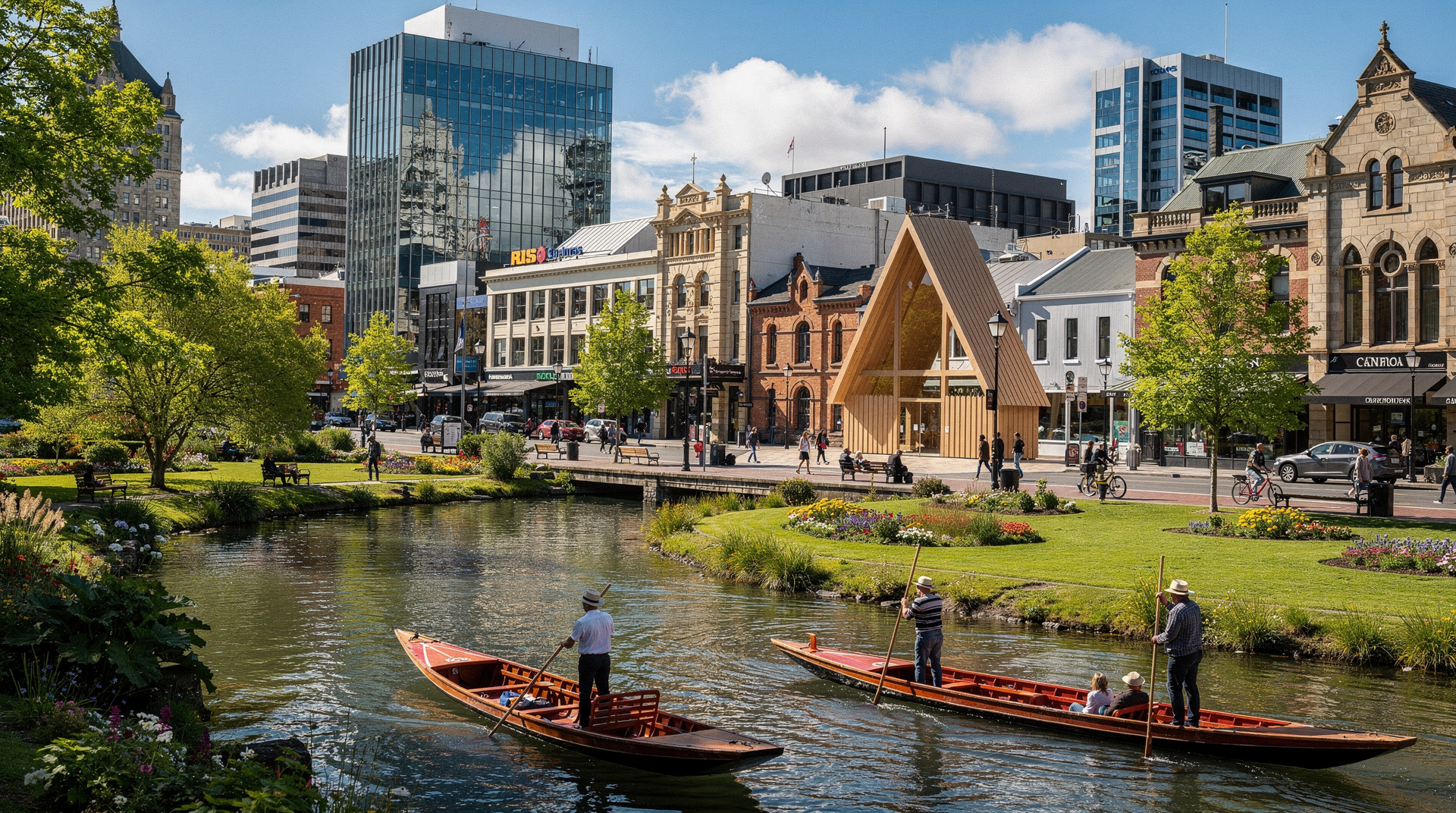
Honest Christchurch guide: the post-earthquake rebuild, best activities, Akaroa day trip — real NZD/USD/EUR prices and what's worth your time.
Lake Tekapo
Honest Lake Tekapo guide: stargazing, Church of the Good Shepherd, hot pools — real NZD/USD/EUR costs and how long you actually need here.
Aoraki / Mount Cook
Honest Aoraki / Mount Cook guide: Hooker Valley Track, Tasman Glacier, scenic flights — real NZD/USD/EUR prices and what to expect in all seasons.
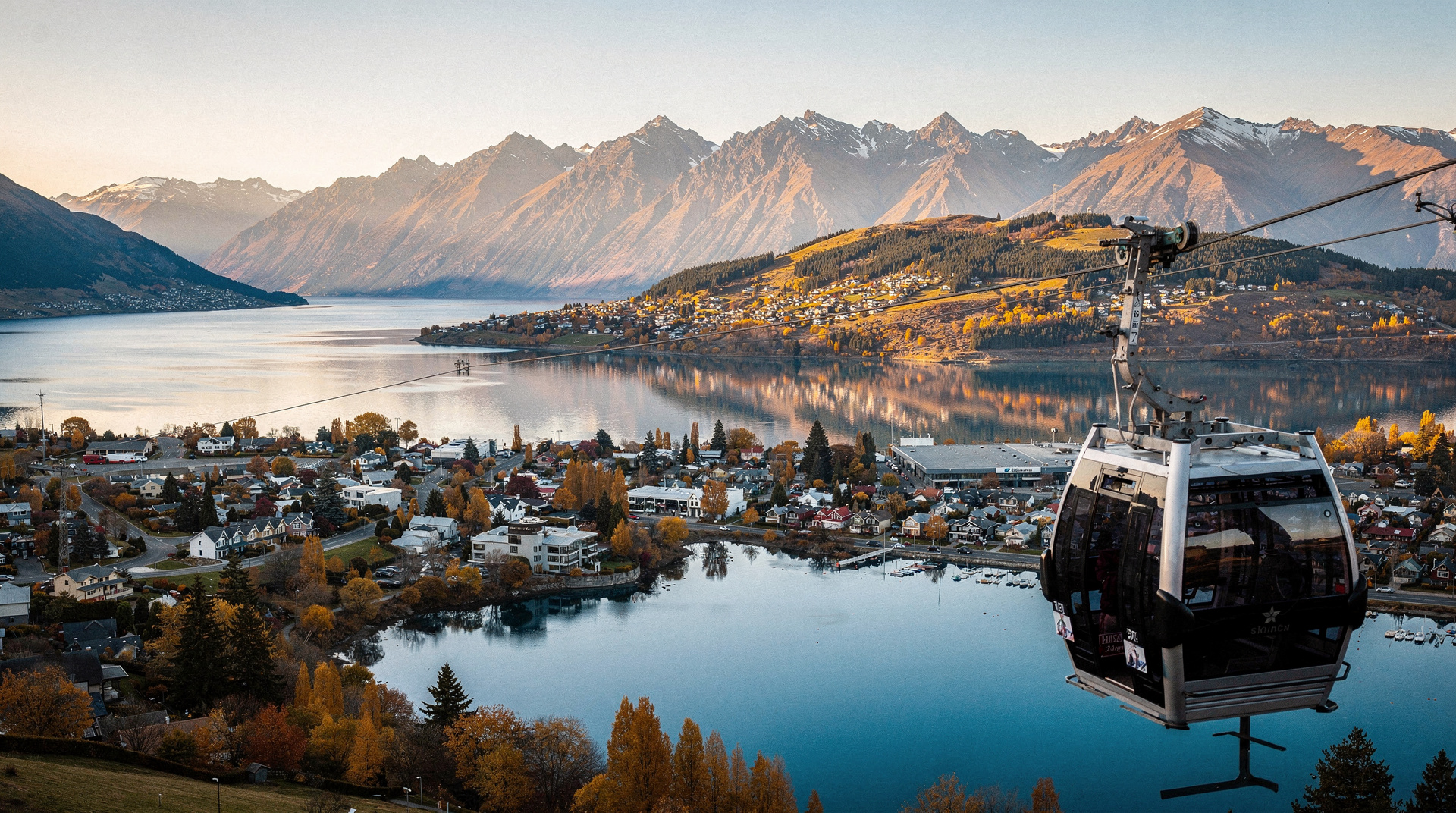
Queenstown
The honest Queenstown planner: bungy, jet boat, ski, scenic flights — real prices in NZD/USD/EUR, what to skip and what's worth your money.
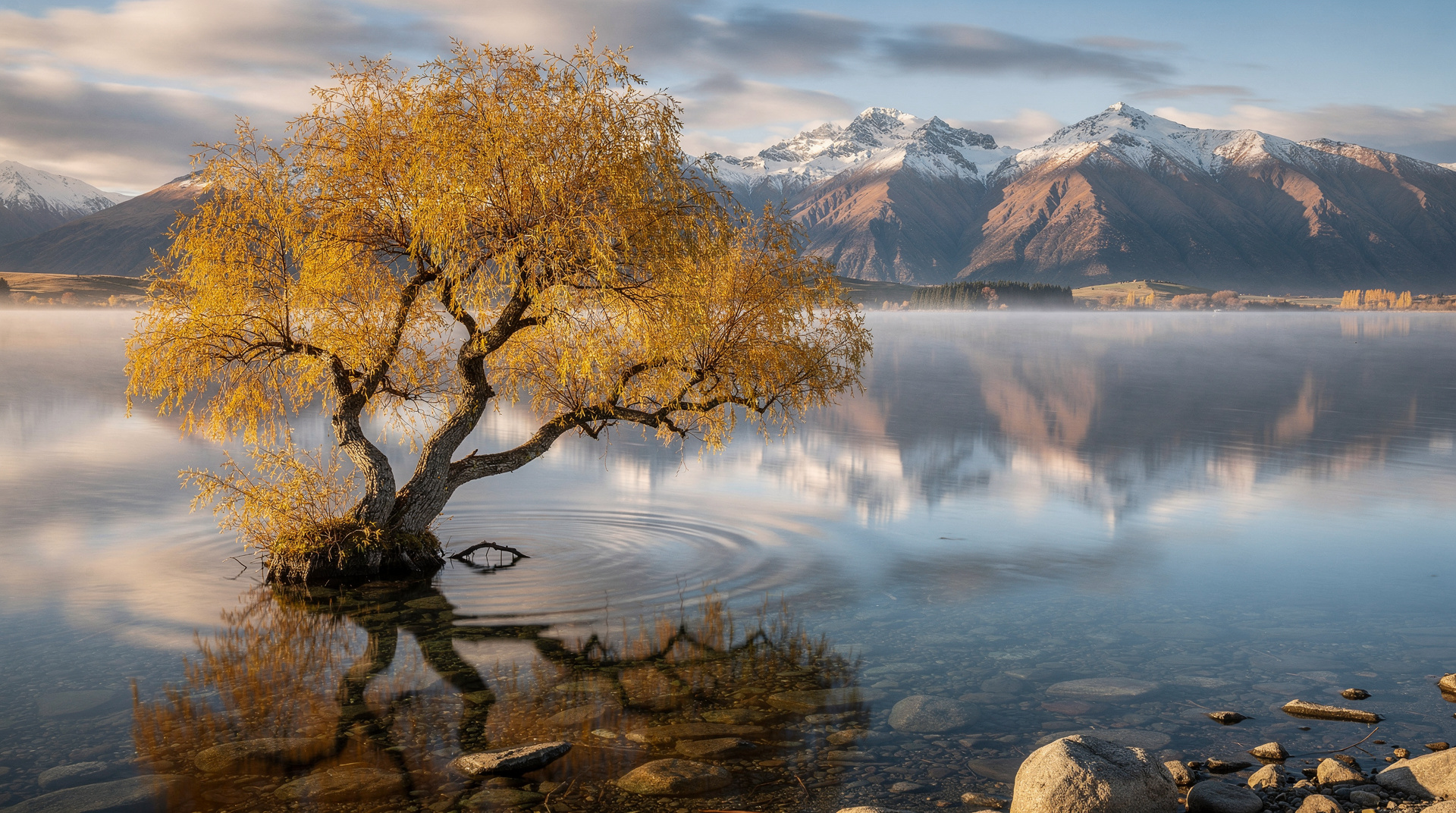
Wanaka
Honest Wanaka guide: Roy's Peak, Cardrona ski, lake kayaking — real NZD/USD/EUR costs and the honest Queenstown vs Wanaka verdict.
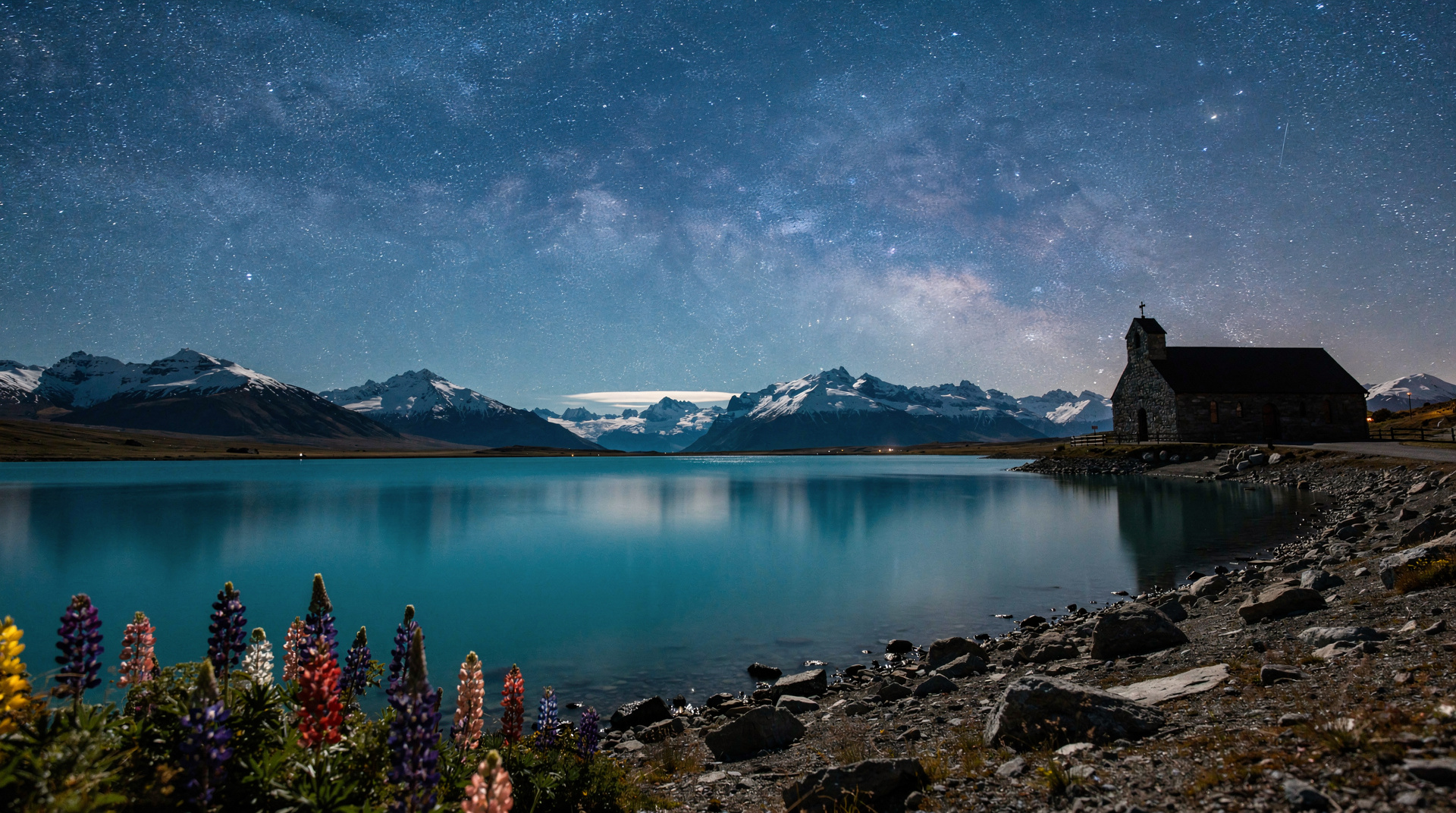
Lake Tekapo — turquoise lake and stargazing guide
Lake Tekapo complete guide: the turquoise glacial lake, International Dark Sky Reserve stargazing, Church of Good Shepherd, hot springs, Mt Cook day trip.
Last reviewed: